“THERE IS a Kappa monster in the river. You will be eaten.”
The warning hangs in the air inside George SK Ty Hall. A father leans forward, voice low and threatening. Across him, his son stares back – unimpressed.
“Dad, Kappa is an imaginary creature,” the boy shoots back.
“I cannot leave the future of this country to adults like you.”
The hall erupts. Students double over. Faculty members exchange knowing looks. What makes it even funnier is this: there is no son onstage. No father either. Only one man, seated on a cushion, armed with nothing but a fan, a hand towel and impeccable timing.
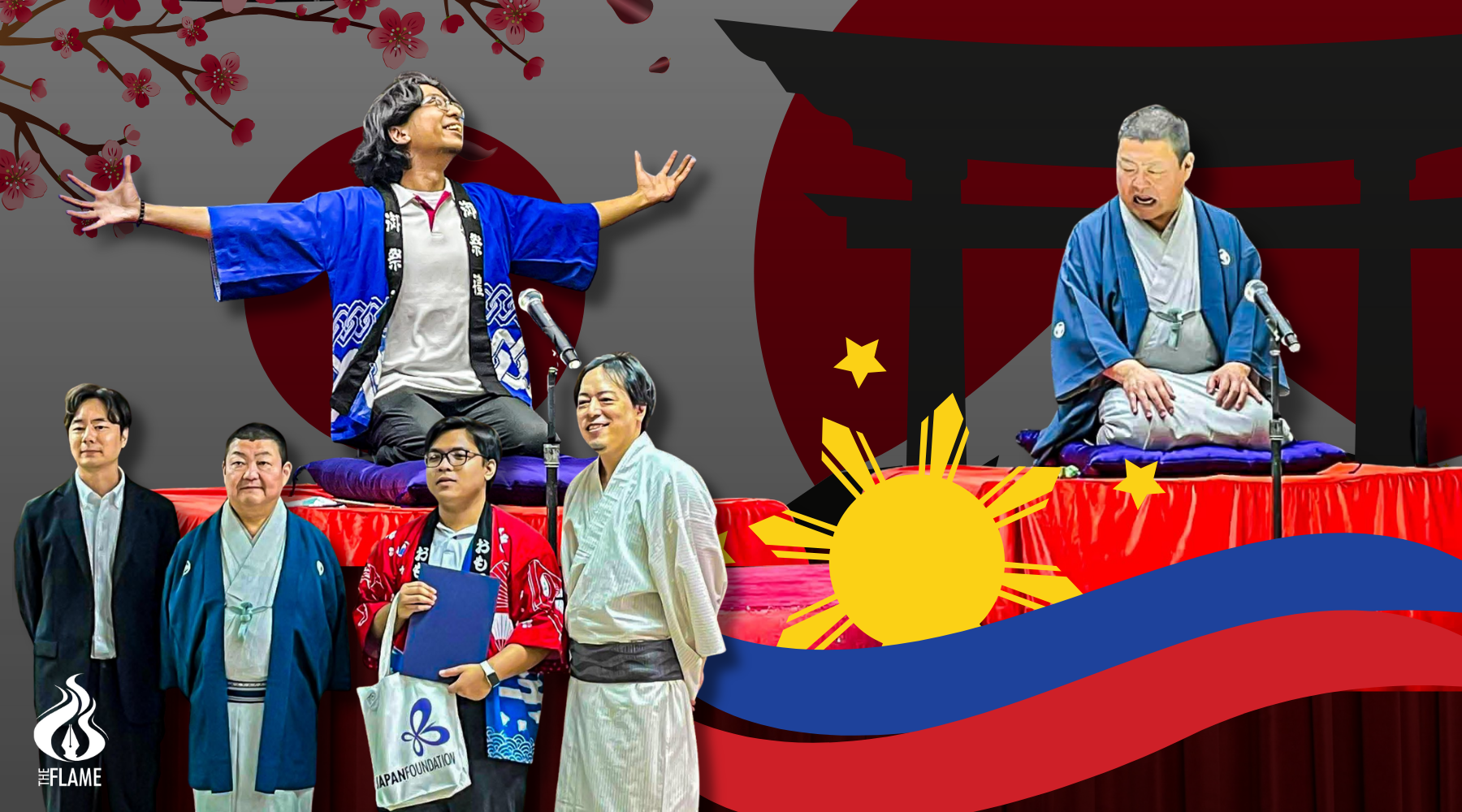
On March 2, Master Ryūtei Saryū performed live Rakugo, the 400-year-old Japanese art of sit-down storytelling, at the University. Presented by the UST Language Center, UST Office of Public Affairs and UST Department of Modern Languages, in partnership with Japan Foundation Manila, the event formed part of the 70th Japan-Philippines Friendship Anniversary and UST’s 115th Founding Year.
But inside the hall, it felt less like a cultural celebration and more like watching your own dad lose an argument at the mall.
One man, many worlds
Rakugo traces back to the Edo period. A lone performer, called a rakugoka, kneels on a raised platform (kōza), armed with only two props: a folding fan (sensu) and a small hand towel (tenugui). He holds only these—nothing more, nothing less.
Yet in Saryū’s hands, the fan became chopsticks, a walking stick, even a child’s snack. His face transformed in seconds: from a stern father suppressing irritation to a boy on the verge of tears. When he mimed licking syrup from his fingers after eating dango, a traditional Japanese snack, laughter rippled through the hall.
“The humor still works because of physical expression, vocal variation, situational comedy, and well-timed pauses,” Asst. Prof. Royce Lim, chair of the Department of Modern Languages, told The Flame.
“These elements make the emotions clear, even if the language is unfamiliar,” he said.
While language matters in Rakugo, especially for wordplay, Saryū showed that the craft demands more than just that. It is also rhythm, tone and audience awareness that solidly deliver the punch.
“The most important part is to see the faces of the audience,” Saryū explained.
Unlike most stage performances, Rakugo keeps the room bright—so the storyteller can adjust to every smile, or lack thereof.
“You will never master it,” Saryū said.
“Even if you practice your whole life.”
Foreign yet familiar
For many students, the father-and-son exchange hit oddly close to home despite being expressed in Japanese. Wyatt Canlas, a sophomore from the Conservatory of Music, noted its similarities with Filipino family dynamics.
“There are a lot of similar themes, especially in how the father and son interact,” Canlas said.
“It’s very relatable.”
College of Accountancy freshman Siegfried Santidad compared the performance energy to that of Filipino sketch comedy in the gag show “Bubble Gang,” citing its punchlines and exaggerated elements.
“Since there are skits, the way that Rakugo expresses himself to the different characters is similar to how Bubble Gang expresses them that which is energetic, showing jokes, one-liners, like that,” Canlas said.
Johnven Capiles, a freshman from the Faculty of Arts and Letters, observed that while the father-son relationship in the performance mirrored those seen in the Philippines, there was a clear difference in the overexpression of Filipino comedy.
“Not to spin the question on its head, but as Filipinos, we are too… over-expressive?” Capiles said.
Freshman Ophelia dela Cruz from the College of Fine Arts and Design said the acting through gestures made the story accessible even without full comprehension of Japanese.
“The reason why this is so effective, even though you’re not speaking in Japanese, is because when it comes to acting, there’s no language barrier,” dela Cruz added.
Nonetheless, Master Saryū did not fail to make the Filipino audience throw their heads back in enthusiasm and laughter as he showed the ‘repercussions’ of not listening to a younger relative who wished for something absurdly unnecessary.
“In the Philippines, humor is often passed down through storytelling,” Lim said.
“Much like how Rakugo masters pass their art to apprentices,” he added.
The comedy may be centuries old, but its instinctive humor—parents versus children, absurd requests, everyday family chaos—felt instantly recognizable. Even students who had never visited Japan could laugh at the absurdity of the father-son conflict.
By the end of the performance, what lingered was not just the punchlines, but the shared reaction. The collective gasp before a joke lands. The split second of silence. The explosion of laughter that follows.
Rakugo may have begun in Japan centuries ago, but inside that hall in UST, it felt immediate and familiar.
One performer. Two props. A room kept deliberately bright.
And a reminder that sometimes, the fastest way across a language barrier is not through translation, but through laughter. F