Art by Alessandra Alinio/ THE FLAME
AS IMAGES and words flew past the screen, Brother Kent Rodriguez mindlessly scrolled through Facebook without minding the November chill in 2013. It was through a post when he first learned the name Carlo Acutis.
‘A young Italian teenager on the road to sainthood,’ its headline read.
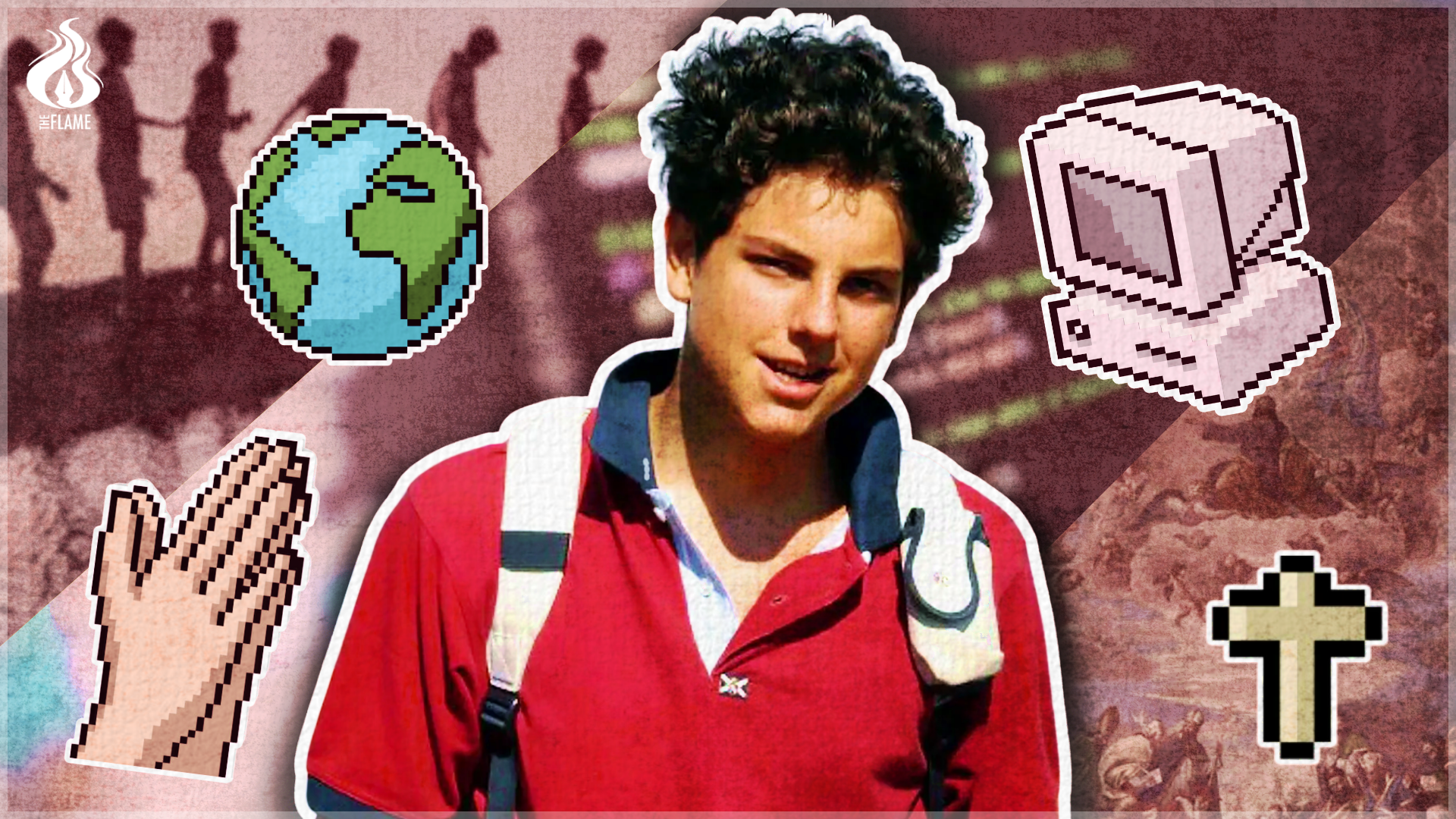
An image of the would-be saint accompanied it. Acutis’ frenzied curls rested on top of a red polo shirt. The blue collar was unfixed.
The young Acutis, with the glaring sun cast upon him, squinted back at Rodriguez.
“I remember being fascinated by how someone my age could live such a holy and purposeful life in today’s modern world,” Rodriguez told The Flame.
“Ang caption ko pa nga, ‘This is AWZOM!’ Sa mga panahon ganoon pa ang language ng mga kids back then.”
(My caption was even, ‘This is AWZOM!’ Kids’ language was like that during that time.)
In 2014, Rodriguez established the Tropa ni San Carlo Acutis group, which sought to promote the canonization of the young saint. Now, ten years later, the group has amassed over 21,000 followers on Facebook, having brought the image of Acutis to different parishes and religious events.
Acutis was born in 1991 in London to parents Andrea and Antonia. A typical millennial who loves video games and online surfing, he would become the first saint of his generation.
His parents described him to be expressive of his faith since childhood. At just four years old, he had already learned the Eucharist, while he walked down the parish aisle to receive communion at age seven. Most of his formative years were spent inside the stone walls of Assisi, Italy.
Acutis gained widespread recognition for a website he created on Eucharistic miracles, an archive of Church-verified miracles from numerous countries. Each of the entries was accompanied by detailed testimonies and outsourced photographs documenting these events.
His work earned him the label of ‘God’s Influencer.’
Programmer and Christ lover
Acutis’ endeavor was the feat of an amateur programmer, but a determined believer.
“He came to have this wish to present a little more historically what were episodes or miracles, mainly prodigies, signs that the Lord wished to give us over the centuries,” his mother Antonia said in a documentary on his life, titled “I Am With You” by EWTN.
“He really wanted to show that in the consecrated bread and wine, there truly is [Jesus]’s genuine, live presence.”
Dust flew from the edges of the shelf each time Rajesh Mahjur, a housekeeper of Acutis’ family, entered the young boy’s room to clean. Rajesh would often see Acutis hunched on his computer desk.
The teen’s eyes would closely follow either lines of coding or pages of research. Books on programming, that he bought himself, were stacked beside him.
“I said to him, ‘What are you doing? That’s a lot of work. You should rest,’ ” Rajesh said in the documentary.
But Acutis was unrelenting. For two and a half years, he meticulously coded the website on his own, building piece-by-piece a wall of Eucharistic miracles, sorted by country and year. Acutis’ mother recalled making trips with her son to certain places in order to get documentation related to a particular miracle.
“We had to make the journeys to the photos, which he considered to be very important, because people needed to see signs, to see paintings,” she said.
The webpage was finally launched in 2004. ‘The Eucharistic Miracles of the World’ has a white typography of its title that reads in script and serif while a painting of the Miracle of Ettiswil fills its background.
The website features 187 entries — 2,000 years of history compiled through the efforts of a self-taught young boy.
But on October 12, 2006, Acutis succumbed to leukemia shortly after being diagnosed with the disease in the same year. The legacy he left behind, nonetheless, continued to serve as a repository for believers to learn more about the miracles of the body of Christ
In 2020, Acutis was beatified at the Basilica of St. Francis of Assisi, a chapel that stands at the edge of his hometown. He was canonized alongside St. Pier Giorgio Frassati this year.
One of us
Despite being known for his holiness, Acutis was like any other boy his age.
In the afternoons, grass stained his knees after a round of football with friends. At home on the weekends, the familiar startup chime of a PlayStation console would echo. Acutis loved to play games like Pokémon, Halo and Super Mario brothers.
When Francia Violeta, a Legal Management sophomore, first heard of Acutis’ canonization, she felt very happy. Recognizing him as someone who grew up in roughly the same era, Violeta sees herself in this millennial saint.
“[Our generation is] chronically online. Parang mas malapit nga [si Acutis] sa ating mga youth, sa ating mga teen. ‘Yung experiences niya, same din sa experiences natin,” she said.
“And through that po kasi, mas lalo kaming na-inspire diyan sa pagiging santo niya.”
(Our generation is chronically online. Acutis is closer to us youth, teens. His experiences are the same as ours. And through that, we are inspired further by him becoming a saint.)
Despite growing up in the internet era, Acutis met its distractions with balance and discipline, always making time for prayer and mass.
Third year Education student and Thomasian volunteer Justine Bryan Manansala feels as though Acutis brought holiness closer to young students like him. He learned of the saint through his friends in Pax Romana.
“Hindi ko inakala na (I could not have imagined that) someone that has lived [within] my lifetime will become a saint,” he said.
“Pinatunayan niya na kahit ‘yung mga ganitong klaseng tao, ay kayang mamuhay ng banal… Kung tutuusin, halos pareho kami ng hilig ni St. Carlo Acutis, eh. Mahilig siya sa sports, mahilig siya sa video games.”
(He proved that even someone like that can live a holy life. If you look at it, St. Carlo Acutis and I have the same interests. He likes sports, he likes video games.)
Moreover, the road to sainthood that Acutis walked was not laced with grand acts or dramatic sacrifice, unlike that of some saints. It rather unfolded in the ordinary: the way he honed his skill for programming and used it to promote faith in the digital world.
Rodriguez likened his story to Acutis’ since at just 10 years old, he would spend his days tinkering with Photoshop, producing edits here and there. He carried this creative curiosity with him as he walked the white halls of De La Salle University – College of St. Benilde, where he enrolled for a degree in multimedia arts in 2015.
Now 27 and working as a graphic artist, he puts his talents into further use as coordinator of his congregation’s social communications committee.
“In many ways, it reminded me of Carlo Acutis and how he used digital media for evangelization. Looking back, I see how that course shaped not only my career path but also my way of serving — integrating faith, creativity, and modern tools for God’s greater glory,” he said.
Violeta plays a similar role to Rodriguez in her own parish. And like Acutis, who relied only on a camera and his self-taught coding knowledge, she and her team work with what they have: their personal phones, a few cameras and a Canva account.
“Limited lang din ‘yung gamit namin pero (our equipment is limited but) we are doing our best to promote the word of God through the use of social media,” she said.
Manansala, meanwhile, makes use of his musicality as a choir singer in the University.
“[Tulad] sa paggamit niya (Acutis) ng kakayahan para mapalaganap ‘yung word of God, ginagamit ko ‘yung talent ko sa music para ma-lead ‘yung people sa pagpupuri sa Panginoon,” he said.
(Like how he used his abilities to spread the word of God, I also use my musical talent to lead people into praising the Lord.)
Communicating Christ through clicks
Youth groups are working to bring a Christ closer to the Acutis generation.
Masses are livestreamed on Facebook, homilies reach millions through YouTube, and even virtual congregations gather in Roblox, an online multiplayer game.
“ ‘Yung mga homily, mga catechism na binibigay ng iba’t ibang simbahan na pinupush sila sa mga digital platform — mas naging accessible siya,” Violeta said.
(The homilies and catechisms provided by different churches that are being pushed onto digital platforms — they are becoming much more accessible.)
More than that, when parishes post photos of their fellowship activities on Facebook or Instagram, a fresher, less static side of religion is brought into light.
Antonia Acutis echoes words from his son that put things in perspective.
“Carlo used to say we are far luckier than those living 2,000 years ago near Jesus, because those living in Jesus’ time were often hindered from seeing him because of space and time,” she said.
“It was not easy to approach Jesus because he was surrounded by crowds, [whereas] we can go to the nearest church outside our home.”
In this day and age, time and space are easily warped, bringing closer communities of believers — all with the click of a touchpad or a tap on a phone screen.
But alongside the faith-filled content made in these online platforms, there is also the constant ring of notifications and endless string of posts that cry out for one’s attention.
Across the globe, Generation Z and Millennials live and breathe online. Over 90% of these young users immerse themselves in video content on YouTube alone. Even children are caught in the web of screen addiction, as 76.4% exceed the recommended screen time every single day.
“Ang daming may access [sa internet], so maraming ideologies and beliefs ang kumakalat. Nando’n din ‘yung attention natin most of the time,” Manansala said.
(A lot of people have access to the internet, so a lot of ideologies and beliefs are spreading. Our attention is also directed there most of the time.)
During Acutis’ time, the internet was beginning to pick up with the rise of broadband Wi-Fi. The young saint found himself in the middle of this tech revolution.
Pope Francis, through his 2019 encyclical Christus Vivit, painted a picture of the digital tides Acutis had to navigate through.
“Carlo was well aware that the whole apparatus of communications, advertising and social networking can be used to lull us, to make us addicted to consumerism and buying the latest thing on the market, obsessed with our free time, caught up in negativity,” the late pontiff said.
Instead of outright condemnation, Acutis’ act of creating his website demonstrated not just the embracing of technology, but also its capacity as a vessel for a larger purpose in service to the church.
“[Carlo] knew how to use the new communications technology to transmit the Gospel, to communicate values and beauty,” Pope Francis stated.
Fighting the fakes
Yet scrolling through his feed, Rodriguez often encounters unsettling content: AI-generated deepfakes of saints or religious figures, their lips moving as if delivering divine messages to viewers.
He also recalls certain instances of individuals being caught relying on AI for a variety of matters. One of which was a woman reading aloud a prayer generated from ChatGPT.
“The bad side nga lang is overusing it and the lack of knowledge and truth in using it… Sobrang dali na gumawa ng prompts, sobrang daling gumawa ng images, videos,” Rodriguez said.
“Kinaiinisan namin ito. ‘Yung mga biglang nagsasalita sila Jesus Christ.”
(The bad side there is overusing it and the lack of knowledge and truth in using it… It’s very easy to make prompts, very easy to make images and videos. We’re frustrated over this. The ones where Jesus Christ suddenly talks.)
Comment sections of posts like that are often flooded with believers, many of them older, expressing awe or praise to these fabricated visions. Each time he stumbles upon one, Rodriguez immediately reports it.
According to a study, older adults who are new users of social media platforms are easier prey for manipulative content.
“Sa bahay palang makakita lang sila ng spliced videos, maniniwala na sila,” Rodriguez added.
(At home, when they see spliced videos, they fall for them.)
The convenience brought by technology comes with a price. What were once quiet moments of reflection have now been invaded by diverse messages coming from different sources — with some less reliable and well-intentioned than others.
On top of the false information internet users are used to looking out for, AI-generated content presents itself as a newer, oftentimes more sophisticated obstacle. Nonetheless, for Rodriguez, the mandate for believers is clear.
“ ‘Yung call natin is to be a guiding light, not just to the church but to the whole world as well… Sa mga non-believers — hindi man sila naniniwala — pero let’s share the truth para hindi na manaig ‘yung fake news,” Rodriguez said.
(Our call is to be a guiding light, not just to the church but to the whole world as well… To non-believers — though they might not believe our faith — but let’s share the truth so that fake news won’t win).
He believes that the first step in dispelling the rampant false information and AI-generated content begins with arming oneself with awareness and education.
“Malaking tulong na ‘yan, not just to us, doon din sa older generation, and malay natin, sa newer generation. Maging isang malaking impact ‘yun kung gano’n ang gagawin natin,” he added.
(It’s already a big help, not just to us, but also to the older generation, and who knows, the newer generation. It will have a large impact if we do that.)
‘A breath of fresh air’
Acutis’ story testifies that with the right intentions and actions, technology can be transformed from a distraction to a digital pulpit that guides and inspires.
“I think ‘yun ‘yung ipinamalas ni San Carlo Acutis — when it comes to using technology sa pagpapalaganap ng pananampalataya and to address those challenges faced by our generation today,” Manansala pointed out.
(I think that’s what Saint Carlo Acutis shows us — when it comes to using technology to spread faith and to address those challenges faced by our generation today.)
Nearly two decades since his passing, Acutis’ influence shows no sign of fading. What began as a teenager’s passion project conceived in his bedroom has grown into a renowned act of Catholic devotion — one whose impact is felt from around the world and into the heart of the Vatican.
Thousands of pilgrims paraded St. Peter’s Square during Acutis’ canonization on September 7. On that day, Pope Leo XIV finally bestowed upon him the title of ‘saint’ alongside Frassati, another model of the youth.
Among the sea of lay faithful that witnessed this moment was Rodriguez, representing the Tropa ni San Carlo Acutis group. He clutched with him a Philippine flag, while a lei with Acutis’ iconic image hung over his white polo.
“After 10 years, naka-attend ako ng canonization and that was a fulfilling part for me and for us na rin to witness finally ‘yung tinatrabaho namin,” Rodriguez reflected back on that moment.
(After 10 years, I attended his canonization, and that was a fulfilling part for me and for us as well to finally witness what we were working for.)
“His (Acutis) story is a breath of fresh air sa dami ng kabataan (for a lot of youth),” the millennial would say of the newly canonized saint.
“[It shows that] you don’t have to be martyrs, you don’t have to be heroes. You don’t have to be killed to be saints.” F