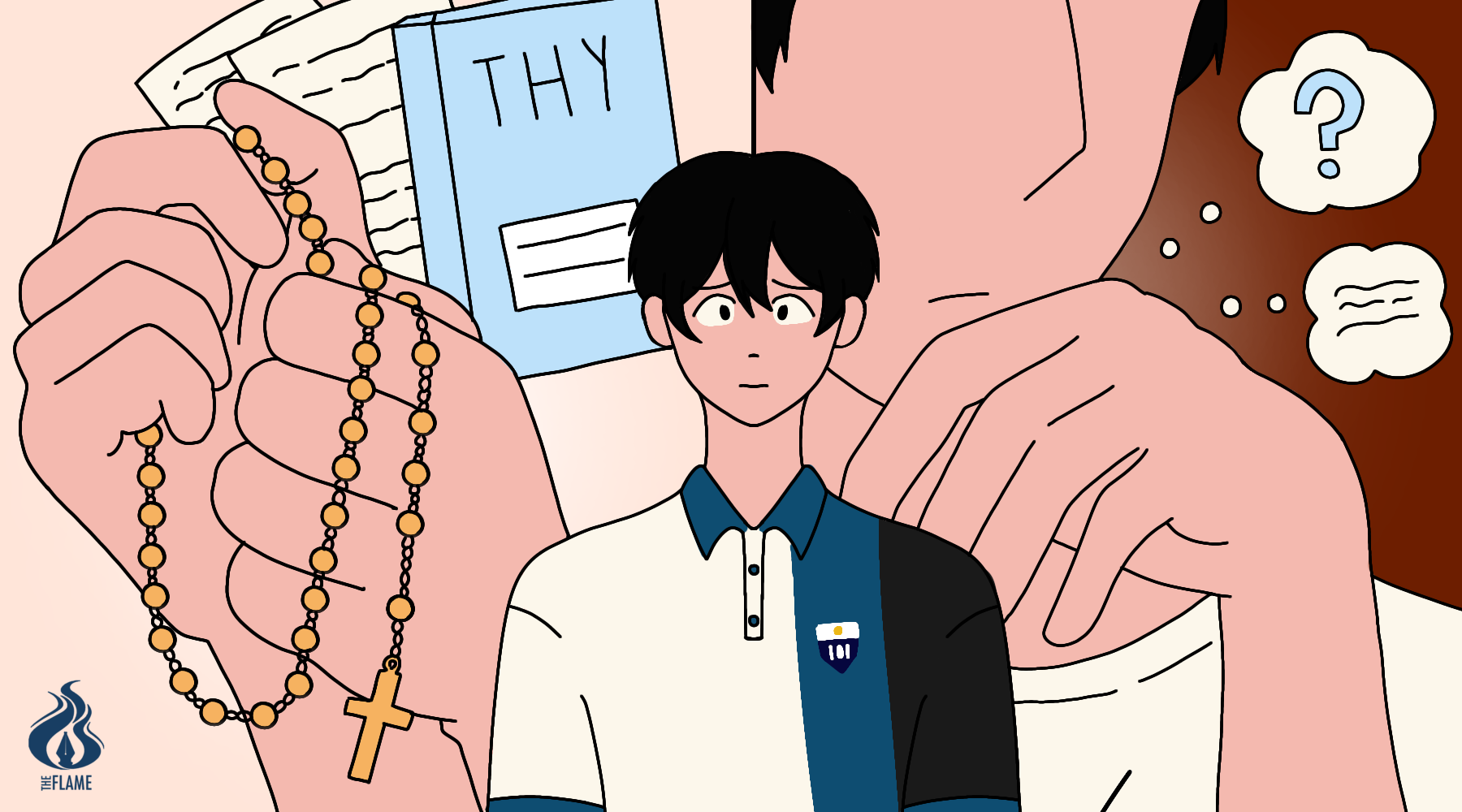
AFTER SOME time, Enzo (not his real name), a Political Science freshman, finally had the chance to come home to Batangas, thanks to the Easter break.
He had planned to make the most of it by spending the week soaking up lazy mornings, visiting friends and family and feeling the crunchy sand on the shores that line the province.
Meters away outside his home, carrozas were engulfed by huge crowds. Swarms of Catholic devotees flooded the streets, illuminating the evening with a sea of candles. The devotees observed Holy Week, the most sacred occasion for Christians, by dedicating their hours in prayer and penance and reflecting on Jesus Christ’s sacrifice.
But for Enzo, it was just free time.
“To me, the Holy Week doesn’t mean that much,” he told The Flame.
“But of course, I still do offer respect to those who believe in such religious events.”
Although he had grown up close to religion and even attended Catholic schools all his life, Enzo realized three years ago that he was an atheist — someone who does not believe in the existence of God.
He is not the only young Filipino to turn to atheism. Michael (not his real name), a Legal Management sophomore, also identifies as one, having just decided his status this year.
Pew Research Center, an independent data hub, reported that an estimated 1.1 billion people globally called themselves irreligious in 2010. This number consisted of atheists, agnostics or those who are not part of any religion. In the predominantly Catholic Philippines, less than one percent of the population claimed to have no religious affiliation in 2023, according to the Philippine Statistics Authority.
Vacation, not devotion
Enzo was no stranger to the Holy Week celebrations. He had taken part in its customs growing up — even following the dietary restrictions, abstaining from meat as tradition dictated.
Michael, too, had memories: quiet church visits, walking beside his family during the Visita Iglesia, their footsteps echoing through polished aisles.
But now, as young adults, the sacredness of the season no longer holds the same weight for Enzo and Michael, aged 19 and 21, respectively.
While many Filipinos mark Holy Week with solemn devotion, for Enzo and Michael, it has become something else entirely — just another break from the demands of everyday life.
“It is so much different,” Enzo said, when reflecting on his past and present.
“Before, I couldn’t eat delicious foods such as meat [during the Holy Week], but now, I am very much free to eat and do anything I want.”
“I still pay respect, of course, just to those who deserve respect and to those who still practice and believe in the essence of Holy Week,” he added.
Meanwhile, Michael spent the break in the usual manner: tagging along with his family’s Visita Iglesia and eating out with loved ones. But now it was more for leisure than spiritual devotion.
“Holy Week was just another week for me. Just, without classes,” Michael said. “The same as last year. Same as now.”
Nagging questions
When he was younger, Enzo grew up close to religion.
A baptized Roman Catholic since birth, his childhood was cradled by the corridors of his Catholic school. Mornings began with their daily worship and Bible reading — activities that Enzo was given the chance to lead when he got older.
As years went by, Enzo had familiarized himself with the serene faces of his fellow churchgoers. They would kneel in the pews to pray and listen intently to the sermon.
But, as he had seen it, their faithful zeal would end at the steps of the cathedral. Throughout the week, they did acts that went against the teachings of the church.
“One act is gossiping and spreading rumors,” Enzo said. “This is quite common and goes against the values of charity and truth.”
When the pandemic came in 2020, he had more time to reflect and began to question things.
“After seeing people’s hypocrisy in the Catholic community, I’ve been just reading the Bible on my own, praying on my own, not in a traditional way,” he said.
According to him, this continued to cloud his perception of religion altogether. He thought that parts of the Bible did not make sense to him — many of which are simply being cherry-picked by believers.
“Yung pagkain ng bacon is bawal (Eating bacon is prohibited),” he cited as an example. “It is forbidden because it is considered dirty food, but people still do eat them.”
“Why would I believe in such things kung hindi ko din naman kayang i-follow lahat-lahat?”
(Why would I believe in such things if I am unable to follow everything?)
“That’s when I realized that I really am an atheist,” Enzo said.
The Catholic Church does not prohibit the eating of bacon or any kind of pork, but its followers are required to fast and abstain from meat during Ash Wednesday, Good Friday and all Fridays of Lent as a form of sacrifice. The requirement applies to Catholics who are 18 to 59 years old.
From faith to hate
Similar to Enzo, Michael’s education was molded by Catholic institutions. Surrounded by religious family members, he became active in church. He enjoyed the rituals that accompanied Sunday Mass: singing along to hymns, lining up for communion, inserting coins in tithe baskets.
“It made me feel like I was part of something. Like I am part of something bigger than life itself,” Michael said.
Among his influences was his late grandmother, a devout Catholic woman. He remembers her as someone who constantly whispered prayers to the rosary. In her purse was a pocket Bible she brought with her everywhere. Their ancestral home in Isabela was a trove of her religious items: small statues, coins with the image of Jesus and parchments written with prayers.
“Everything was for God. That’s how she lived her life,” he said.
In 2013, on the night she reached her mid-70s, she passed away. His mourning turned his admiration for God into hate.
“I guess I started to hate [God] then. I didn’t want to pray to Him.”
The grief he had been carrying morphed into rebellion. Michael did not hide his distaste for religion even in school. Walking around the campus, he would come across nuns. As a form of respect, his schoolmates greeted them and performed the mano. But Michael refused to acknowledge them.
“I would just stare at them. I even got reported,” he said.
Moving through life, Michael found himself longing for something to believe in. That search led him to Marian devotion — a deep faith centered on the Virgin Mary. He was drawn in by an uncle who kept images of her all around the house, a man whose life seemed to overflow with blessings: a thriving business and a healthy, happy family.
Michael hoped for the same grace.
“When I would ask the Virgin Mary for something, she would give it,” he recalled.
At first, it was simple wishes — a crush returning his feelings, a gift from his father, a quiz he forgot about but still hoped to ace. And for a while, it felt like she answered. But over time, things changed. According to him, his prayers went unheard. His supplications seemed to have been responded to with silence.
“Life was getting harder, not better,” he said. “So I stopped asking. I just gave her thanks — but it still hasn’t worked.”
By late December to early January of this year, something in him shifted. The silence became too loud.
“I lost my faith,” he said softly.
“And now, I don’t practice being a Marian devotee anymore.”
Limits of religion
The Pew Research Center projects an increase of irreligious individuals from 1.1 billion in 2010 to 1.2 billion in 2050.
Fr. Delfo Canceran, O.P., a Dominican theologian and instructor at the Faculty of Sacred Theology, said this rise could be traced to a historical shift.
“Irreligion started in the Enlightenment, because from religion it went to the secular world. Hence, many are converted to being anti-religion or irreligious,” he told The Flame.
Similarly, English author Julian Baggini claimed in his book “Atheism” (2021, Oxford University Press) that while disbelief in deities has existed since the time of Ancient Greece, atheism developed into an open and consciously declared belief system in the latter stages of the Enlightenment period.
According to Baggini, atheism was first a naturalism conceived by early Greek philosophers from the ancient city of Miletus. These pre-Socratic thinkers argued that the natural world did not need myths to be explained, being the whole of existence itself. Reality can be understood using human logic, being a “self-contained system.”
Baggini noted that atheism did not suddenly become a popular worldview, as denying God’s existence was unthinkable then. Yet, its adherents were steadily growing in number and, at the same time, sparking debate. By the 21st century, Western atheism quickly rose to a significantly higher level of visibility.
In the individual scale, Canceran enumerated three factors that push people, particularly the youth, to turn to atheism.
“In the study of religious violence, religion is used only as a framework to order all of these things that we encounter in the world,” Canceran said.
“Bakit nagkakaganito ang mga estudyante? Kulang-kulang, siguro kulang din ‘yung ating explanation sa religion or theology. Hindi sila convinced.”
(Why is this happening to students? The explanation of religion or theology may be inadequate. They are not convinced.)
For his second point, Canceran highlighted the overwhelming flow of information on the internet, an endless and ever-changing ocean of outside influences. Impressionable young minds are often exposed to ideas like secularism and agnosticism.
His third point turned outward, focusing on the external conditions that mold a person’s life.
“Mahirap ang buhay (Life is hard). You cannot rely on religion alone. You have to work hard, so everyday life is really about the world,” he said.
“All of that will become a hodgepodge of different forces that contribute to the questioning of religion.”
Suffering often pushes people to question the core teachings of religion.
“If God is love, why do people endure so much pain?” Canceran said.
“Maraming mga kuwestiyon na hindi ma-address clearly ng religion or theology (There are a lot of questions that cannot be clearly addressed by religion or theology),” he said.
“It’s a question of faith, and faith cannot explain everything. We are all in search of an understanding of our faith and our life. There’s no end to that. Some find answers. Some don’t. Some would turn to atheism because it’s more convincing.”
At times, these invisible forces push individuals into losing their faith, or perhaps, burrow deeper into it.
Atheists in a Catholic school
Enzo and Michael found themselves enrolling at the University of Santo Tomas through different paths and reasons, shaped by circumstance more than choice. Despite this, none of them recalled having negative experiences as atheists.
Once, Enzo accidentally came out as a non-believer. During a fieldwork trip for his National Service Training Program, the instructor asked everyone to stand: a prayer before the long journey. Enzo had been quietly seated at the front of the bus. Suddenly, the instructor pointed at him and asked him to lead.
Caught off guard, Enzo blurted out, “Ay, sir, atheist po ako (Sir, I am an atheist).”
A beat of silence. Enzo braced himself for judgment or at least awkward glances from his peers. But instead, the instructor blinked, tilted his head, and asked, “Ano ‘yan? (What is that?)”
Enzo gave a quick explanation. Without further comment, the instructor simply nodded and picked someone else to lead the prayer. The moment passed. No one teased him, no one questioned him, and the bus rolled on as if nothing happened.
“It made me feel good since there are no judgments from others, although I am in a Catholic school,” Enzo said.
Michael has felt the same way.
Compared to his previous schools, the University revealed itself to be less strict. Sometimes, when he was walking across campus and the bell rang for the Angelus, he would not stop, but simply kept walking, hands in his pockets, mind elsewhere.
“If someone tries to look at me, I’d look at them back,” Michael said.
“But so far, nothing has happened like that.”
In his previous schools, that kind of behavior would have earned a sharp reprimand or a disapproving look. But as he has observed now, nobody minded.
“The religious students, despite seeing me, remain standing still, and those who are obviously not religious, they continue to walk just like me,” he said.
Michael had seen that there was room to be devout and room not to be.
“Based on my experience, no priest, no nun, no professor, not even theology professors — no one has ever forced me to pray or make the sign of the cross,” he said.
‘No monopoly of truth’
For Canceran, such leniency is deliberate.
“The Church encourages openness, welcoming to all religions, to all Christians in the world. It does not close its gates or its walls from this other faith or other religion,” he explained.
The Church has been supportive of ecumenism, which seeks unity among Christian denominations and interreligious dialogue, which emphasizes harmonious relationships with non-Christians. The spirit of inclusion extends even to non-believers like Enzo and Michael.
“If they are atheists, that’s their belief, position or conviction. We cannot impose our own beliefs on others,” Canceran said.
“We are not the monopoly of truth, we should not be self-righteous like the Pharisees.”
Canceran urged fellow believers to meet those of different beliefs — including atheists — with openness and dialogue, not with furrowed brows or forceful invitations to Mass against their will.
“Hindi na uso ang indoctrination o conversion (Indoctrination or conversion is outdated). It is by witnessing to our faith that they will slowly open themselves to us.”
“Part of witnessing is dialogue. For example, Jesus is merciful, then we are merciful. We are showing that we are Catholics or Christians. They (atheists) have their own way of deciding for themselves if they want to be evangelized or not. . . . That’s their own call. . . . We testify to the love of God and to the mercy of Jesus.”
He acknowledged that there are those whose ways are different from what the Church encourages.
“That’s in the teaching of the Vatican, but in practice, well, we may be more close-minded or restricted on people,” he said.
Canceran cited the need to promote understanding to avoid interreligious conflicts, such as prejudice in the aftermath of the 9/11 attacks that fueled discrimination against Muslims.
“In history, religion plays an ambivalent position,” he said.
The dual nature of faith throughout human history swings like a pendulum, dependent on the acts of its believers. On one end, it has ignited wars and fueled division; on the other, it has the power to stir movements of peace and compassion.
“Both faces of conflict and peace are in religion. But Jesus was a peacemaker,” the Dominican priest said.
“ ‘Blessed are the peacemakers, for they will be called children of God, ” he added, quoting a line from the Beatitudes.
‘A big leap’
Despite UST being the only pontifical university in the country, neither Enzo nor Michael faced significant challenges as non-believers.
“‘Di ba nga, [AB] ‘yung pinaka-open sa mga ganyan. Hindi tayo close-minded,” Enzo said, referring to the UST Faculty of Arts and Letters.
(Isn’t it that AB is the most open on those things? We are not close-minded.)
Canceran said Catholics need not convince non-believers to join the Church. For him, what matters more is allowing them to witness authentic faith and engaging them in open dialogue.
“Bahala na sila (It’s up to them),” he said. “They have their own way of deciding if they want to be evangelized or not. That’s their call.”
Michael spoke with quiet enthusiasm about the direction UST is taking when it comes to inclusivity. In contrast, Enzo expressed doubt that the University would truly embrace other beliefs.
“I feel like UST becoming super open to other beliefs would be such a journey before it happens,” he said.
“Factor number one — puro Dominicans ‘yung administrators natin (Our administrators are all Domincians). They’re very religion-centered in their views since they are priests.”
Though views differ on where the University is headed, Michael remains optimistic yet realistic with his expectations. He recognized that there would always be some who raise their brows at the sight of the unconventional.
“Yeah, there are still people like that. We really can’t avoid it,” Michael said.
“But compared to before, it’s a big leap.”
As the final procession made its way through the street, the images of the Risen Christ and the Virgin Mary met at the forefront of the church in time for the Easter Vigil Mass. The stream of believers poured their devotion into a faith both Enzo and Michael once explored and held.
Sorrowful chants and melancholic sermons about the death of Christ were replaced with Alleluias and triumphant discourses about new beginnings.
As the Mass came to an end, the crowd dissolved into a scattered rush to return home after a week of solemn observance.
Enzo inhaled the final moments of his school break, letting the silence settle where the hymns once were. F