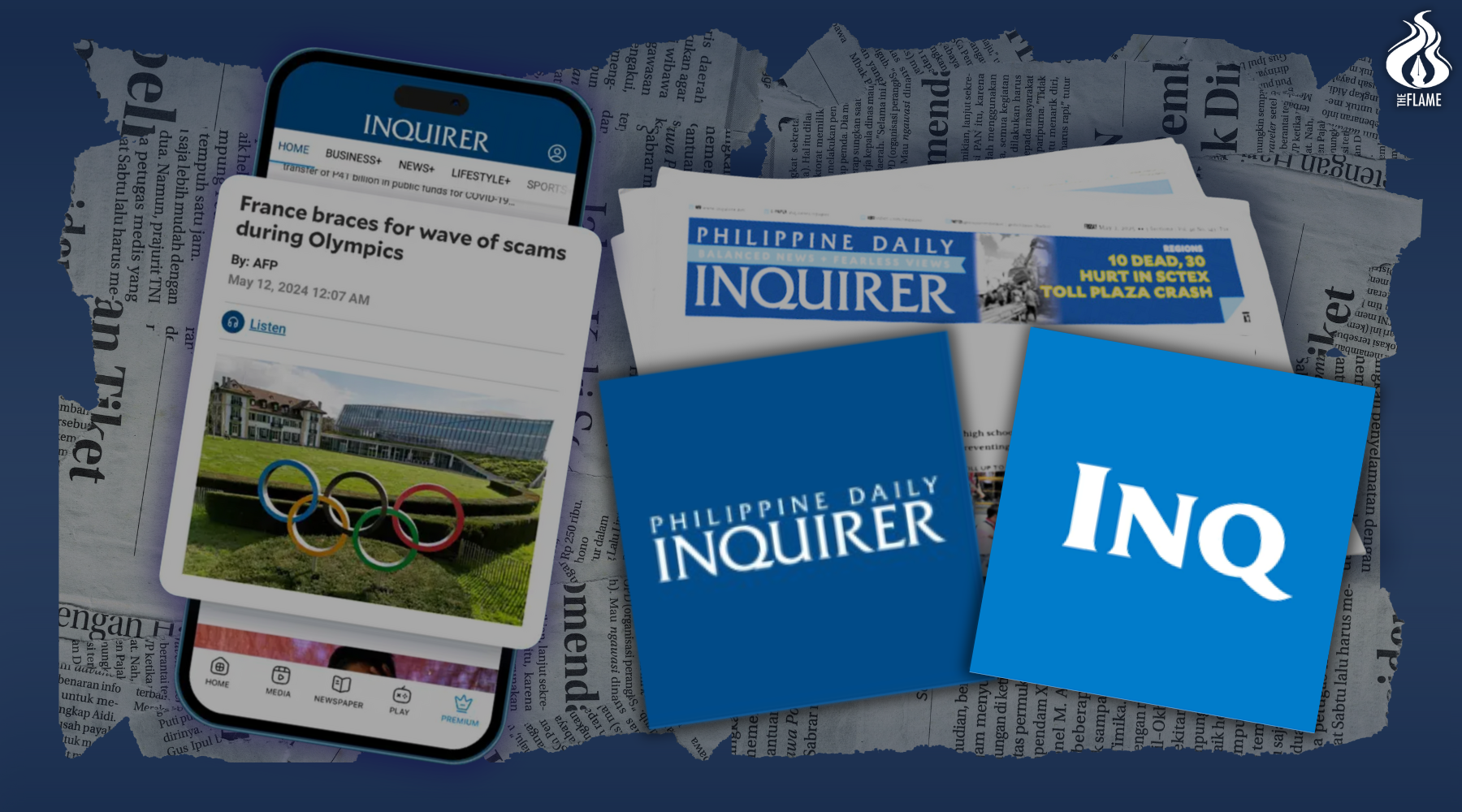
WHEN THE merger of the print and digital operations of the Philippine Daily Inquirer (PDI) took effect last July 1, media observers came up with a lot of discourses about its impact on the identity and the future of the once mighty newspaper.
But for Gina (not her real name), a former employee of PDI, the so-called end of an era came and went without much fanfare.
“I was no longer waiting for June 30 to arrive… I could actually focus on looking for a new job and leave 20 years of PDI history behind me,” Gina told The Flame.
She was referring to her last day with the newspaper, which was founded by Thomasian alumna Eugenia “Eggie” Apostol and her fellow journalists Betty Go-Belmonte, Max Soliven, Luis Beltran and Arturo Borjal in 1985.
Gina is one of the over 100 employees displaced by the PDI management’s decision to hand over the publication of the newspaper to its sister company, Inquirer Interactive Inc., which also manages the website Inquirer.net.
According to the Inquirer, the deal is expected to strengthen its financial foundation and to enhance its ability to deliver news in traditional and digital platforms.
There have been debates on what led to the merger, which was widely seen as yet another manifestation of the decline of the print media. Some blamed the alleged refusal of print old-timers to embrace innovations, while others attributed the integration, which ended the operation of PDI as a company, to bad business decisions and huge costs.
While commentators can only offer guesses about the fate of Inquirer, one thing is certain – most of the employees displaced by the integration are facing an uncertain fate because of things that were beyond their control.
Displaced
According to the PDI Employees Union, 124 of its members were affected by the integration as of June 30.
Employees who were offered roles in the online unit were hired “back to zero” and stripped of tenure and prior benefits, a source familiar with the matter told The Flame.
There is no available data on the number of employees who were absorbed after the merger. However, a former employee of PDI said only six out of the nearly 20 reporters in the day desk had received offers to remain in the newspaper.
Although losing one’s job is bad enough, employees who served for less than five years had a worse fate as they were not eligible to a separation pay. However, the management provided them with financial assistance.
In its statement announcing the integration, the Inquirer said “several” members of PDI’s editorial team have been invited by Inquirer Interactive to join it in managing its multimedia platform.
“The Board of Directors has committed that all affected employees shall receive the severance or separation benefits that may be due them under the law or the collective bargaining agreement with the PDI Employees Union, as the company winds up its operations,” it added.
According to the Inquirer’s employees union, the management decided to close down the PDI because of “serious business losses and/or financial reverse for the past eight years.”
Sonny Coloma, publisher of major Philippine broadsheet Manila Bulletin and former presidential communications secretary, said Inquirer’s decision had something to do with the need to ensure sustainability.
“It seems to me that Inquirer management is taking needed steps to rationalize their operations and to ensure continuing viability amid the challenges brought on by technological progress,” Coloma told The Flame.
However, some media practitioners believe that the closure of the original company that ran the newspaper could lead to the loss of workers’ rights, compromised outputs and editorial tensions.
More work, fewer personnel
National Union of Journalists of the Philippines (NUJP) chairperson Jonathan de Santos said the integration had resulted in the dissolution of the PDI Employees Union, the labor group formed just two years after the PDI was founded in 1985.
“That’s really a loss also for workers’ rights because PDI union has always been acknowledged as the strongest media union,” de Santos told The Flame.
He noted that many employees were not absorbed by Inquirer Interactive, significantly reducing union representation and weakening organizing efforts in the industry.
“Definitely, many lost their jobs…In fact, I would say more employees were not absorbed,” de Santos said.
De Santos pointed out that while newsroom consolidations are not new, they almost always result in reduced staffing, which places heavier pressure on remaining workers who would have to shoulder additional workload.
“Every media worker who leaves the profession, leaves us weaker. That makes us fewer. That means more work for whoever is left,” the NUJP chairperson said.
“I suppose that the company will be able to cut costs. But at the expense of people. At the expense of potentially overworking media workers even more.”
Pulitzer Prize-winning journalist and UST journalism instructor Manuel Mogato described as a “waste of talent” the departure of PDI journalists affected by the integration.
“Hope the talented journalist—editors and reporters—find a new home in print and in digital,” he said in a Facebook post on July 1.
Operational tensions
According to de Santos, the differences in operations pose the biggest challenge in the merger because of possible editorial tensions between legacy print values and online demands.
The NUJP chairperson noted that some veteran print reporters may be hesitant or resistant to take on tasks like writing reviews or producing content for online platforms. He also cited a perception that online journalism is of lower value, framing it as a divide between being a “journalist” and simply producing “content.”
De Santos warned that the possibility of hired legacy print writers shouldering additional tasks tailored for online platforms, such as writing breaking news stories, may come at the expense of context and depth.
“Since it is an online version, one needs to finish it within a certain period. There are also aspects of virality. So, it could also impact how it will be done by online operation [and] could also affect news lines,” he said.
For veteran journalist and media critic Vergel Santos, the consolidation poses more risks than opportunities for progress, given that the profession demands a high skill and a moral sense of responsibility from its practitioners.
He said the fast-paced nature of digital publishing could lead to shortcuts and the release of unverified information.
“Given the efficiency of the digital medium, the competition in who gets the news out first becomes stiffer, and taking shortcuts becomes more tempting; hence, the danger of the news going out before being properly validated,” he told The Flame.
Others are upbeat about Inquirer’s digital shift, including its former business editor Daxim Lucas, who said that the pivot “could mark the beginning of its resurgence.”
“Its online platform commands one of the largest digital audiences in the country. It already has the scale. Now, it is being handed the strategic primacy it previously lacked,” Lucas, now the chief executive officer and senior reporter of Insider PH, wrote in an opinion piece dated June 30.
Lucas said the Inquirer’s digital arm has the foundation to explore new revenue models because of lower costs, unified editorial oversight and better data analytics.
“Yes, this pivot is late… but not too late. Its loyal readership, institutional memory, and editorial bench still offer competitive advantages,” Lucas wrote.
“Success will mean demolishing legacy media habits, serving digital audiences with rigor, and sustaining quality journalism in an age of disinformation and fragmentation. The Inquirer is not vanishing, just being restructured. Whether it thrives again will depend not on sentiment, but on strategy and execution.”
Journalistic values
Despite the change in operations, Santos said the Inquirer should remain focused on verifying the truthfulness of news stories while embracing the demands of the digital medium.
“Keep the new medium, but also keep the print tradition of putting the news through layer upon layer of check before putting it out, and correcting promptly any errors committed in spite of all that rigor.” the veteran journalist said.
De Santos said the merger should take into account the compatibility of its reporters with both in-depth and fast-paced reporting.
“It is possible that existing (Inquirer.net) reporters will continue doing what they are doing. So, that’s fast-track. And those from print might still focus on more in-depth. We hope that happens, that they will strike a balance,” he added.
The Inquirer has assured its readers that it would stick to its core values despite its new set-up.
“PDI asks its subscribers, readers, partners and the public to continue to place their trust in the Inquirer as it embarks on this new chapter in its life, steadfast in its resolve to deliver ‘Balanced News, Fearless Views,’ and to serve Filipinos now and the generations to come,” it said.
Before the integration, the PDI had a reported daily readership of over one million nationwide, making it one of the most widely circulated broadsheets in the Philippines.
During its heyday, PDI was the main agenda setter, with its banner stories influencing the news line-up of other media entities and practically determining what topics will land on public discourses.
It received more than 500 recognitions from respectable award-giving bodies such as the Catholic Mass Media Awards, Jaime Ongpin Awards for Investigative Journalism, Anvil Awards and WAN-IFRA Asia Media Awards.
Gina and other employees displaced by the integration can only hope that the Inquirer’s storied past will help them move on and start a new career within or outside journalism.
“I know in my bones that there’s no use looking back on ‘glory days’ that will never come back – especially that my exit from PDI was not a matter of choice but was imposed on me and hundreds of other employees,” she said. F – Nicole Anne Bautista