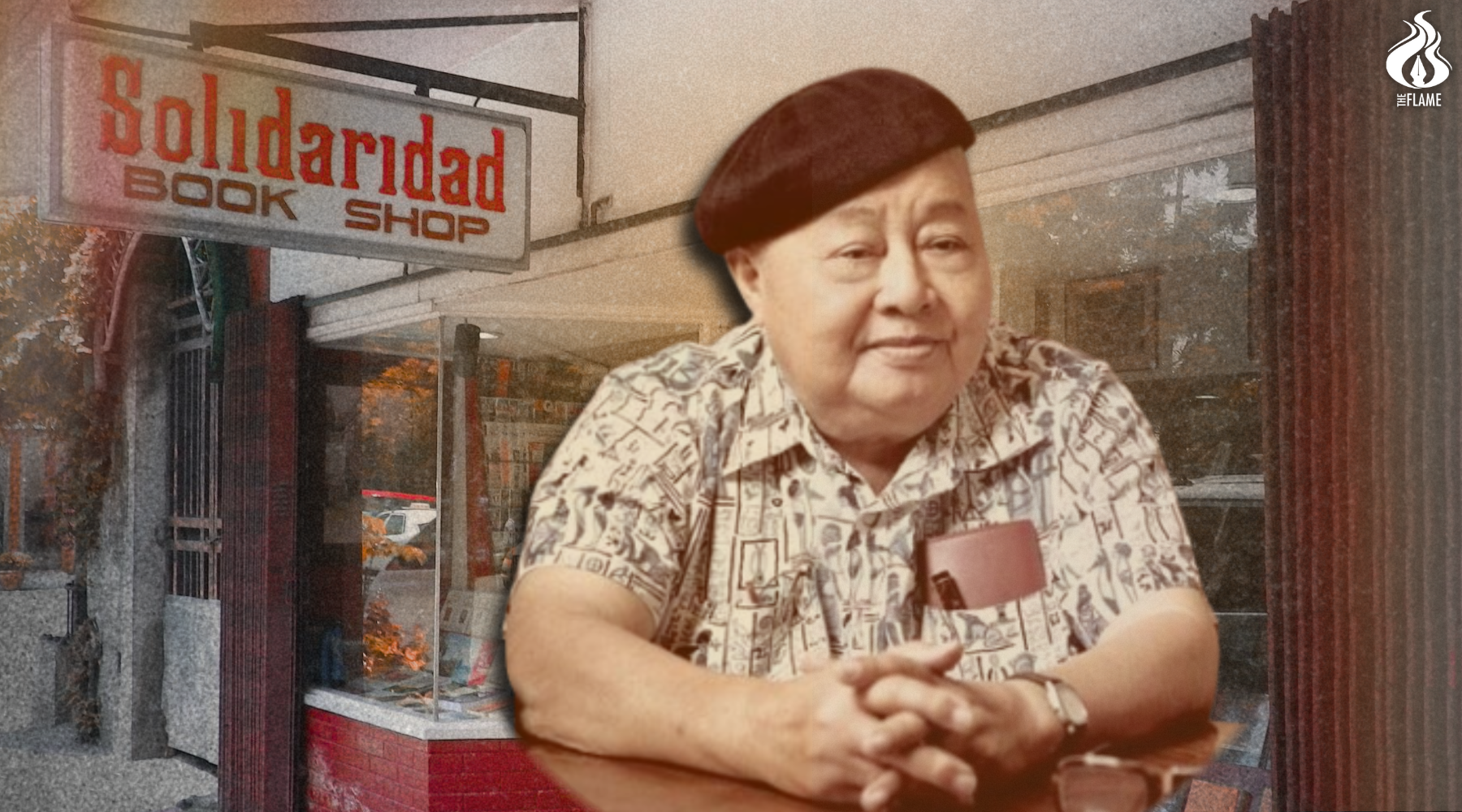
POET AND educator Nerisa Del Carmen Guevara recalled the ambiance of Solidaridad as much as the man behind it: wooden interiors, polished floors, the distinct smell of old books, and spontaneous conversations that happened in a quiet corner or around a large table.
While not everyone had a direct encounter with its founder National Artist F. Sionil José, his presence was felt throughout the space, from the curation of titles to the way he hosted small gatherings upstairs.
“He was more like…a grandfather. He had always been…Not many words were traded, but there was a lot of charcuterie and cocktails mixed in this small little corner. And I think that was the first time I encountered cold cuts. And it mattered, you know,” Guevara, an associate professor at the UST Creative Writing department, told The Flame.
“He and his wife, they would sit in the corner. Most of the time, [it was] quiet. But the conversations happened around the round table that seemed too big for the space,” she said.
So when news broke that the bookshop was being put up for sale, Guevara thought it was “the end of an era.”
Solidaridad marked its 60th anniversary on July 20, possibly its last under the ownership of the family of the late National Artist as it is now up for sale. Financial difficulties made it difficult to operate the bookstore, prompting the José family to sell it.
The bookstore and cultural landmark is being offered to interested buyers for P35 million to P38 million.
In a recent interview, Antonio “Tonet” José, son of the late National Artist and Thomasians litterateur, told The Flame at least four parties have expressed interest to buy Solidaridad.
READ: Four parties interested in buying Solidaridad bookstore
Plans to use the proceeds from the bookstore’s sale to fund scholarships for students are in place, but many remain concerned that commercialization might change Solidaridad’s cultural identity under a new owner.
Light and life of Solidaridad
Historian Ambeth Ocampo weighed in on the book shop’s legacy in a social media post on July 19, expressing hope that its buyer would maintain it and “make it viable for the next 60 years.”
“Frankie Jose was the light and life of Solidaridad Bookstore, that celebrates its 60th anniversary today. It rose to become the cultural heart of Ermita. I owe a lot to Frankie and Tessie, the bookshop, and the kindred spirits who gathered there,” he said.
Ocampo disclosed that he offered to purchase Solidaridad twice in hopes of fulfilling a lifelong dream to run a bookstore in retirement. He even proposed leasing the property at a “friendly rate” to keep him afloat. But the elder José declined, saying his children would manage it.
Now that José’s children have decided to let go of the shop, its patrons are hopeful that its character, which is very much intertwined with its founder, would survive an ownership change.
But for Guevara and other Thomasian writers, the essence of the bookstore has long faded with the passing of its founder.
“I think when Frankie (Francisco Sionil) José died, there went the bookstore. He was the bookstore,” Michael Maniquiz, former Thomasian Writers Guild (TWG) member and lecturer at Fresno State University, California, told The Flame.
Guevara said Solidaridad, as an independent bookstore, was driven not by popularity or market demand but by the presence of its curator, who shelved titles based on personal interest rather than mass appeal.
She said such a curation built the “personality” of Solidaridad which made it distinct from other commercially owned bookstores. This, she added, was lost when José passed away in 2022.
“F. Sionil José was an independent bookseller…Small independent booksellers actually…have personalities. And that’s what makes an independent bookseller independent…The fact that it is not commercial in a way, because there’s a human behind the curation of that,” she said.
Shifting habits, economic pressures
Maniquiz said the move to sell Solidaridad is an evidence of the dwindling demand for physical books in an era where digital copies have become more accessible.
“It marks the end of an era. And it’s just a confirmation of the increasing irrelevance of physical books…In one aspect, you want to feel nostalgic about its loss because we grew up on books, and that’s how we fell in love with what we do right now,” Maniquiz said.
Television journalist and former The Flame editor-in-chief Sandra Aguinaldo echoed the sentiment, citing the closure of several other bookstores.
“In a way, it is a representation of what’s happening I think around the world…there have been closures because everybody’s going digital, ganun. But of course, our generation is affected because we really want the physical copy of the book,” Aguinaldo, who was also a member of TWG, told The Flame.
According to writer Reinerio Alba, a member of the TWG and an alumnus of The Flame, older generations visit the store out of nostalgia even under a new ownership.
However, the selling of the bookstore may not have much impact on readers who never had any attachment to it. The literary habits of younger generations, Alba added, are more influenced by their reading circles and by digital platforms than by the bookstore’s legacy.
“The nostalgia comes in for the people who used to frequent Solidaridad. But beyond that, the general public doesn’t really care…People will go there only for nostalgic reasons,” Alba told The Flame.
But writer Liezl Sitosta, who was a contributor for TWG, said sustaining a bookstore requires more than nostalgia.
“Let’s be realistic. On the business side of things, to open up a bookstore or to sustain it as a business, there must be sales,” Sitosta told The Flame.
She pointed out that sustaining a bookstore requires consistent sales to cover operational costs like electricity, water, and rent. While the act of visiting a bookstore and meandering through its shelves holds meaning, she said that such a model might no longer be viable and a new owner would still have to think about practical concerns beyond culture.
“So, well, if they can survive that, then that’s good. It can be retained. But if not, I think it’s also about time to be realistic,” Sitosta said.
While profitability is among the considerations when determining a business model, the late National Artist had shown aversion to the idea of prioritizing profits over identity.
In a recent interview, Tonet, who manages Solidaridad’s administrative matters, shared that there was a proposal for the book store to begin selling school and office supplies.
His father rejected it, citing the need to preserve the bookstore’s reputation.
There was also a suggestion to expand Solidaridad into a branch network, but the late National Artist turned them down to keep Solidaridad “independent and singular.”
READ: Solidaridad for sale: F. Sionil José chose independence over profit
“My father was against it. His point was if people… want to but your books, they’ll come, they’ll go to you. Now, that is impossible because of the heavy traffic on the way here,” Tonet told The Flame.
Cultural heritage
Alba hopes that Solidaridad, having been owned and curated by a National Artist, will be considered and treated as a cultural heritage by the government.
“If it’s bought that way, it should be treated as heritage…As a property of a National Artist, the National Commission for Culture and the Arts should ideally step in. What to do with it should follow how we handle the properties left behind by other National Artists,” he said.
Alba explained that although the store itself has not been declared a historical site, its curated collection and identity should warrant cultural preservation, especially if the books are recognized as part of the artist’s body of work.
“They (the heirs) have a say in selling it if it was passed on to them. But collectively, it’s unclear where and how the government can intervene,” he added.
‘One less place of inspiration’
While Solidaridad became an important spot for writers under José, Maniquiz said its sale would not have a significant impact on the literary community.
“I think we have this strong idea of the impact of Solidaridad..We became writers because of our professors. They’re the ones that inspired us. And it just so happens that La Solidaridad was there because a writer owned it,” he said, adding that the loss is “minimal” for young writers who may find inspiration in various places.
“If at one point somebody found inspiration when they were at that store (Solidaridad), that’s great. So, we just have one less place of inspiration.”
Aguinaldo shared the view, saying the present generation may have fewer opportunities to experience the same literary inspiration with Solidaridad under new ownership. The challenge now lies with the new generation to find ways to keep Solidaridad’s spirit alive, she added.
For Guevara, selling Solidaridad risks the loss of the archive and the personality of an independent bookseller.
“Because the books that he (José) wanted were the books that were there…Whether national or international titles, they were the books that were there.”
However, she noted the rising number of other independent bookstores that often operate online and in bazaars or festivals instead of owning physical shops. These independent booksellers, she said, may see the story of Solidaridad as an inspiration to aspire for a bookstore of their own.
“What is lost is a bookseller that barely sold any books…There’s a writer in Malate who owns a bookstore. That is a story that has ended, and it might have been a story that could have inspired other independent booksellers,” Guevara said. F