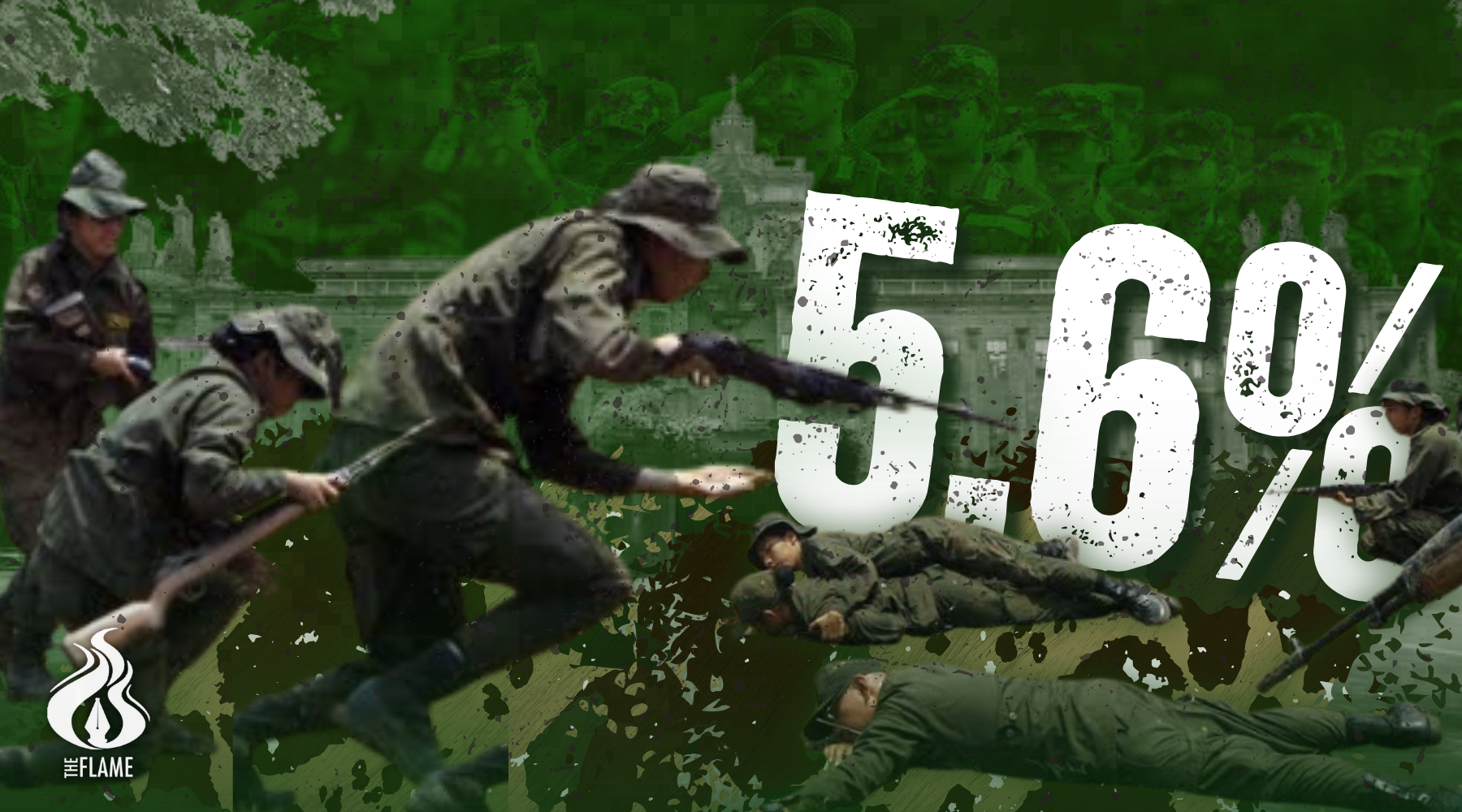
THE UST Reserved Officers’ Training Corps (ROTC) managed to attract only 5.6% of the 9,005 Thomasians enrolled in the National Service Training Program (NSTP) in the first term of academic year (AY) 2025–2026.
Out of the total NSTP enrollees this year, only 500 picked ROTC, compared to the 6,145 (68.2%) students who chose Civic Welfare Training Service (CWTS) and 2,360 (26.2%) who took Literacy Training Service (LTS), according to NSTP Office data obtained by The Flame.
ROTC’s share of NSTP enrollees has shrunk since the academic year 2022–2023.
In academic year 2020–2021, ROTC had 1,906 students or 12.2% of the total NSTP enrollment. The figure rose slightly to 2,433 students or 16.3% the following year.
Since then, its percentage of enrollees began to fall. In the academic year 2022–2023, students enrolled in ROTC dropped to 1,725 or 11.8%, then plunged to just 809 students or 5.1% the following year. In the academic year 2024–2025, the number of ROTC students stood at 1,030 or 6.1% of the NSTP enrollees.
Thomasians’ interest in ROTC waned desire efforts by some lawmakers to push for a bill restoring the mandatory ROTC, which they claim will bolster national defense and instill discipline among students.
The measure, which was passed by the House of Representatives in December 2022, is still pending in the Senate.
In February, Sen. Ronald dela Rosa, the principal author of the proposed ROTC Act, moved to close the Senate debates on the measure, insisting it had already undergone “careful scrutiny.” He noted that the Legislative Executive Development Advisory Council (LEDAC) had placed the bill in its priority list and is supported by President Ferdinand Marcos Jr.
In September 2024, then senator Francis Tolentino said the measure already has the “go signal” of the Marcos administration.
The proposed revival of the mandatory ROTC in the curriculum has been the subject of intense debate among educators, student groups and lawmakers, with its critics claiming it has a history of mental and physical abuse.
ROTC was first made compulsory in the Philippines in 1939, when then-president Manuel Quezon issued Executive Order No. 207 requiring colleges and universities with at least 100 students to implement the program.
However, its mandatory status ended after the death of UST student Mark Welson Chua in 2001.
The killing of Chua, who exposed the alleged corruption in the University’s ROTC unit, sparked nationwide outrage and led to the passage of the National Service Training Program Act of 2001, which gave students the option to choose among ROTC, LTS and CWTS.
CWTS has consistently lured the majority of NSTP students in the University.
Out of 15,610 students in academic year 2020–2021, 10,066 or 64.5% chose CWTS. Its share dipped to 62.6% the following year.
During the academic year 2022–2023, CWTS enrollment climbed to 9,824 students, or 67.1% of the total NSTP enrollees, and then to 11,606 students or 73.5% the following year. In academic year 2024–2025, CWTS accounted for 70.4% of the total 16,942 enrollees of the program.
LTS has remained relatively stable as the second-most preferred track.
In academic year 2020–2021, LTS drew 3,638 students or 23.3% of NSTP enrollees. Its share slightly decreased to 21.1% in the academic year 2021–2022 and stayed at the same level the following year with 3,093 students.
In academic year 2023–2024, LTS attracted 3,376 students or 21.4%. The enrollees rose to 3,986 students or 23.5% in academic year 2024–2025. F