ACTIVISM IS different from violent extremism, a security official said during a forum that drew flak from activists who decried the involvement of a government body that they said has a track record of human rights violations and red-baiting.
National Security Council (NSC) consultant Jose Egco said radicalization and recruitment only become dangerous when persons are conditioned with violent and extremist beliefs, which may eventually lead to terrorism.
“It was said earlier that communism is not terrorism, and I agree. What more of activism? In fact, it’s healthy. There is no problem with activism. I was a former activist,” Egco said during the forum on “terror grooming” organized by The Political Department on Thursday, Nov. 6.
“But in the context of violent, extremist grooming…where you’re influenced to eventually blow yourself up, that’s a different thing,” he added.
During the forum, Egco presented his doctoral study on terror grooming, which suggests that youth and impressionable individuals are often targeted by recruiters through a “sense of purpose and belonging.”
According to Egco, the process of violent extremist grooming involves emotional and social bonds to steer young people into radical causes.
“[Violent extremist grooming] targets vulnerable people [and] uses deception and psychological manipulation. It removes free will and informed consent,” he said.
According to Egco, the process can be subtle enough to operate across various institutions, such as schools, groups, community networks and even online platforms.
“The rise of YouTube, TikTok, etc., they also became a platform. So, it needs to be used. These platforms provide scale intimacy, secrecy, and private groups, encrypted, are also being used,” he added.
In the same forum, a former New People’s Army (NPA) member said legal activist organizations have been found to be avenues for “covert recruitment” into underground armed movements.
Arian Ramos, who claimed to be a former leader of the armed group, presented her study on radicalization, whose initial findings suggest that participation in youth activist organizations can supposedly lead to entry into the NPA through “ideological immersion.”
“Student activism has long been part of our democratic life. Youth involvement in the political process is a constant feature of the Philippine public sphere. However, the recurring issue of student recruitment into armed movements, particularly the CPP (Communist Party of the Philippines)- NPA, has reemerged as a public and policy concern,” Ramos said.
According to Ramos, the ongoing study, which features 50 former rebel interviewees, indicated that the decision to remain in such organizations is often relational, driven by trust toward their fellow members instead of pure ideology.
“Recruitment grows out of genuine activism and trust. Students enter through legitimate issues and communities of care. Trust is the door. Once inside, mentoring deepens commitment,” Ramos said.
“We recognize that activism is essential for social reform. What we want to avoid is the use of youth spaces for violent purposes,” she added.
Activists: NTF-ELCAC still involved
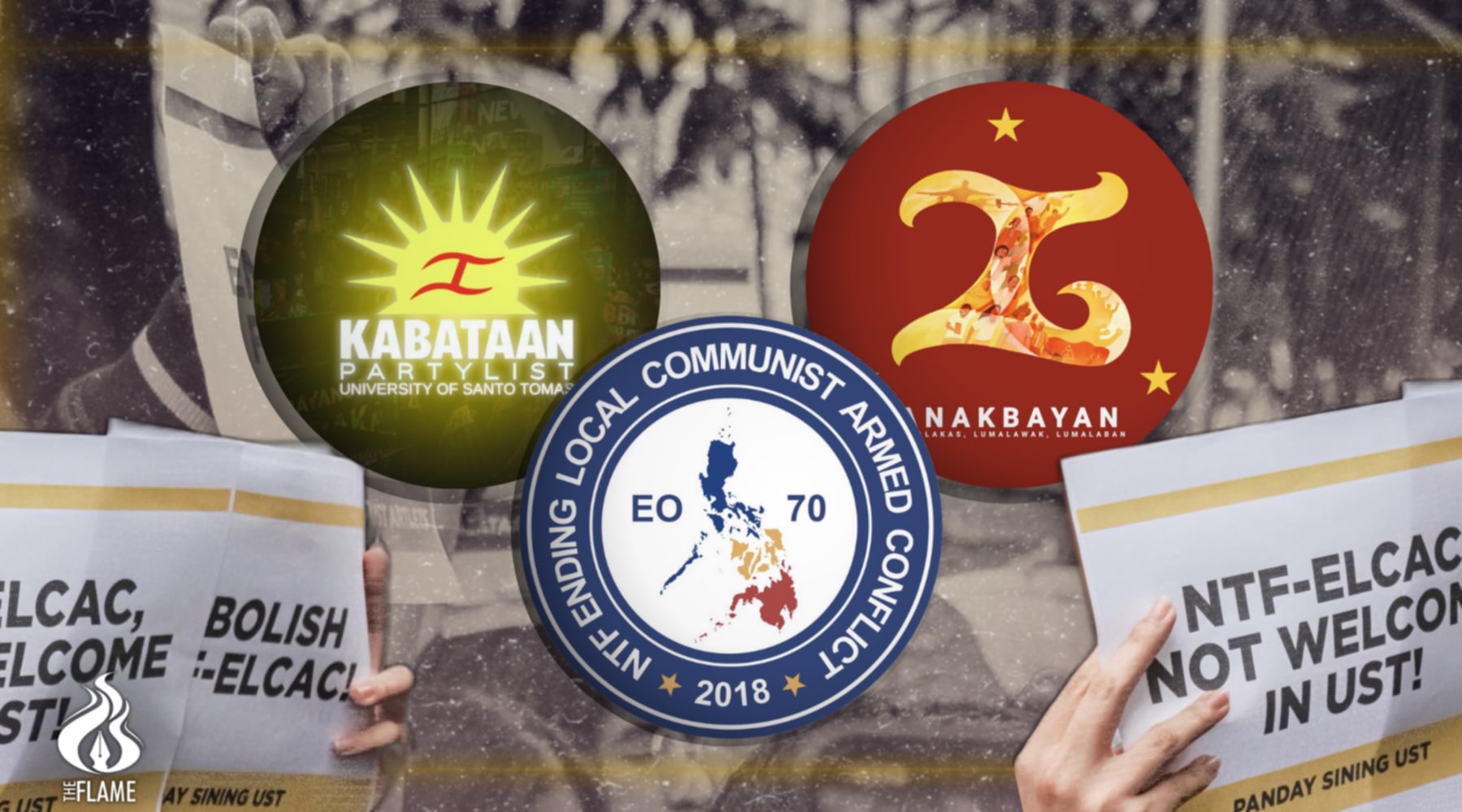
During the colloquium, student activists claimed that the National Task Force to End Local Communist Armed Conflict’s (NTF-ELCAC), a body they accused of being a state instrument for human rights abuses, is still involved in the forum despite an assurance that it had been excluded.
Department of Political Science chairperson Assoc. Prof. Dennis Coronacion earlier announced the removal of the anti-communist insurgency agency after various groups claimed that its inclusion would result in fear mongering and the peddling of propaganda.
READ: AB admin removes NTF-ELCAC from research forum after backlash from students
In a statement, the Kabataan partylist said UST did not uphold its promise of dropping the task force and labeled the event’s speakers as “operatives.”
“The administration’s claim of distancing from the Task Force rings hollow when known NTF-ELCAC operatives Dr. Jose Joel Egco and Arian Ramos were still presented as speakers,” the group said.
The NTF-ELCAC was formed in 2018 as part of the government’s “whole-of-nation” approach to address armed insurgencies and attain peace in conflict-hit communities. However, various groups claimed that the task force is a state apparatus for committing abuses and silencing dissent, including the red-baiting or “red-tagging” of persons and organizations critical of the government.
Egco said his role was to present his study titled “Countering Violent Extremist or Terrorist Grooming and Building Resilient Communities in the Philippines through Positive and Engaging Dialogue,” which he had submitted for his doctorate. He added that the research was not affiliated with any agency.
Ramos, through the NTF-ELCAC, had linked lawmakers from Bayan Muna, ACT Teachers and Kabataan party-list to the communist rebels.
“UST’s decision to approve this event and push through with inviting state-sponsored killers into the four corners of our campus is immensely disheartening and a grave betrayal both of safety to its students and the principles it claims to uphold,” Kabataan said.
Anakbayan also criticized the participation of Egco and Ramos in the forum, calling it a “clear presence” of the anti-insurgency agency.
‘One-sided’
Philosophy freshman and Kabataan partylist member Raven Racelis expressed her disappointment over what she described as a “one-sided” discussion on terror grooming and youth radicalization.
“I was really disappointed with the topic because it…did not really discuss the other side of the coin,” Racelis said during the forum.
Racelis left the event before its speakers could fully respond to her statements. A participant was heard yelling ‘Alis Komunista.’
She later echoed her remarks in a social media post, accusing the experts of framing educational discourses of organizations as a form of “ideological grooming.”
Racelis disputed NTF-ELCAC’s claims about “legal democratic organizations” as “recruitment grounds” of communists, saying “I am not stupid. I was not ‘groomed.’ I am a Philosophy student who knows how to read context and understand an ideology.”
Organizer: NTF-ELCAC excluded
After student activist groups raised concerns over the NTF-ELCAC’s participation in the forum, Coronacion said the department had requested the NSC, its co-organizer, to remove the segments allocated for the task force.
“The main concern raised by the left-leaning organizations, they’re scared to participate in this forum because they might get red-tagged…They (NSC) agreed [to remove NTF-ELCAC]. So why get scared? There’s nothing to be scared of,” Coronacion said.
Coronacion said he was saddened by Racelis’ decision to leave before hearing the speakers’ response, adding that the forum was an opportunity to express grievances toward the NSC.
He urged participants to name an actively enrolled Thomasian student who has been red-baited and raise the issue with the NSC while it’s on campus.
“‘None’ is their answer to me. ‘It’s a general feeling.’ General feeling, right? It’s like you’re scared of a ghost,” the department chair said.
During her opening remarks, Faculty of Arts and Letters Dean Prof. Melanie Turingan urged Thomasians to actively participate in intellectual discourse.
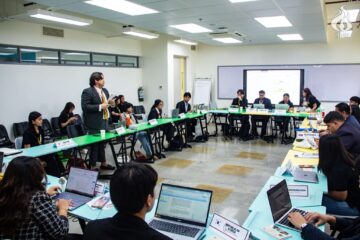
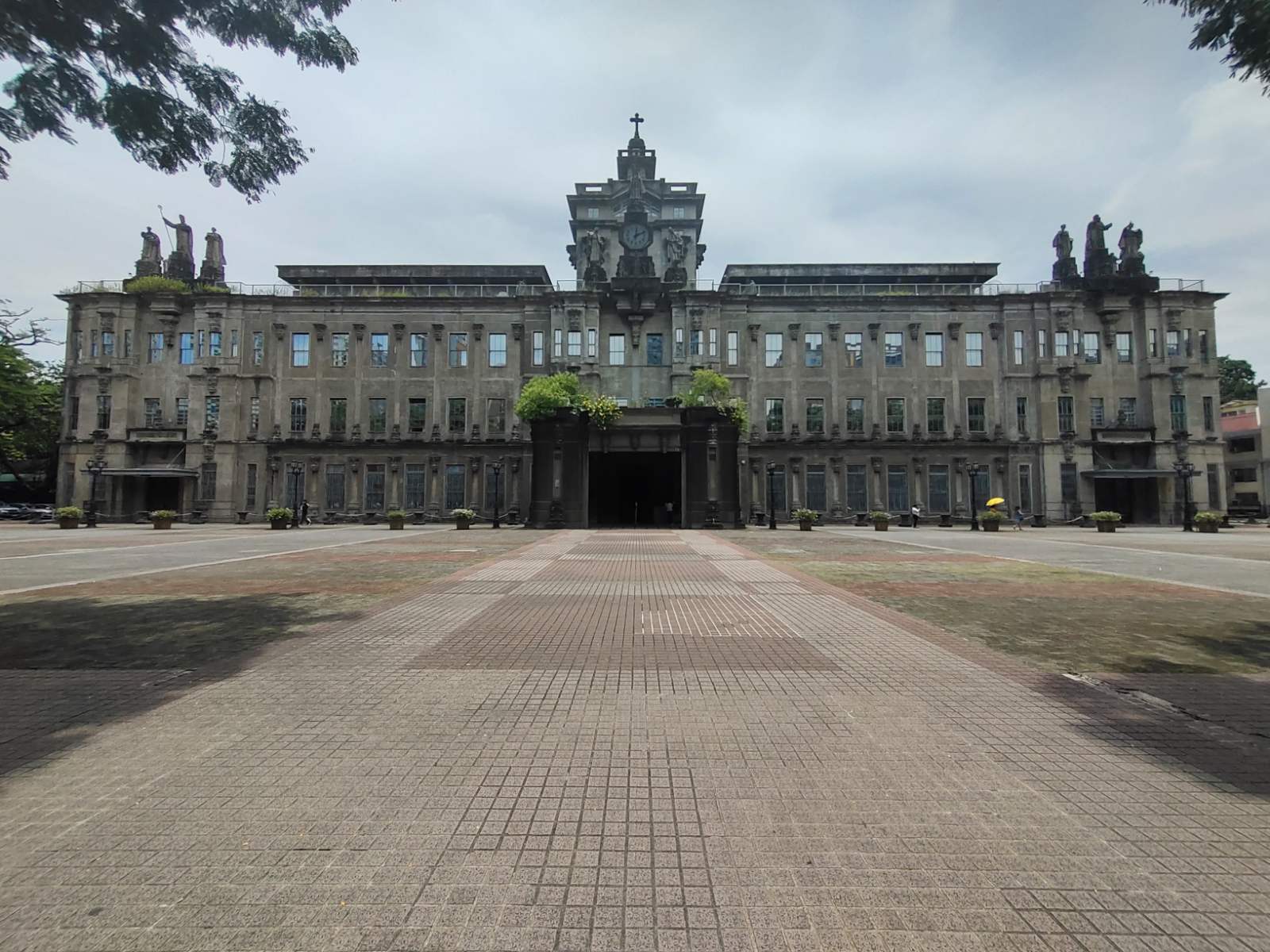
Held at the Thomas Aquinas Research Center Auditorium, the forum was the Political Science Department’s second academic colloquium on terror grooming prevention. F — K. G. and M. L. W.
EDITOR’S NOTE: The Flame has updated its story “Security official: Activism not terrorism but…” to include what a participant had said during the forum.