

EVEN JOURNALISTS can fall victim to misinformation in the “evolving digital space,” a reporter of the Agence France-Presse (AFP) said during the news agency’s first workshop in the Philippines.
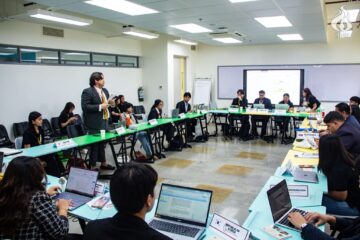
On the first day of the AFP digital investigation workshop on Tuesday, Nov. 4, student journalists were told to focus more on their methods for using digital tools instead of the technology itself.
“They’re already in the field (media professionals) and they’re really dealing with these firsthand daily. So it’s the same. We’re all victimized by the same stuff online. Like even if you’re a working journalist already, you still deal with this problem,” AFP Manila reporter Ara Eugenio told The Flame.
“It’s all really to, you know, like keep people abreast with the types of [misinformation] that could victimize them online,” Eugenio added.
Through the workshop, the France-based wire service pre-launched its digital course on identifying AI-generated content.
Participants were also trained on geolocation, or the use of technology to identify a location on the map and verifying photos, videos and information for fast-paced news.
According to Sophia Xu, training manager of AFP in the Asia-Pacific, media professionals should keep up with the capability of advanced technology to create both solutions and problems.
“AI can be helpful in detecting forensic traces of synthetic generation so sometimes AI detection tools can assist us in certain ways, but we must be fully aware that, to date, no tool is capable of identifying an artificially generated image with 100% accuracy – detection results can even be wrong,” Xu told The Flame.
Xu added that detection tools should only be used as reference point during investigations and verification of information should still rely on people’s investigation skills.
The two-day digital investigation workshop, which ran from Nov. 4 to 5, was in partnership with Google News Initiative, Foreign Correspondents Association of the Philippines and University of the Philippines-Diliman College of Media Communication.
Student journalists participated in the event at the University of Philippines-Diliman, while its second day was held at Makati City for media professionals.
Founded in 1944, AFP is an international wire news service based in France reporting in six languages, namely French, English, German, Spanish, Portuguese and Arabic. It succeeded Agency Havas, the world’s first news agency established in 1835. F





It’s interesting how this article emphasizes that even professional journalists can still fall victim to digital misinformation. This shows that digital literacy is not only a necessity for students, but also for professionals in the field. Do you think this kind of training should be made a mandatory part of the journalism curriculum at universities?
It’s iinteresting how this article emphasizes that even professional journalists can still fall victim to digital misinformation. This shows that digital literacy is not only a necessity for students, but also for professionals in the field. Do you think this kind of training should be made a mandatory part of the journalism curriculum at universities?