TO KEEP pace with the rise of artificial intelligence (AI), law educators must train their students to ask “how” and “why” questions, inquiries that cannot be accurately answered by AI tools, an expert said.
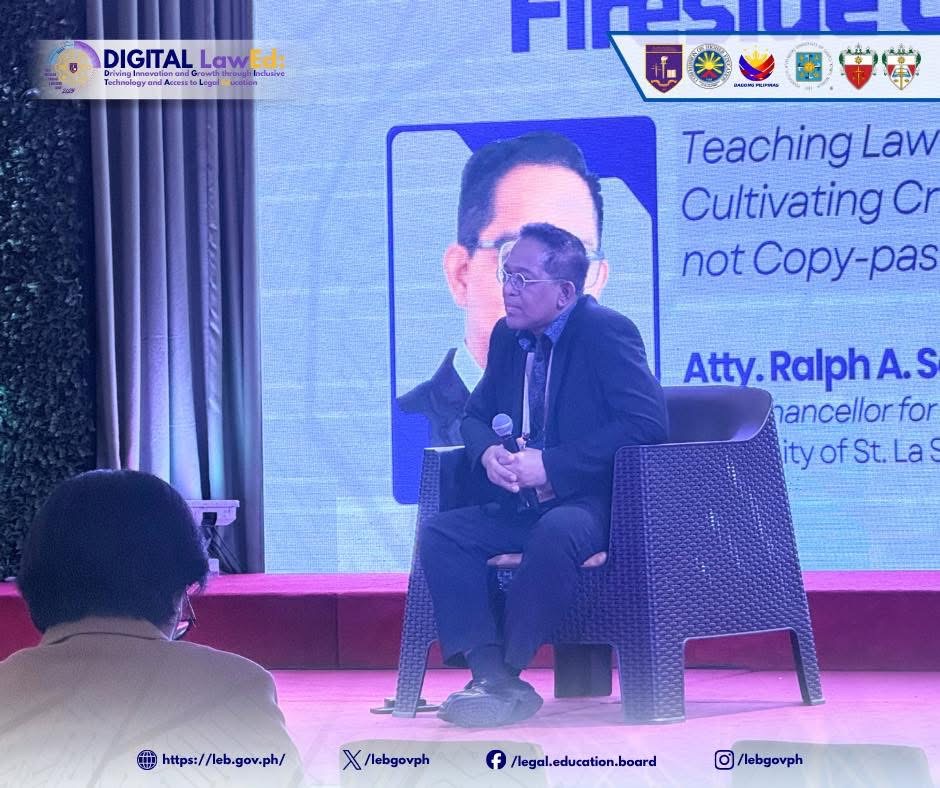
In a legal education forum, University of St. La Salle vice chancellor Ralph Sarmiento, urged teachers to implement the new “Socratic AI” method, which goes beyond “what” questions or “merely information retrieval.”
“Thinking like a lawyer in the age of AI should be able to go beyond merely retrieving information. They should be questioning the information [to] be able to discern the applicability of [it], and therefore, [to form] judgments,” he said.
“The real threat to legal education is not AI. It’s our resistance and our inability to adapt to the technology.”
Sarmiento likewise called on law students to learn and practice how to interrogate, evaluate and analyze information from AI to continue developing their legal thinking skills.
According to Sarmiento, the “old Socratic method,” which focuses on “what” questions, only allows law students to present inquiries that can be easily answered by AI.
“There has never been a single AI or CHAT-GPT-generated answer in my constitutional law class, which succeeded during the Socratic AI recitation.I was able to debunk all of them. And that is…what we need to develop,” he added.
“Anyone can just ask AI or CHAT-GPT [like] to define what’s the meaning of a particular legal term.”
Law educators, Sarmiento explained, should teach their students to instead focus on crafting and forming legal theories, which he described as the “primary and core purpose of legal education” in the country.
“Ask them to generate legal knowledge [because that] should be the primary and core purpose of legal education. We have to teach our students to make theories,” Sarmiento said.
Joan Largo, vice president for administration of the University of San Carlos, raised concerns over the overreliance of law students in generative AI and pointed out the role of ethics and critical thinking in dealing with the technology.
“But more about ethics and critical thinking, [students] should be able to discern what to use and why they should use it,” Largo said.
The discussion was part of the first Legal Education Technology and Inclusion Summit, which tackled how educators can effectively teach law in the age of AI.
The event, which carried the theme “DIGITAL LawEd,” was held from Nov. 13 to 14 in the Buenaventura G. Paredes O.P. building. It was hosted by the Legal Education Board in collaboration with the UST Faculty of Civil Law and Graduate School of Law. F — B. G.







It’s interesting that this article emphasizes that the greatest threat isn’t AI, but our inability to adapt. I agree that ethics, analysis, and the ability to evaluate information are the foundations of modern legal education. Does the author see a need to add specialized courses like AI Ethics in Law or Legal Tech Literacy to law schools?