
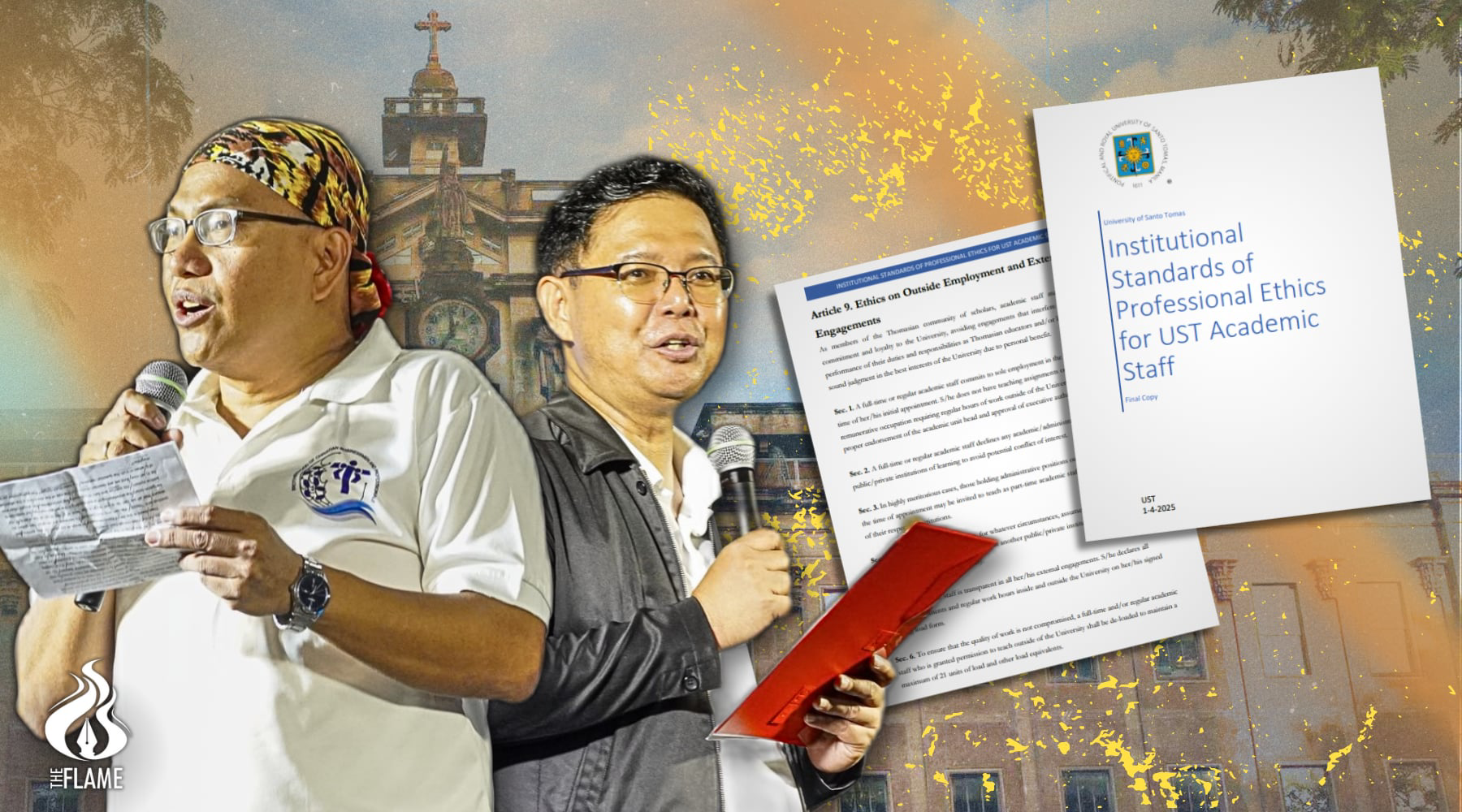
THE UST administration will meet with faculty members to address concerns over some provisions of the newly released Institutional Standards of Professional Ethics (ISPE) that supposedly conflict with the 2026 collective bargaining agreement (CBA).
In a letter dated Nov. 7, UST Rector Fr. Richard Ang, O.P. said the administration is establishing a special panel involving the Ad Hoc Committee and authors of the ISPE, which will represent the University in the dialogue.
“The University reiterates its openness to engage in a constructive and collaborative dialogue with the USTFU in view of the concerns raised regarding certain provisions of the ISPE,” the letter, addressed to UST Faculty Union (USTFU) president Asst. Prof. Emerito Gonzales, read.
The Arts and Letters Faculty Association (ALFA) previously expressed its concerns over the newly-drafted ISPE, saying its imposed blanket ban on outside and exclusive employment goes against the CBA.
READ: AB faculty union raises concerns over new outside, exclusive employment rule
Under the ISPE, all full-time or regular academic staff must be solely employed in UST, without any teaching assignment or occupation that requires regular hours of work outside the University. Exceptions, however, are made with proper endorsement from their respective academic unit head and approval of administrators.
Regular academic staff with tenured employment in other private or public institutions are also required to forfeit their permanent status in the University.
In the letter detailing its concerns sent to USTFU in October, ALFA said the CBA’s “narrower rules,” which limit the use of unpaid leave to prevent working at other institutions, should take precedence over the ISPE’s broad prohibitions.
“The CBA prevails over conflicting University policies and routes disputes to the CBA’s grievance machinery. The ISPE’s broader ban, therefore, exceeds bargained terms and should be revised or withdrawn,” it said.
The group also argued that the ISPE’s description of sole employment imposes a “grievable” condition over the CBA’s definition of full-time, which is based on teaching load.
ALFA also asked for clarification on other provisions, such as how appeals are processed, the definition of official representative, digital-conduct provisions and rules on academic freedom and conduct.
The UST had said it is open to continued dialogues on the ISPE, adding that the draft guidelines was initially circulated to collect comments from academic administrators and the USTFU before its final adoption.
Ang said the dialogue would begin through a formal letter of invitation to be sent to the USTFU once the panel is finalized.
“It is our sincere hope that through this joint effort, we will not only align our policies but also foster a deeper sense of unity and shared purpose as one academic community,” the rector added.
‘More constructive’ ISPE
ALFA President Assoc. Prof. Rene Luis Tadle said the group intends to work toward a “more constructive and enabling” ISPE that sets clear guidance and provisions to support good practice.
“Our aim is to help make the ISPE more constructive and enabling—clarifying academic freedom, due-process protections, and conflict-of-commitment guidance—so it supports good practice rather than just listing prohibitions, while staying true to UST’s Dominican identity,” Tadle told The Flame.
“We also hope our UST teachers will seize this opportunity to participate meaningfully in the dialogue—sharing experiences and concrete suggestions—so the final ISPE truly reflects our community’s best thinking.”
Gonzales welcomed the administration’s move in a recent statement, saying the faculty union is open for a “constructive dialogue” with the university and is ready to assign representatives to the panel following a formal invitation.
“We confirm that USTFU has formally responded, welcoming this process and conveying our readiness to participate at the soonest possible time,” the USTFU president said.
“We are optimistic that this engagement will clarify concerns, strengthen the ISPE, and reinforce our collective commitment to a thriving academic community,” he added. F






[…] READ: UST faculty union, admin to discuss ethical standards on outside employment […]