IN THE wake of the closure of one of the Philippines’ most well-known news networks, an executive of the company, who is also a Journalism professor at UST, created a manual on broadcasting that is tailored to the Filipino context, a project he had previously shelved due to lack of time.
Asst. Prof. Jose Maria Carlos’ book titled “On-Air Na! Pinoy News Anchors Live!: A Guidebook on News Anchoring in Philippine Media,” which tackles the state of broadcasting in the country, will soon be available at the UST Publishing House.
It features the viewpoints of 31 high-profile Filipino news anchors from different backgrounds, including Korina Sanchez-Roxas, Julius Babao and Joanna Marie “Pinky” Webb, who discussed the profession in light of relevant issues in the journalism industry, such as the rise of Artificial Intelligence and the emergence of news influencers.
Carlos, who obtained his Communication degree from UST in 1974, said the manual can help guide the youth who aspire to become news anchors, which he described as the most sought-after job in the industry due to its power to shape audience perceptions.
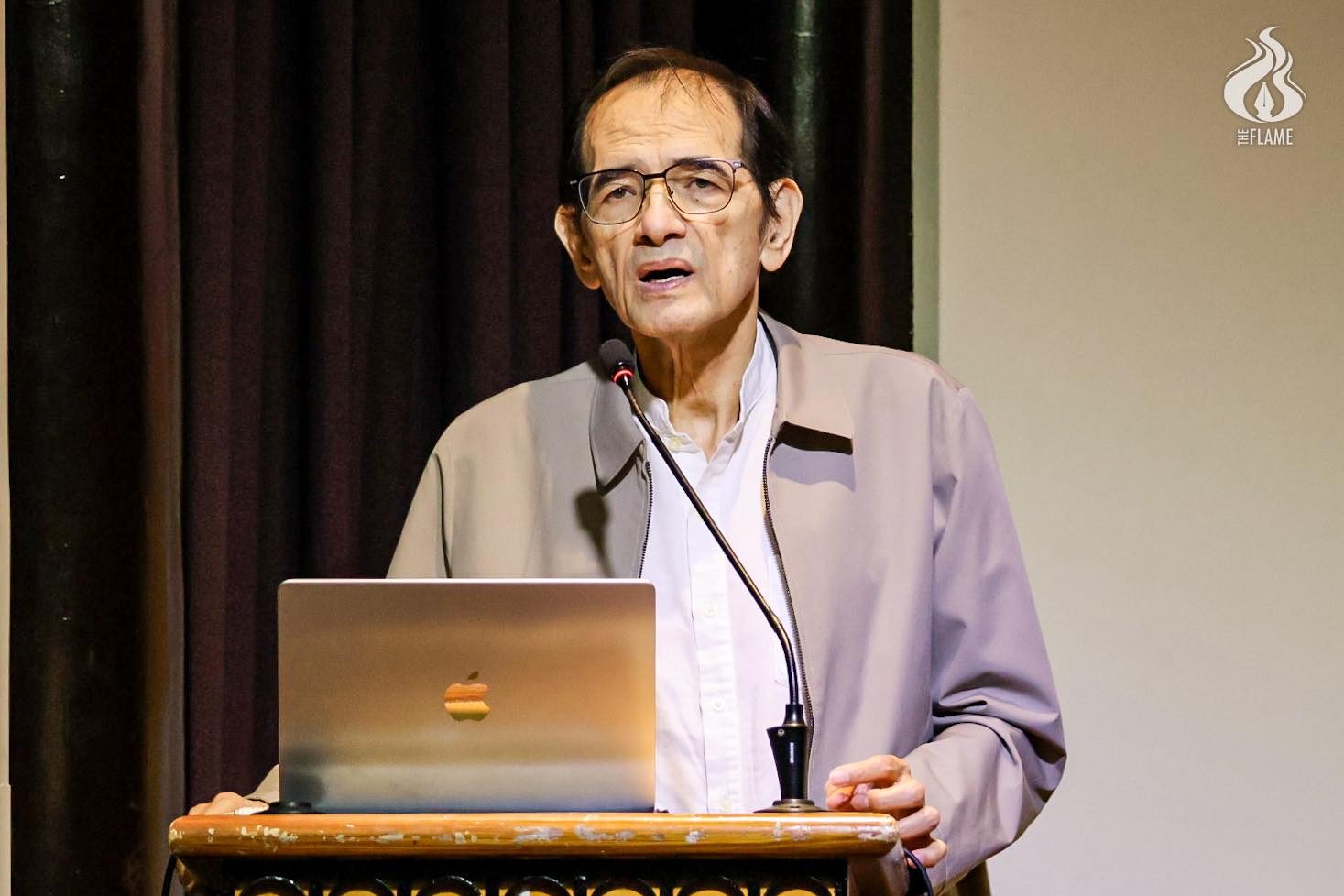
“News anchoring is the most coveted profession in the news industry, for many reasons. One of them is that, you know, they can help shape the way we see and understand the world. And, news anchors are not mere presenters. They are interpreters of reality,” he said during a lecture on Friday, Nov. 14.
Silver lining
Carlos, who was the assistant vice president for news at the now-defunct CNN Philippines, said he finally found the time to write the book after the company’s closure, working almost every day in coffee shops and even during a hospital stay.
“I’ve had this idea for a long time, to come up with a book, but I didn’t know what topic at that time. But I really wanted to write a book on Philippine media, and so, I thought that news anchoring, for those reasons I mentioned. So, when CNN closed, I had time,” he told The Flame.
“I was even hospitalized, and in the hospital, I started writing the chapters of the book, but it’s so difficult when you’re in the hospital to be able to write those chapters. But anyway, that gave me more time to really write and complete the survey,” he added.
Carlos said CNN’s shutdown disappointed him as the network was beginning to gain a reputation as “a very credible news organization” despite lacking the financial and manpower of competing news outlets.
“We were really focusing on the biggest stories, what we felt were very important stories that would be useful and meaningful to our audience, and people appreciated that,” Carlos, who worked in the broadcast media for more than two decades, said.
“We only had about more than 20 news teams compared to GMA-7 or ABS-CBN, who had more than 50 news teams, so they have more resources, and so they can do more. But given our limited resources, we had to focus on the stories that we were covering,” he added.
However, the Journalism educator acknowledged that an all-news channel was unsustainable in a country that loves entertainment.
“In the Philippine context, viewers love entertainment. They love K-dramas, they love Showtime, Eat Bulaga, and we did not have that…So we had to live with that, and while we were getting support from advertisers, they were not substantial to generate enough or sufficient profits to continue,” he said.
CNN Philippines ceased operations on Jan. 31, 2024, after nine years due to “serious financial losses.”
‘Go-between’ of the public and government
Despite the shift from traditional media to digital platforms, Carlos said broadcast news remains indispensable, as its journalists serve as the middlemen between the public and those in power. He explained that the news anchors are responsible for echoing the masses’ plight and holding the government accountable when there is underperformance and corruption.
“News anchors are supposed to be the go-between between those [who] govern and are governed. We provide political feedback to the government. We tell the government, ‘Hey, people are unhappy. People are sad about all of this. You must do something,’” Carlos said.
The former news executive told aspiring presenters that the job is not about prestige, but about aiding public decision-making.
“It’s not just about access to power, being able to interview people in higher offices. It’s really about our power to influence, persuade people, that we have to do something with our country. It involves a lot of commitment, a lot of public service,” he said.
“News anchoring remains a very relevant profession, and for those who want to go there, this is a guidebook that can help them become effective and better journalists in the country.”
The book, published by the UST Publishing House, was originally scheduled for the SINAG 2025 Grand Book Launch on Nov. 11, but it was cancelled due to the onslaught of Typhoon “Uwan.” The new launch date has yet to be announced. F ― with reports from Ma. Alyanna Selda