CAMPUS PUBLICATIONS must go beyond parroting school announcements and statements and pursue accountability as they perform their role as the students’ watchdog, a Thomasian journalist said.
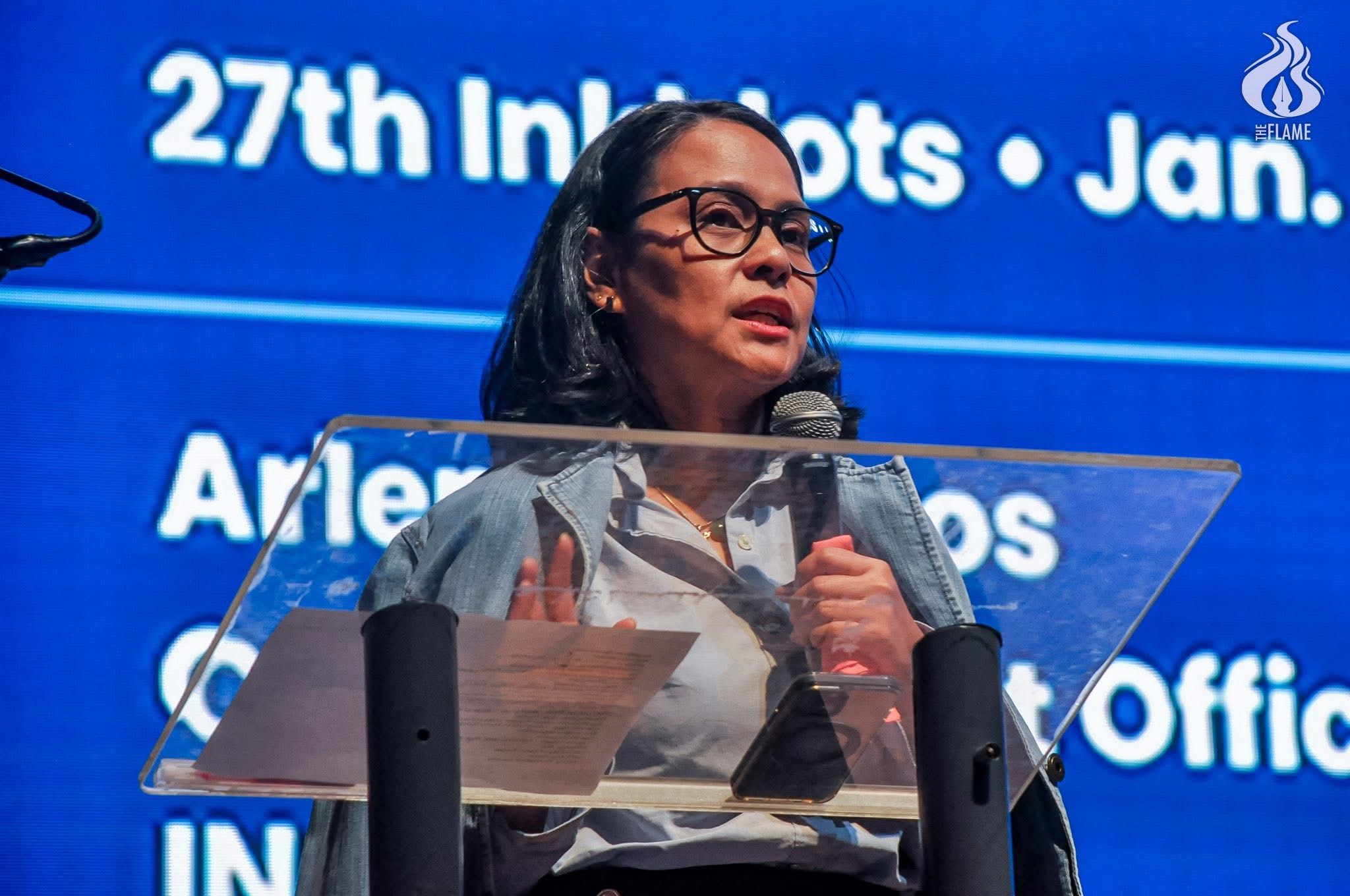
In her lecture during the first day of Inkblots 2026, Inquirer.net chief content officer and Artlets alumna Arlene Burgos said the deeds of school administrators recorded in their press releases should not be reported as fact but must be scrutinized by the campus press.
“Many campus papers get trapped covering only what they are invited to cover. The administration announces a new policy, sets up press releases, and the paper publishes it verbatim as fact. That has to stop,” Burgos said on Tuesday, Jan. 13.
“Those press releases are deeds. They are not the story. The real question is to find out. What problem prompted this? Who lobbied for it? Who will benefit and who will be hurt? What will it actually do?” she added.
According to Burgos, a Political Science graduate, student journalism is not merely “practice journalism,” as it can serve as a “real watchdog” that holds those in power accountable.
The veteran journalist cited the Martial Law era as an example when campus press became the voice of resistance as national media entities were censored.
“Student reporters documented extrajudicial killings, exposed government corruption, and gave voice to the voiceless. The campus press was not decorative. It was essential to fight for democracy,” she said.
Burgos said campus publications may be the “only force” in schools that can demand transparency from administrators about potentially harmful policies. Students and parents depend on these school-based media entities to “make sense of their own universities,” she added.
“Accountability is not about facts or sensationalism. It is about clarity. Who decided what, based on what information, with what consequences?” the veteran journalist said.
Karol Ilagan, investigative reporter and chair of the Journalism department of the University of the Philippines Diliman, echoed the view that campus papers must serve their communities as watchdogs.
“Campus journalism is never neutral. It’s not just a practice. When you write a story, you perform a service for a group of people, for a community, and for a certain purpose,” Ilagan said in a separate lecture during the event.
Unlike mainstream media, campus journalists are challenged by their proximity to the people they cover, making accountability feel more “personal,” she added.
“The more you know can be uncomfortable, when the subject might be an administrator or a professor who knows your name. If anything, this is supposed to force ethical clarity,” the journalism educator said.
Carrying the theme “The Campus Press and the Fight for Public Accountability,” the 27th Inkblots will be held until Jan. 14 at the Saint Pier Giorgio Frassati, O.P. building auditorium.
The campus journalism fellowship, organized by the UST student publication The Varsitarian, was attended by about 20 campus publications nationwide. F – with reports from Charisse Tapawan