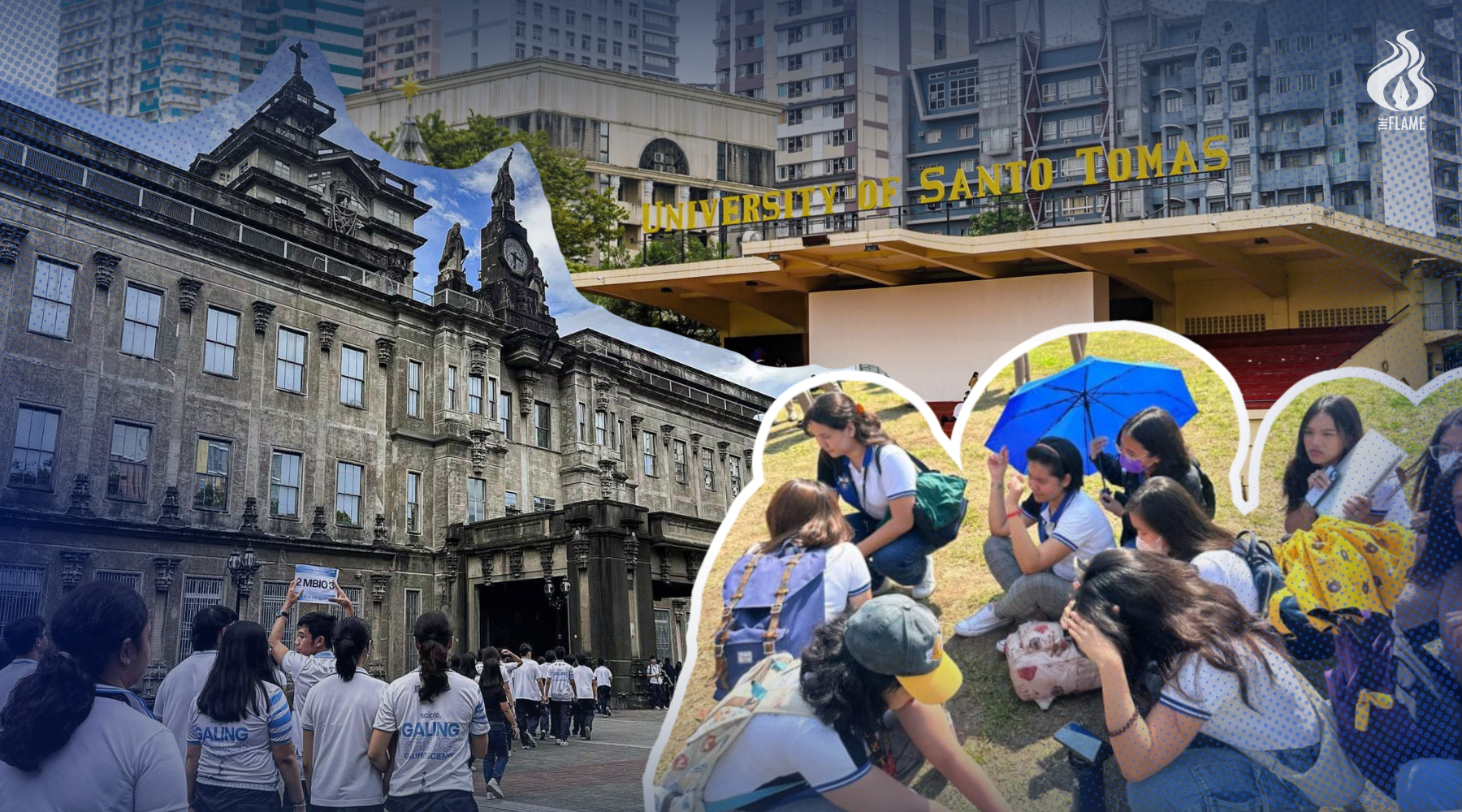
THE UNIVERSITY of Santo Tomas is planning to hold a campus-wide earthquake drill that includes the UST Hospital as part of its preparations for “The Big One,” a catastrophic earthquake that may hit Metro Manila.
Following the completion of various disaster readiness drills for UST’s individual academic units, preparations are now underway for a campus-wide earthquake drill along with updated instructional materials and videos, according to the Facilities Management Office (FMO).
“We are still preparing for that (Big One) because we are not yet done with the university-wide earthquake drill but we are preparing…what we are gearing towards is the earthquake drill for the whole university. We are getting there,” FMO director Fr. Dexter Austria, O.P. told The Flame.
“The hospital, of course, there would be ambulatory [patients], those in emergency, in the ICU (intensive care unit). I think they have a whole activity for the earthquake drill, but we make sure that whenever we have our University drill, earthquake drill, they (patients) need to be included as well,” Austria added.
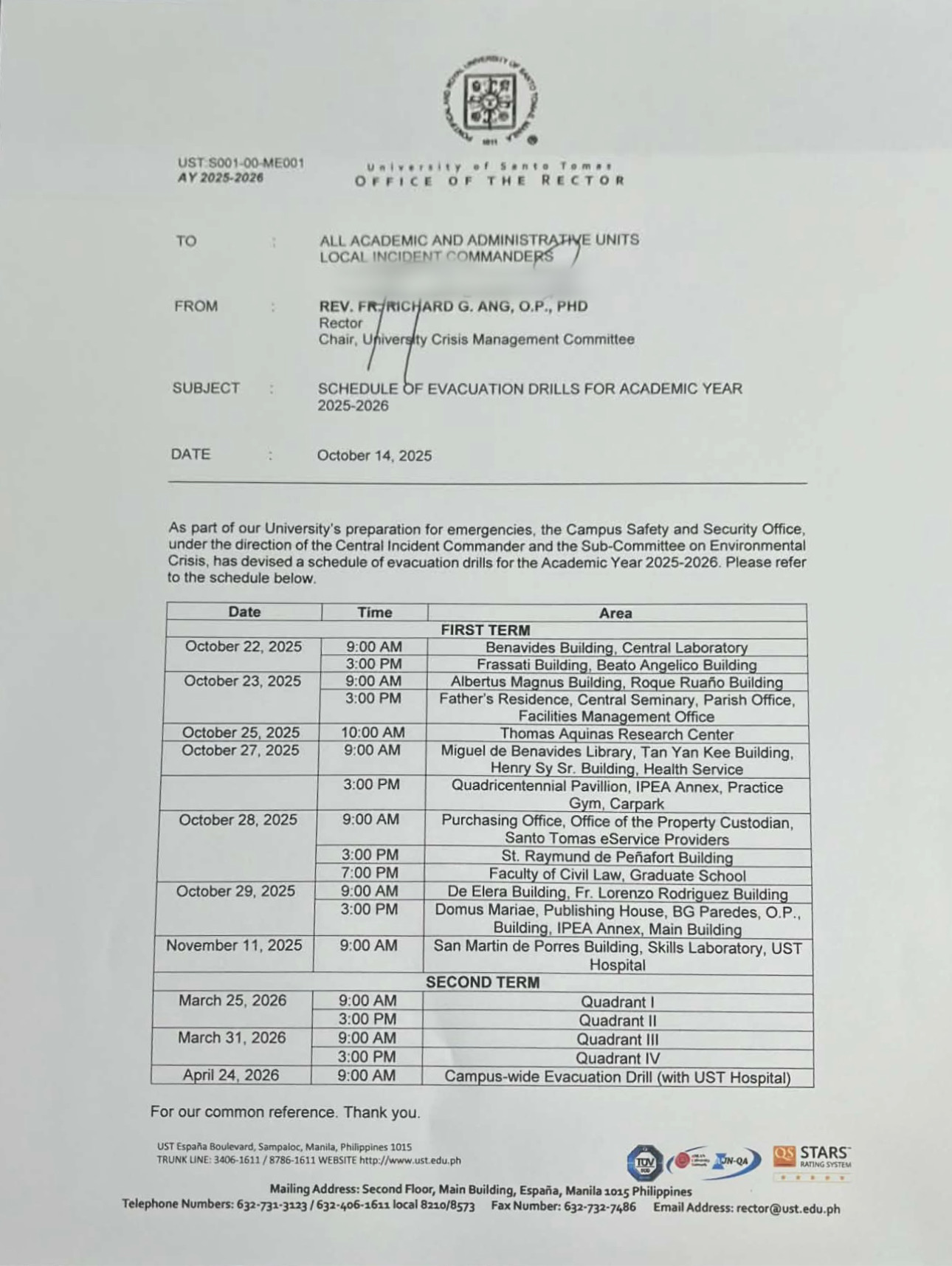
The University previously announced a series of earthquake drills for the second semester through a memorandum dated Oct. 14, with quadrants I and II scheduled for March 25, quadrants III and IV on March 31, and a campus-wide evacuation with UST hospital on April 24.
Last term, the University already conducted preparatory activities for each unit and program as part of its ongoing disaster-readiness initiatives. These included evacuation drills for students, faculty members and personnel, as well as live broadcasts of safety reminders in the campus.
The FMO director said these broadcasts are set at 3 p.m. as “constant” reminders for Thomasians. This comes with plans of releasing updated instructional materials, including evacuation videos, for students’ locations in the field, Austria added.
The schedule for the upcoming drills would still depend on class suspensions and other academic disruptions, according to Campus Safety and Security director Assoc. Prof. Juliano Parena, Jr.
Parena said the University’s earthquake preparedness efforts this term are focused on expanding from specific colleges to quadrant-based evacuations involving multiple academic units at once.
“We’re trying to see if you would fit on the quadrant assignments and if everybody knows where to go. The majority of the drills that we had in the first semester were to see if we would be able to see the proper response coming from our students, which is that at the time you feel the earth shaking, you should be doing the duck, cover, and hold,” Parena told The Flame.
He added that special drills are also being planned for faculties with night schedules, including the Faculty of Civil Law and Graduate School.
All quadrants would occupy the UST Field, while the hospital will evacuate to the Plaza Mayor and possibly Lacson Avenue, the campus security director said. Should the field be unavailable, other open spaces, such as the roadways, Quadricentennial Square and Benavides Park, will be considered alternatives.
Two-way radios
According to Parena, the University has also strengthened its communication system in preparation for disasters by establishing two-way radios. He added that through this, daily radio check-ins are conducted across offices from 8:15 a.m. and 3:15 p.m.
“Starting this academic year, our crisis communication lines are now in full swing via two-way radios,” he said.
“We don’t expect the cell sites to be there (if the Big One happens).”
The safety and security director also added that the University is building its emergency response by recruiting volunteer responders from faculty and support staff under the Volunteer Emergency Response Corps.
“You have [to invest in] the equipment. You need to also invest in manpower. And of course, the training. So we were already able to initially have five volunteers who are support staff. And then we will add more this year, we will train them again,” Parena said.
The training for volunteers in firefighting and disaster search and rescue would be in coordination with external agencies such as the Metropolitan Manila Development Authority, he added.
Ensuring compliance
Austria and Parena noted that a campus-wide evacuation requires additional planning, as safety measures can vary per building.
Austria said those farthest from the UST field, such as the UST Hospital, pose a challenge for the drills. He added that the Saint Pier Frassati building also demands more attention due to its higher number of floors. The 22-storey building, which houses the UST Senior High School and the College of Information and Computing Sciences, is located just outside the España campus.
Buildings with a “very dynamic” population like the UST library must also be considered, Parena said. He explained that unlike other buildings with rough population estimates, the number of people in the library varies throughout the day.
“And we are adjusting also as to how the security would respond to that kind of evacuation, because it depends on the buildings. But more importantly, we are able to see in the quadrant if there is enough space,” the safety chief said.
Student compliance, Parena said, is a continuing concern. During past drills, he said some students left the campus instead of reporting to designated evacuation areas. Such an act affects the headcounts and potentially puts search and rescue teams at risk, Parena added.
He admitted that there is always room for improvement in earthquake drill preparations, particularly in people’s mindset of a “false sense of security” regarding disasters.
“The mindset of people that ‘that would not happen’…We’re hoping that from what we’re doing, students would be able to understand that this is really something that you should take into consideration,” Parena said.
From Sept. 30 to Oct. 11, several earthquakes hit Cebu, Davao Oriental, La Union, Zambales and Surigao del Sur, prompting emergency responses across the country.
In a Facebook post by the Manila Public Information Office, Mayor Francisco “Isko” Domagoso urged schools, both public and private, to serve as evacuation centers and participate in earthquake drills in preparation for the Big One. F