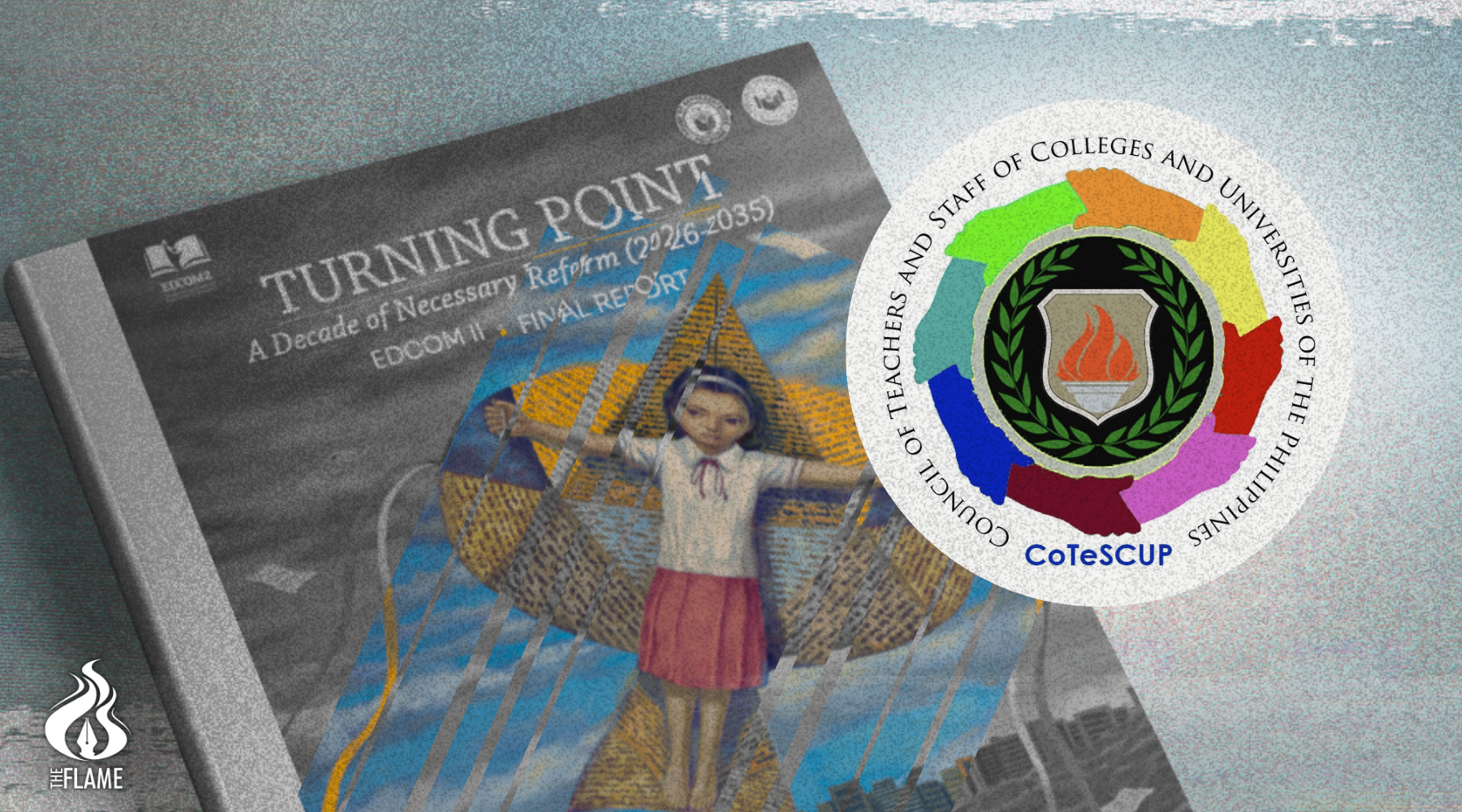
FACULTY UNIONS of private universities have criticized the Second Congressional Commission on Education’s (EDCOM II) final report for its supposed “omission” of the issues faced by workers of the sector.
In a statement, the Council of Teachers and Staff of Colleges and Universities of the Philippines (CoTeSCUP) called for the integration of labor justice in the country’s education system through consultations with teaching and non-teaching staff.
The omission of workers’ issues reflect a disconnect between reform discourse and social justice, the council added.
“Education reform that ignores labor justice weakens the very system it seeks to improve,” CoTeSCUP said on Saturday, Feb. 7.
“There can be no enduring improvement without decent work for education workers. Education reform and labor justice must advance together—or both will fail.”
The EDCOM II report, released on Jan. 26, is an evaluation of the country’s education system from 2023 to 2026 and contains a unified strategic plan to resolve the national learning crisis over the next decade.
The comprehensive report, formally dubbed as the National Education and Workforce Development Plan (2026-2035), was officially adopted by the Senate as the country’s policy framework for education reform on Tuesday, Feb. 3.
The coalition claimed that the report views teachers as “human capital to be deployed, trained and optimized,” rather than as professional laborers who require “dignity, security and voice.”
“The report names burnout but avoids overwork, notes attrition but avoids precarity, [and] highlights shortages without addressing why teachers leave or why there is an actual shortage,” the group added.
CoTeSCUP also called for coordination across unions in demanding a “worker-centered reform agenda,” which includes limits on teaching hours, improved employment security, abolition of abusive contractualization, mental health protections and faculty participation in decisions.
Headed by UST Philosophy Assoc. Prof. Rene Luis Tadle, CoTeSCUP represents 19 labor organizations of private universities in the country. The UST Faculty Union, through its president, Asst. Prof. Emerito Gonzales, is among the signatories of CoTeSCUP’s statement.
Accessing schools’ financial status
Prior to the issuance of the statement, labor groups highlighted the costs of requesting documents from the Securities and Exchange Commission (SEC), which help workers verify if private schools are fairly distributing tuition shares.
Responding to these concerns, Kamanggawa Partylist Rep. Elijah San Fernando announced that he is finalizing a House resolution to waive these costs, as they are shouldered by groups during collective bargaining agreement (CBA) talks with school administrators.
“I’m happy to report that this is ongoing in the legislative branch. We need to preempt the processes [that hinder] in requesting these documents,” San Fernando said during the inaugural National Consultation for Private Academic Schools on Jan. 24
According to the SEC, audited financial statements are only assessed based on page count, number of copies and authentication type. Its baseline service fee for an authenticated request is P1,252.35 as of February 2026.
For Tadle, San Fernando’s resolution is especially relevant as the expense can be “burdensome” for unions lacking sufficient funds.
“It’s P50 per page, and the FS (financial statement) could even be around [100] pages. Normally, we get three to four years of FS to better understand the school’s financial capacity. So, for a resource-challenged union, it’s burdensome,” he told The Flame.
The Rules of Senate require bills and joint resolutions to undergo three readings before they are considered laws. Only simple and concurrent resolutions, usually filed by representatives to express their opinion on an issue, are exempted because they do not have the force of law.
San Fernando said he would summon the SEC to a hearing at the House of Representatives to get the corporate regulator’s statement on the issue.
Tadle also claimed that some private schools withhold copies of their financial statements from unions, which he said causes longer negotiations and “unnecessary tension.”
“When unions try to secure audited financial statements from the SEC, they often discover that the school hasn’t even submitted its statements. And since the SEC simply allows late submission with a penalty, the school faces no real consequence for withholding information. This leaves unions negotiating in the dark,” the labor leader and educator said.
The resolution would promote transparent dialogue between the union members and the school administration, according to Tadle, who also expressed hope that San Fernando would include “real penalties” for refusing to provide financial statements to the commission.
Under SEC Memorandum Circular No. 4, of 2026, stock and non-stock corporations with total assets or liabilities over P3 million must submit their unaudited financial statements to the SEC.
UST Legazpi labor union secretary Glenn Balberan told The Flame that the University provides its financial statement to the group on time, as the members press school management for the document ahead of its given deadline.
“You have to be aggressive because if not, it would appear that you are not serious,” Balberan said.
“We cannot avoid the situation where they would not immediately give you because there is a process. They also have work that they must attend to.”
Labor disputes
The push for free access to financial statements came in the wake of tensions across various educational institutions over prolonged CBA disputes. Labor leaders claimed that a lack of transparency from institutions has led to “misunderstandings” of the law.
Tadle said poor monitoring and non-uniform implementation and interpretation of labor policies have left many workers in the dark.
“If these problems are happening within unionized schools, how much more for the majority of the schools that are not unionized,” he said.
“There’s a possibility that their rights or the share to them are not given to them for the simple reason that they don’t know.”
The labor group leader said these grievances have already triggered a wave of unrest among institutions such as UST, Silliman University, Centro Escolar University and University of the East Ramon Magsaysay Memorial Medical Center, which have recently faced notices of strike.
A notice of strike is filed with the labor department 30 days before a strike, which usually stems from deadlocks in CBA negotiations and other labor issues.
‘Delay in labor education’
Beyond financial disputes, the consultation also raised the four-year delay in implementing the Labor Education Act. Signed in 2021, the law aims to integrate labor rights into the tertiary and vocational curriculum.
However, it remains in limbo as the Department of Labor and Employment continues to coordinate with the Commission on Higher Education and the Technical Education and Skills Development Authority to finalize its implementing rules and regulations.
Bureau of Labor Relations Director Arturo Herbosa said equipping both students and teachers with a baseline understanding of labor rights is a “gateway to decent work.”
“The more you know your rights, the more you fight for them…“It’s [about] equipping our workers to exercise their rights freely and bargain collectively,” Herbosa said.
The National Consultation for Private Academic School Unions held from Jan. 23 to 24 at the University of the Philippines Diliman (UPD) was organized by CoTeSCUP, Federation of Workers and the UPD Center for Labor Justice. F