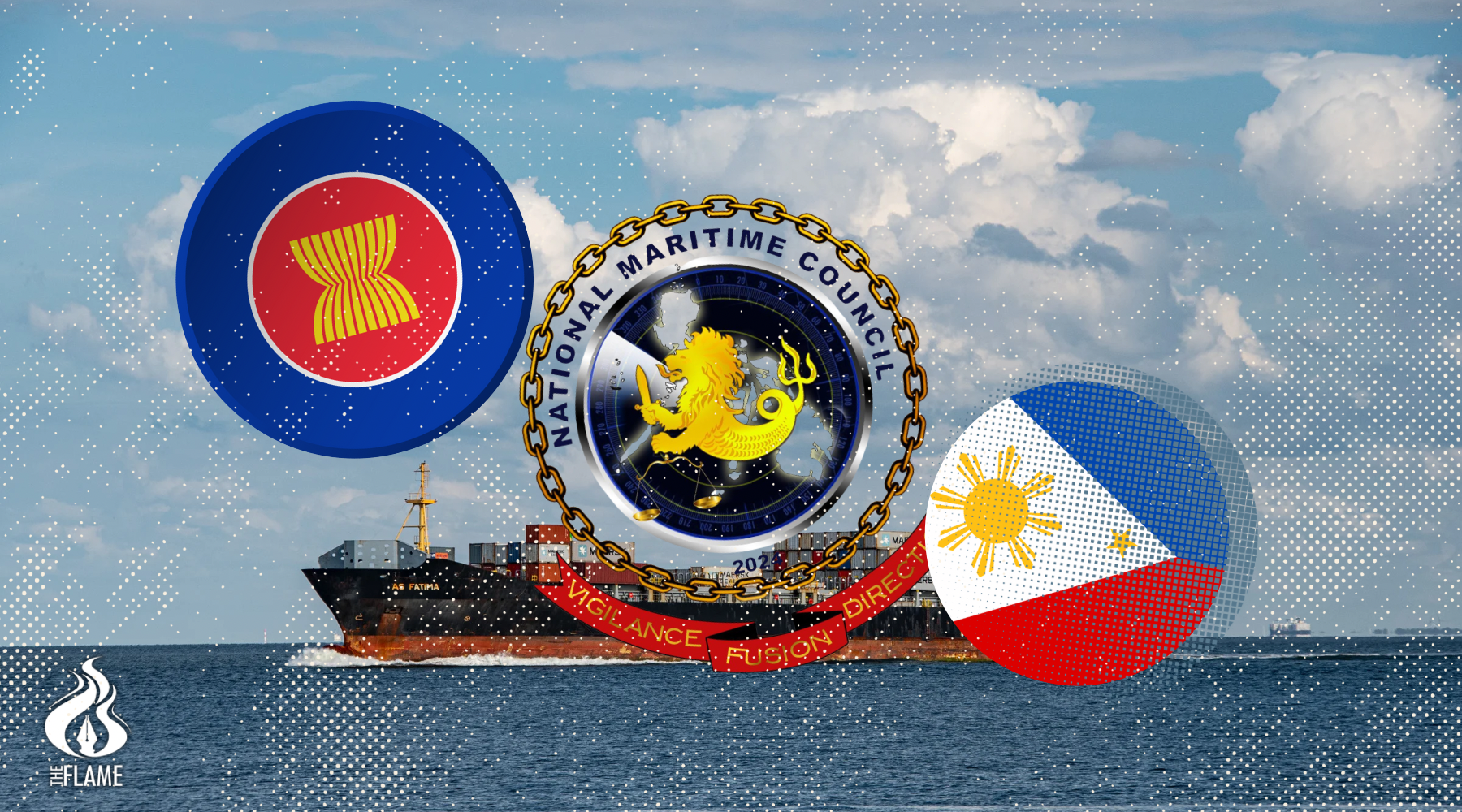
MARITIME COOPERATION will be the meeting place of the Philippines’ priorities as chairman of this year’s Association of Southeast Asian Nations (ASEAN) Summit, an official said.
National Maritime Council spokesman Undersecretary Alexander Lopez said peace and security anchors, prosperity corridors and people empowerment would be the key priorities of the Philippines in the regional meet, which is expected to tackle vital issues, including the South China Sea row.
“This year, the Philippines, assuming the chairship of the ASEAN Summit, organizes its work around three priorities. First, peace and security anchors. Second, prosperity corridors. And third, people empowerment. Maritime cooperation is where these three priorities meet in real life,” Lopez said during the UST Model ASEAN Meeting plenary session on Thursday, Feb. 19.
According to Lopez, crises at sea do not begin with declarations of conflict, but with uncertainty, dangerous maneuvers or absence of communication
“Consensus may be slow, but it is also the reason why ASEAN decisions endure. Our shared seas can easily become places where mistrust grows” the official said.
“Peace depends on predictability or restraint. It depends on rules, communication or constant dialogue and professional conduct or behavior.”
Four ASEAN members, namely Vietnam, Malaysia, Brunei and the Philippines are claimants in the maritime dispute over the South China Sea, a vital sea route where more than $5-trillion in goods pass through each year.
Other parties in the maritime row are Taiwan and China, whose claim covers practically the entire area, but has been voided by an international arbitral court in 2016.
However, China refused to recognize the ruling and Chinese ships continue to harass Filipino vessels in the South China Sea, including in parts that are within the Philippines’ exclusive economic zone.
Lopez affirmed the role of ASEAN, which operates on consensus, in a polarized scene of global politics.
“Even when disagreements or tensions are high, even when domestic potencies are loud and demand strong rhetoric, and even when compromise is uncontrollable and views differ sharply, despite these events, ASEAN stays at the table,” he said.
Lopez, a retired Navy official, said that while the youth may not avoid tensions in the future, escalations could be avoided through diplomatic language.
“While it’s (AI) not explicitly mentioned in the theme, and also in the three Ps, the prosperity corridors, the people empowerment, and of course the peace and security anchors, but it’s embedded there,” Imperial said.
“The reason why artificial intelligence does not have its own, because it’s cross-party, it can be in all three groups. And that’s actually the point of highlighting artificial intelligence in this chairship.”
The UST Model ASEAN Meeting is a three-day simulation held from Feb. 19 to 21. The event carried the theme “United in Continuity: Driving Innovative Solutions for Regional Stability towards a Prosperous and People-Centered ASEAN.” F