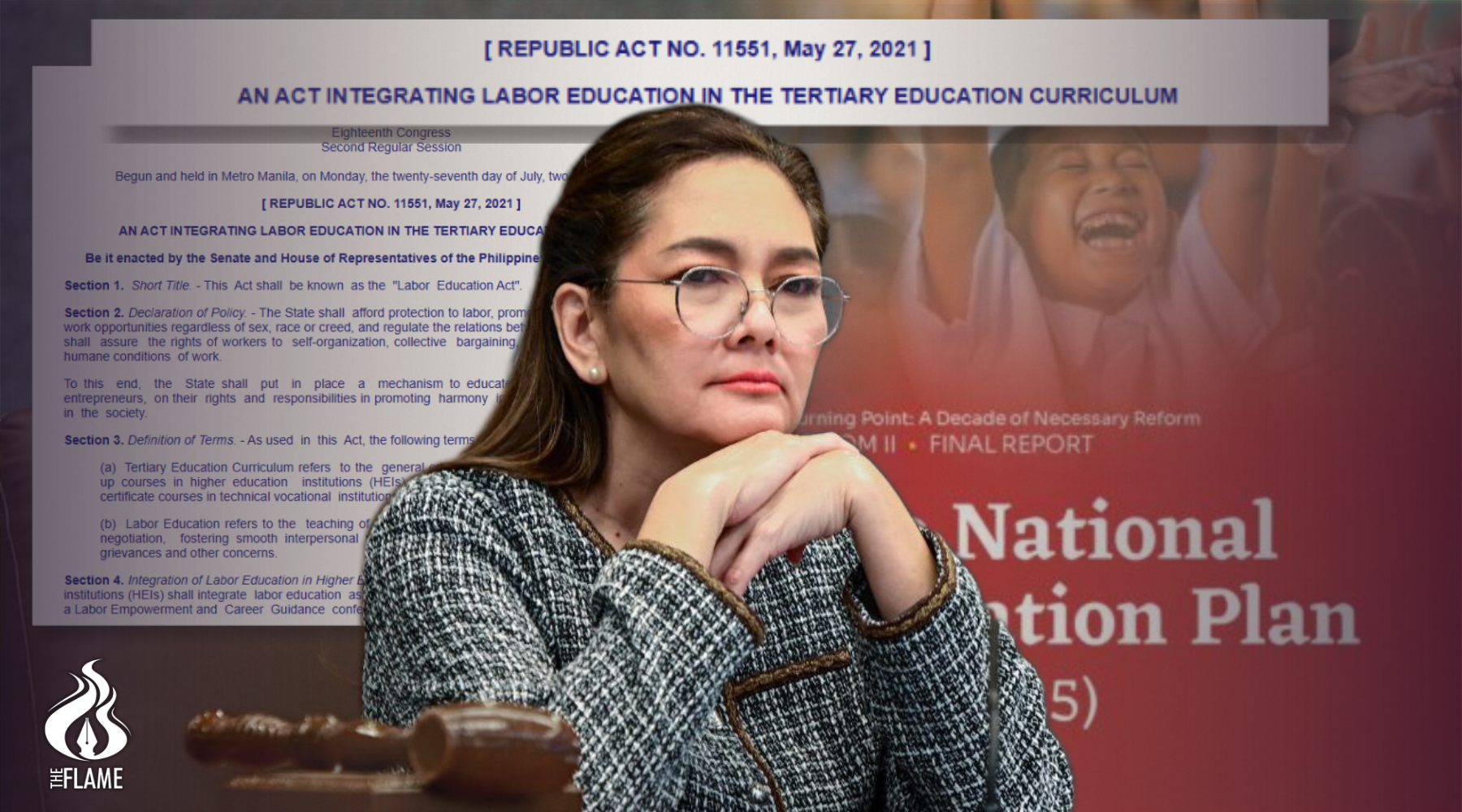
SEN. RISA Hontiveros called for the inclusion of labor education in universities, saying it is needed for employees to understand and defend their rights in the workplace.
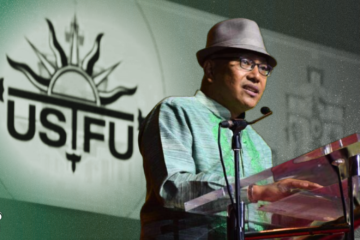
During the UST Faculty Union general assembly on Friday, March 13, Hontiveros said labor education should be mainstreamed in the tertiary curriculum and should form part of civics and foundational knowledge for all workers.
“It is important because from basic education in Social Studies up to college, everyone becomes a working person. Whatever career or profession we enter, public service or private sector, we need to understand and defend our rights in the workplace,” she said.
Hontiveros made the statement during a discussion about the status of the implementing guidelines for Republic Act 11551 or the Labor Education Act.
The matter was previously raised in the first National Consultation for Private Academic School Unions held last January, where Bureau of Labor Relations Director Arturo Herbosa said a baseline understanding of workers’ rights leads to a “gateway to decent work.”
READ: EDCOM II education reform lacks ‘labor justice’ — faculty group
The law, signed in 2021, intends to integrate labor rights into the tertiary and vocational curriculum.
However, the law has yet to be fully implemented in Philippine universities as the labor department continues to coordinate with the Commission on Higher Education and the Technical Education and Skills Development Authority to finalize the law’s enforcement.
Hontiveros said she would review the matter with the legislative branch.
Education a ‘field of struggle’
According to Hontiveros, education must be seen as a “field of struggle” that advances reforms, modernization and institutional improvement over the next decade.
She said the proposed plan of the Second Congressional Commission on Education (EDCOM II) recognized the country’s education system as a crucial space for pushing reforms in the next 10 years.
“With the passing of EDCOM II, the national education plan they proposed for the next decade at least acknowledges that our education system is also a field of struggle, a field for advancing reform, a field for modernization, a field for improving a very important institution for the country,” she said.
“I am with you in ensuring that these themes are not lost, but instead become an important part of the process of reforming our education system.”
EDCOM II, through its national education plan, aims to restructure the country’s education system into an “integrated, responsive and data-driven” framework by 2035.
The 2026-2035 National Education Plan names the following as its key priority areas: supporting early childhood development; developing the functional literacy of early learners; developing critical thinking, digital skills and graduate readiness; promoting inclusive learning; improving access to quality education; and enhancing governance and resource allocation in the sector.
Hontiveros also called for the preservation of Philippine arts and culture alongside these reforms, which she said would ensure the representation of teachers.
“Strengthening and enriching our educational system is an important part of our Filipino identity…Not just the subject matters, but also the themes within education, are very important and should not be lost. The Philippine arts and cultures are the root of our identity as Filipinos,” Hontiveros added.
Workers’ participation needed
Sonny Matula, president of the Federation of Free Workers (FFW), urged union members to actively participate in discussions, saying such an engagement ensures their voices are heard in leading initiatives.
“We encourage each member of the union to join discussions and choose solutions that align with the realities of every worker. I think this will help the members to strengthen the union, and not everything can be achieved through ordinary dreams,” Matula said.
The FFW president raised the importance of seeing a union as a “school of democracy” and a “market of ideas,” where differing viewpoints should be resolved through deliberations.
“It is healthy to have debate and discussion, and we should not allow our suggestions, discussions or differences to result in division or the weakening of our own union,” he said. F