
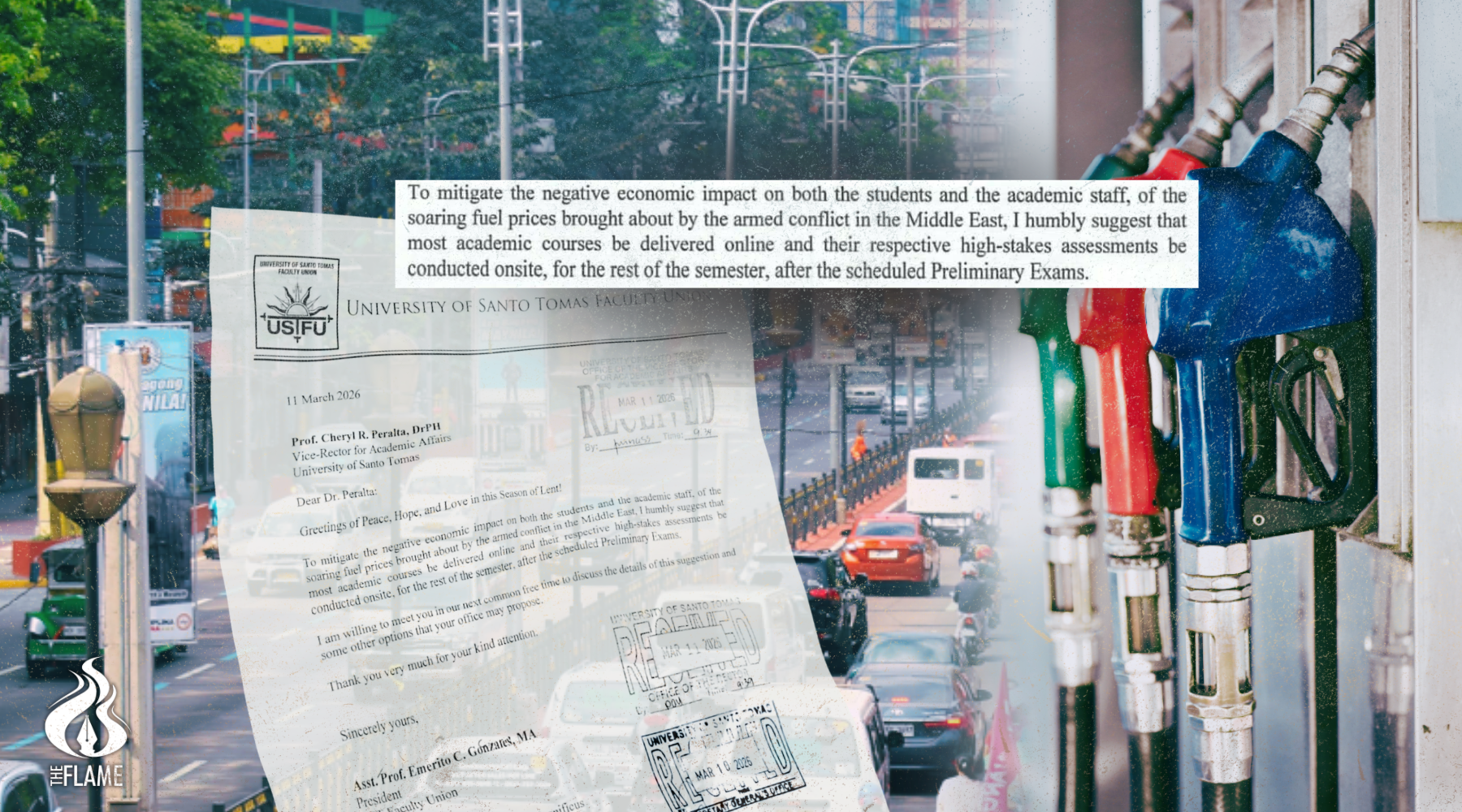
THE UST Faculty Union (USTFU) president has urged the administration to shift course lectures online following the surge in oil prices triggered by the ongoing conflict in the Middle East.
In a letter to Vice Rector for Academic Affairs (OVRAA) Prof. Cheryl Peralta, USTFU head Asst. Prof. Emerito Gonzales proposed delivering most courses online while requiring high-stakes assessments to be conducted onsite.
The president said the measure would help ease the financial strain caused by rising fuel costs on students and faculty members.
“To mitigate the negative economic impact on both the students and the academic staff of the soaring fuel prices brought about by the armed conflict in the Middle East, I humbly suggest that most academic sources be delivered online and their respective high-stakes assessments be conducted online, for the rest of the semester, after the scheduled Preliminary Exams,” the letter, signed by USTFU President Asst. Prof. Emerito Gonzales, read.
Energy Secretary Sharon Garin previously said prices may post their “highest jump” this week, with increases reaching as much as P24 per liter due to supply concerns tied to the ongoing conflict in the Middle East.
Garin added that oil firms had agreed to implement staggered increases over several days instead of a single large adjustment to cushion the impact of the price hikes on consumers.
According to Gonzales, he is open to discussing the proposal, as well as other possible arrangements, with the University administration.
UST currently implements a hybrid learning modality for all its academic units, with the Faculty of Arts letters following a 70:30 onsite to online ratio per course.
READ: AB to adopt 2:1 onsite-online class hour ratio per course
The setup was implemented permanently in UST by the OVRAA to “maximize” the use of technology in education.
READ: (UPDATED) Hybrid learning to be a permanent set-up in UST, says academic affairs chief
The last time the majority of lectures were delivered online was in the academic year 2022-2023, when the University was transitioning from a fully virtual setup due to the COVID-19 pandemic. F





[…] READ: UST Faculty Union head calls for online classes as fuel prices surge […]