AFTER ONE of UST’s publication materials on Facebook was swarmed with accusations of being generated by artificial intelligence (AI), a University official vowed to involve more creative professionals and students in its processes, which he clarified is still largely “human-led.”
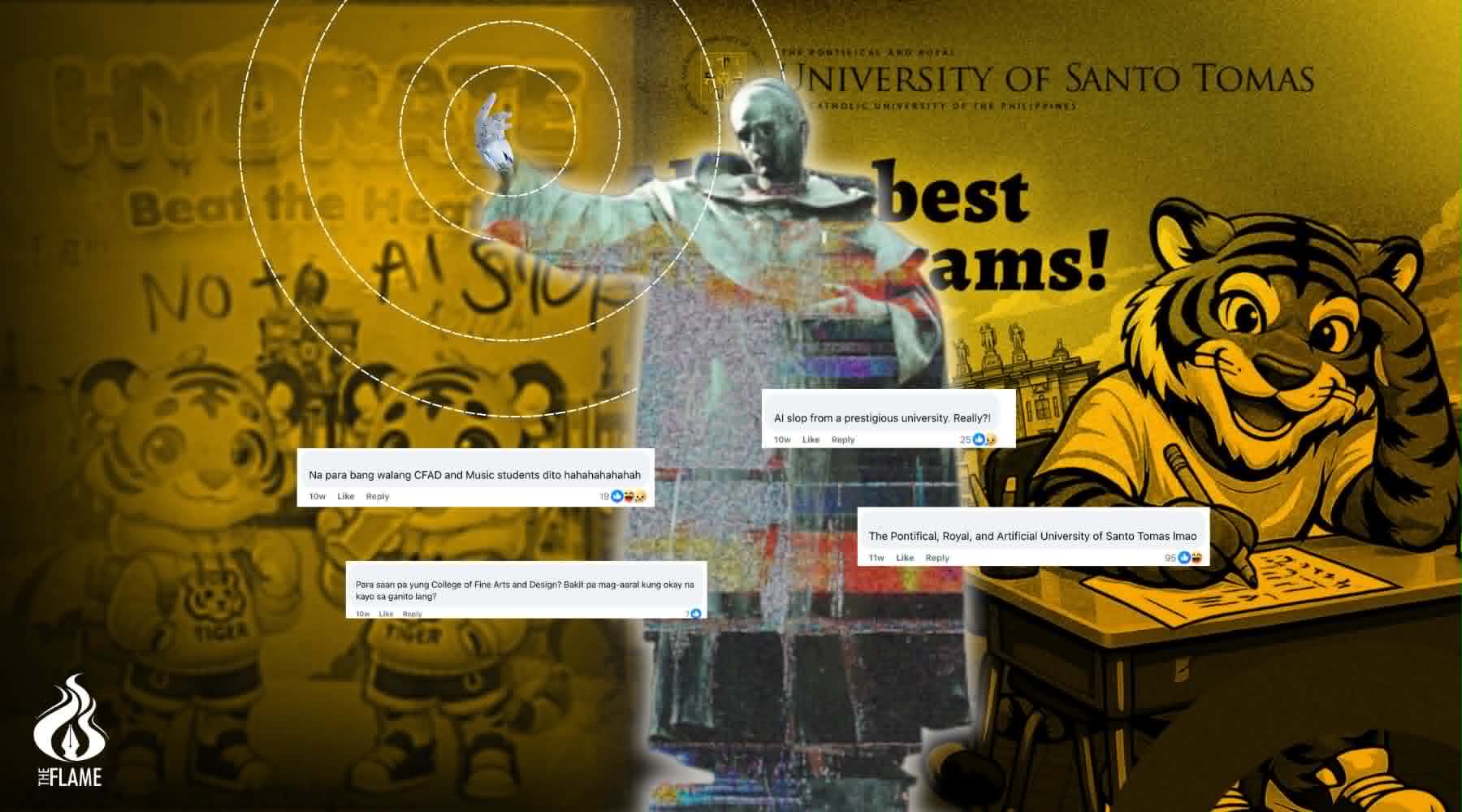
The image, which depicts a tiger taking an examination in front of the UST main building, has garnered over 3,500 likes, 584 shares,and 98 comments as of June 4.
However, the post gained traction for the wrong reasons as several Thomasians and other social media users expressed disappointment over what they deemed an “AI slop.”
The Communications Bureau (CB), which handles the University’s social media presence, said the use of digital tools such as AI is still part of a broader “human-led process of conceptualization, review and approval.”
“Digital tools, including emerging AI-assisted platforms, may be used in contemporary communication work, but these are never intended to replace human judgment, artistic discernment or institutional accountability,” CB director Philippe Hernandez told The Flame.
“Moving forward, the University remains open to strengthening initiatives that involve students, academic units, and creative professionals in the development of publication and communication materials,” he added.
Other comments under the post also pointed to the University’s own College of Fine Arts and Design (CFAD) and questioned why UST supposedly opted for AI over its own student-artists.
“I get that AI makes work be done a lot quicker, but it lacks meaning and intention that art created by humans has,” Deanne Bantigue, a recent CFAD graduate told The Flame.
Meanwhile, a widely circulated post on a Reddit forum for Thomasians have raised concern about the use of alleged AI-generated posters in University spaces, with many other users calling the practice “disrespectful.”
Located near water fountains across campus, the posters showing two tigers in front of the main building drinking water with the heading “Hydrate, beat the heat,” have been vandalized with the phrase “No to AI slop.”
Responding to these concerns, Hernandez said the use of AI was not intended to disrespect the “rich, creative talent” of Thomasians. He said the criticisms are a helpful reminder that AI must always “serve, not sideline” the person, citing Pope Leo XIV’s first encyclical on the technology and its implications on human dignity.
“For a Catholic university such as UST, this means that technology must be used with prudence, transparency, creativity, and respect for human dignity,” the University official said.
On the criticism that AI use may be sidelining student creatives, despite the existence of its own art college, Hernandez acknowledged it as “a valid point for continuing reflection,” adding that responsible use of technology requires “clear ethical discernment” in an institution whose mission includes formation and creativity.
“The final responsibility for any official material remains with the University and its duly designated offices… The use of AI or AI-assisted tools, when employed, should be understood as part of a broader creative and editorial process. It is not meant to diminish the contribution of artists,” he said.
The CB said it welcomes constructive feedback from the Thomasian community and vowed to involve more stakeholders to improve the quality of its outputs. F