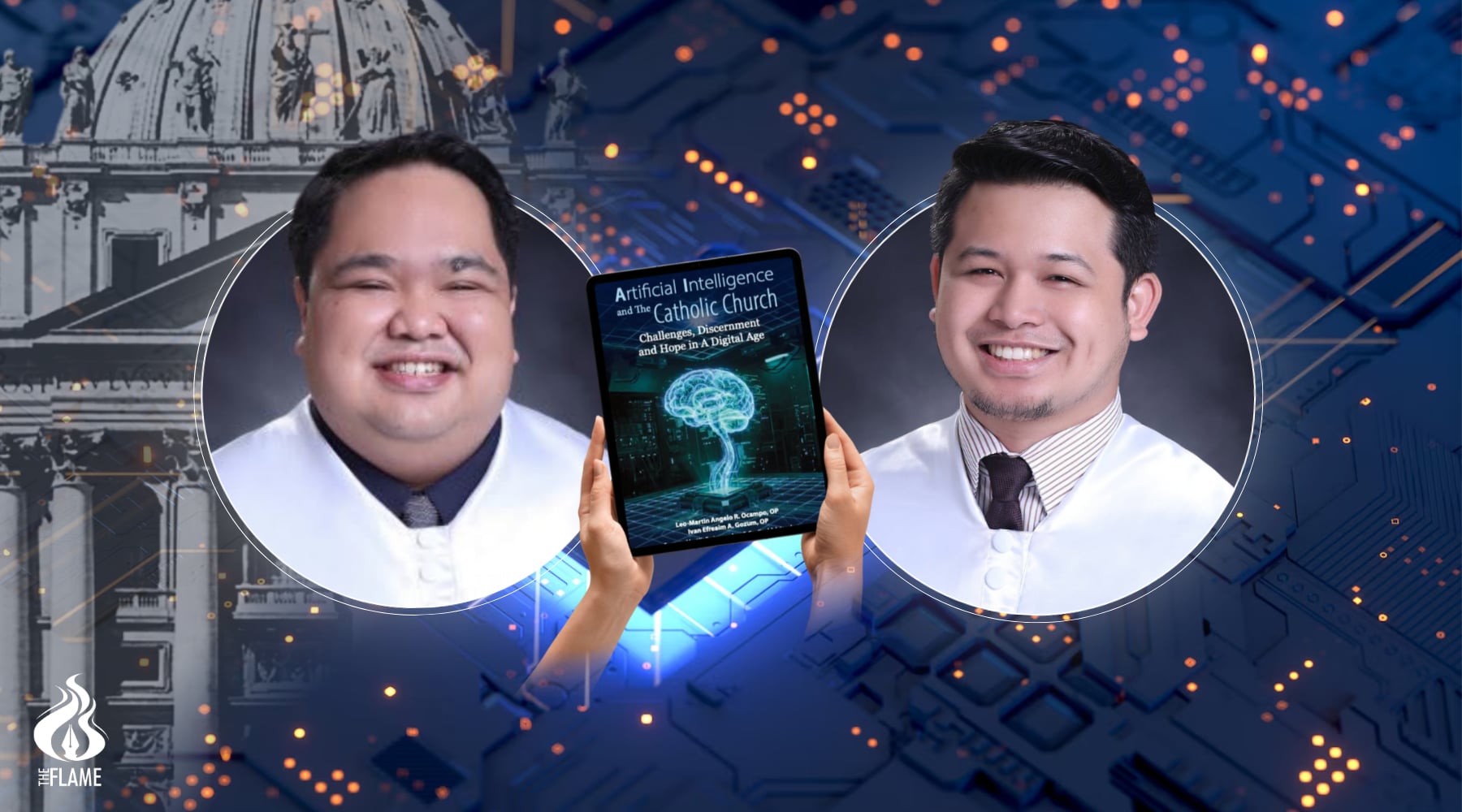
TWO RESEARCHERS from the UST Institute of Religion will publish a new book examining the implications of artificial intelligence (AI) in the Catholic Church, particularly in religious education, pastoral ministry and evangelization.
The book titled “Artificial Intelligence and the Catholic Church: Challenges, Discernment and Hope in a Digital Age,” written by Asst. Prof. Leo-Martin Angelo Ocampo and theology instructor Ivan Efreaim Gozum, explores the opportunities and challenges that the technology presents to Catholicism.
It will be officially launched on Sept. 9, 1 p.m., during the Manila International Book Fair at the SMX Convention Center in Pasay City.
Gozum said that their inspiration for writing the book stems from the Church’s need to respond to AI as it becomes increasingly evident in society.
“I see AI as an important question for the Church today because it is no longer simply a future possibility but a reality being presented to us now,” Gozum told The Flame.
Several concerns surrounding AI were identified in the book, such as bias, manipulation, worsening inequality, environmental effects and its use in warfare.
Gozum also cited society’s growing reliance on generative AI, possible job displacement and the technology’s demand for energy and resources as issues that required greater attention from the Church.
Ocampo added that the book echoes Pope Leo XIV’s recent encyclical, which identified AI as one of the chief concerns of the society.
“In this book, we are one with the Pope in calling for the protection of human dignity and the promotion of discernment in the use and development of AI,” he said.
In his encyclical Magnifica Humanitas, the Pope called on the Church to safeguard human dignity by practicing responsible governance and oversight of AI, reminding Catholics that human intelligence, conscience and freedom remain at the center of technological development.
Rather than simply embracing or rejecting AI, Ocampo and Gozum emphasized in their book the need to discern how the technology is developed, governed and used, while upholding human relationships and responsibility.
Gozum said the Church must examine not only what AI can do but also what kind of society is being created when efficiency and technological capability are prioritized over human dignity, meaningful work, solidarity and the common good.
Gozum said the book can provide spaces for theologians, educators, scientists, technology experts, pastoral workers and young people to discuss the implications of AI on human life and the mission of the Church. He added that responsible AI requires not only rules for technology but also the formation of people capable of exercising wisdom, conscience and responsibility.
“For me, this is one of the Church’s important contributions in the age of AI: helping people remember who they are, what they are called to become, and how technological development can remain oriented toward human flourishing and the care of creation,” Gozum said.
Ocampo expressed hoped that the book would equip Church leaders with an intelligent overview on the moral and ethical discussions of AI usage and empower them to take part in the ongoing discussions about the issue.
“Having a good intention and correct disposition will guide our discernment as well as our decisions as to when and how to use AI wisely,” he said.
Ocampo is a research associate at UST’s Research Center for Theology, Religious Studies and Ethics who focuses on digital evangelization and religious education. Gozum has published research on AI ethics, particularly its applications in healthcare. The two scholars previously co-authored a study on AI’s intersection with Catholic higher education, comparing UNESCO guidelines with Catholic Church teachings. F