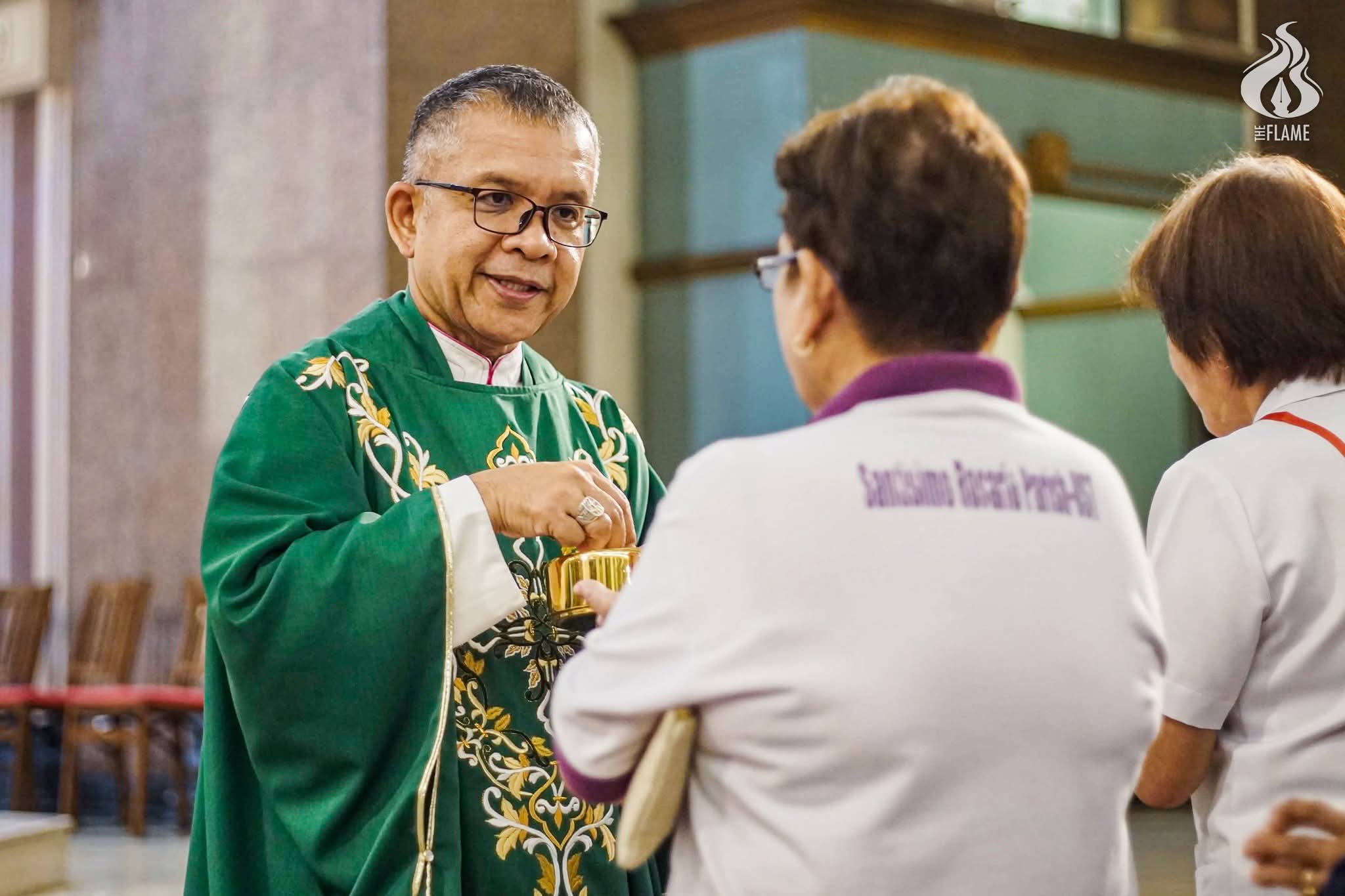
CATHOLICS MUST not yield to fear and anxiety when facing the country’s “ecological crisis” and should take concrete action to protect creation and communities threatened by environmental destruction, a bishop said.
“The Christian response to [the] crisis is neither denial nor hopelessness. Christians today are called to move beyond fear, to move beyond anxiety, toward responsible action,” Diocese of Calapan Bishop Moises Cuevas said on Friday, Sept. 4.
During the University’s celebration for the care of creation, Cuevas told Thomasians that their fears cannot heal damaged ecosystems, protect vulnerable communities or secure a sustainable future.
Cuevas said fear can overwhelm people in times of crisis like in the story where Jesus and the disciples braved storms at the sea, but faith must remain greater than their fears.
“Faith that inspires commitment. Faith that leads us to go beyond and persevere. Faith that is a willingness to work for the common good even when the challenges appear overwhelming,” he added.
The bishop also raised concerns over four environmental issues, namely the proposed Pax Silica project, fossil gas expansion in the Verde Island Passage, critical-mineral extraction amid the global energy transition, and alleged irregularities in flood-control projects.
On Pax Silica, Cuevas urged authorities to consider the communities that could be affected by development projects involving watersheds, agricultural lands, coastal ecosystems, and indigenous people’s livelihoods.
“Communities, [as] we know it, [are] not obstacles to progress. They are often the first to understand the value of the places that sustain life,” he said.
The prelate also warned against the fossil gas development in the Verde Island Passage, which he described as a place of extraordinary ecological richness and global significance.
“The challenge before us is not simply how to secure energy for today, but how to protect the integrity of creation and safeguard the well-being of present and future generations whose lives are inseparably linked to the sea,” Cuevas said.
Cuevas said this understanding reflected the worldview of the indigenous folk he encountered as the chairperson of the Catholic Bishops’ Conference of the Philippines’ Episcopal Commission on Indigenous Peoples.
“The indigenous peoples regard nature as sacred, belonging ultimately to God and therefore deserving of reverence, respect, and care rather than exploitation,” he said.
Citing Pope Francis’ Laudato Si, Cuevas reminded the faithful that caring for creation is not an optional part of Christian life but a fundamental responsibility.
“In a world that often treats nature merely as a resource to be extracted, bought, sold, and consumed, the Gospel reminds us that creation ultimately belongs to God,” he said.
“The sea does not belong to us. The forests do not belong to us. Rivers, mountains, watersheds, coastlines, and oceans are not merely economic assets. They are part of God’s creation and remain under His sovereignty.”
Reflecting on the 2026 Season of Creation’s theme “Immersion in Living Water,” Cuevas urged the faithful to recognize water not merely as a resource but as a gift from God that sustains life and communities.
The bishop also noted that polluted rivers, damaged watersheds, degraded marine ecosystems, and destructive floods show the urgency of protecting the country’s water sources and ecosystems.
Water also helps citizens reflect over the failed flood-control projects intended to protect communities, Cuevas said, criticizing how the irregularities and improper use of public funds left communities vulnerable while they suffer from constant flooding.
“When projects intended to protect people fail because of corruption, poor implementation, or misuse of public funds, the suffering becomes more painful… Stewardship therefore requires not only environmental care but also honesty. It requires accountability and integrity in public service,” he added.
Cuevas urged Catholics to let their faith lead them toward responsible action and perseverance in working for the common good, even when environmental challenges appear overwhelming.
“The ecological storms of our time, therefore, call us not only to be aware, but it calls us for moral courage, public responsibility, and a renewed commitment to protect the gift of creation entrusted to our care,” he said.
The bishop also cautioned that the global transition toward renewable energy must not create new forms of environmental harm, adding that the global pursuit of environmental solutions “cannot justify environmental harm at the local level.”
“The transition to a greener future must also be guided by justice and respect for human dignity. Otherwise, same, same. It’s like one form of ecological harm merely replaces another in the name of renewable energy,” he added.
Cuevas encouraged Catholics to practice “ecological conversion” by protecting water sources, defending ecosystems, supporting sustainable livelihoods, and standing with communities whose lives and resources are threatened.
“We are called to be witnesses of hope by promoting ecological conversion. This is what we truly need: ecological conversion, responsible stewardship, and solidarity with the poor,” the prelate said.
The mass marked the beginning of the 2026 Season of Creation, a period in which the Church calls the faithful to deepen their care for creation and reflect on humanity’s responsibility toward the natural world. F