WHEN HE was 15 years old in 2015, Christian Ang participated in Masses celebrated in Davao de Oro as an altar server.
Being active in Church activities is something expected of someone who grew up in a predominantly Catholic environment.
However, Ang felt that the rituals of the hour-long Mass were not helping him strengthen his faith. He became convinced that he could find spiritual fulfillment somewhere else.
In his search for religious meaning, he scoured the internet and stumbled upon the traditional Latin Mass—a ritual he now views as an “ideal version” of his faith.
Ang attended his first Latin Mass in Cebu in 2016 and joined the monthly liturgical celebrations of the Latin Mass Society in Davao. After the group was dissolved, Ang found himself participating in Latin Masses celebrated by the Society of Saint Pius X (SSPX) priory also in Davao.
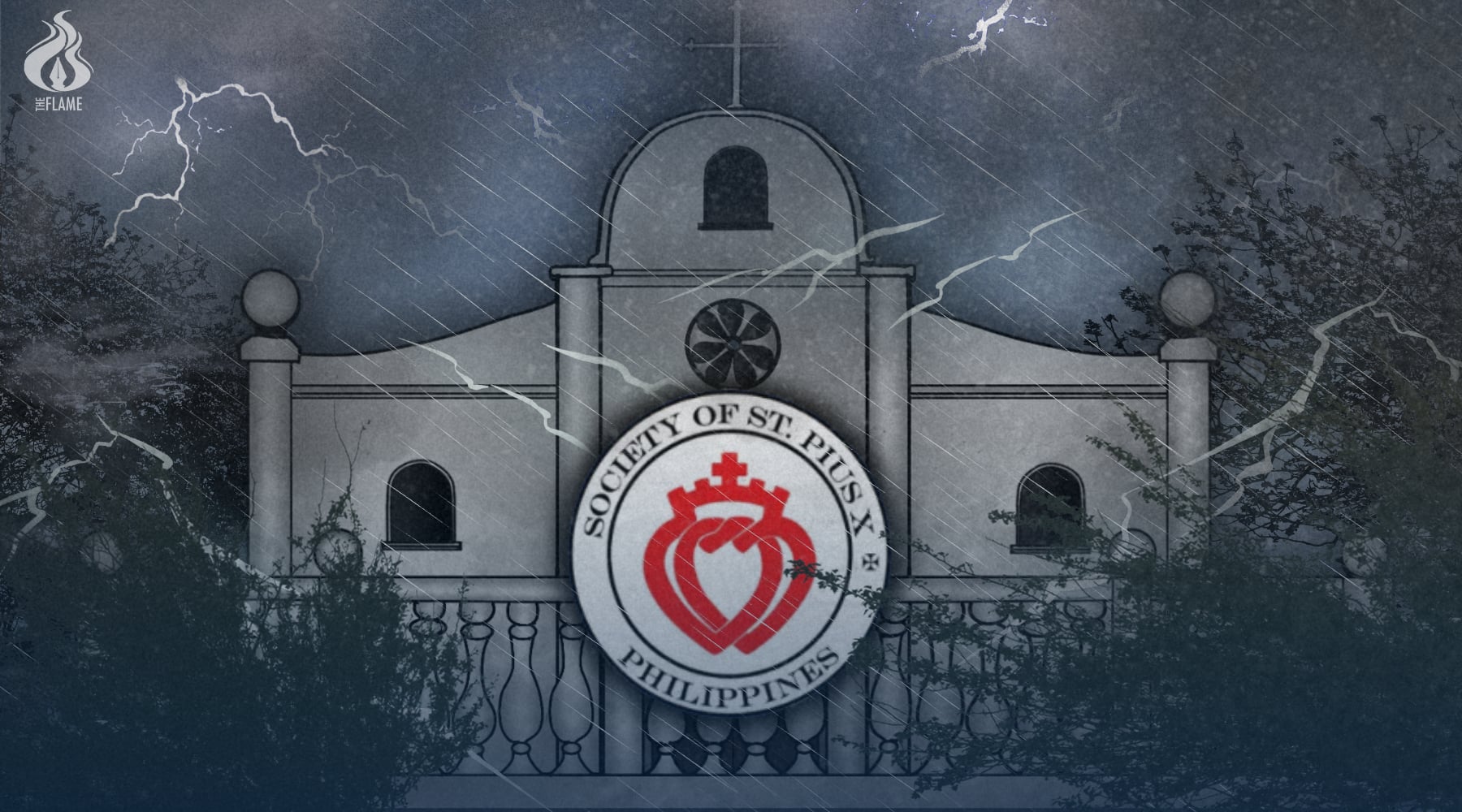
The SSPX is a traditionalist group founded by Archbishop Marcel Lefebvre in Switzerland in 1970. It claims to have around 600,000 members worldwide.
The group, which aims to form “holy and well-instructed” priests, rejected the ideals and reforms introduced by the Second Vatican Council or Vatican II in 1962, including interfaith dialogue, religious freedom and the use of local vernacular languages in Masses.
The SSPX’s practice of traditional spirituality includes the holding of the Tridentine Mass, most notable for priests celebrating the liturgy in Latin while facing the altar and communion strictly received through the tongue while kneeling. In its website, the group enumerated 26 chapels and missions in the Philippines, whose population is about 80% Catholic.
Data cited by the Associated Press state that the SSPX has six bishops, 751 priests, 264 seminarians training in five seminaries, 145 religious brothers, 88 oblates and 250 religious sisters representing 50 nationalities.
Through the SSPX, Ang deepened his faith’s foundation. Attracted by the group’s dedication to novena and adoration, he carried this devotion all the way to Manila, where he studied college.
However, his beliefs were challenged when the Vatican declared the SSPX in schism with the Catholic Church last July 2. The Church defines schism as the refusal of submission to the pope or of communion with the members of the Church subject to him.
The declaration was announced through a decree released by the Dicastery for the Doctrine of the Faith, which cited the group’s ordination of four bishops without the pope’s consent.
According to the Code of Canon Law, the ordination of bishops is only valid once endorsed by the Apostolic See or appointed by the pope. The ecclesiastical law also states that disobeying the pope is considered an act of schism or a “formal and willful separation from the unity of the Church,” which results in automatic excommunication.
Excommunication is the harshest sanction under Church law. Because of the Vatican decree, the confessions and marriages administered by SSPX priests are now considered by the Church as invalid.
“I don’t know how to make sense of that, being called non-Catholic when all my life and all the things that I did, all the decisions that led me to the SSPX was because of my Catholic faith,” the now 25-year-old Ang told The Flame.
History repeated
In 1988, SSPX prelates were also excommunicated for consecrating four bishops without the permission of the pope.
The late Pope Benedict XVI lifted the excommunication in 2009 and urged the SSPX bishops to return to the Church.
However, Benedict clarified in a letter to bishops that the SSPX does not possess a canonical status in the Church and its ministers do not exercise legitimate ministries.
“In order to make this clear once again: until the doctrinal questions are clarified, the Society has no canonical status in the Church, and its ministers – even though they have been freed of the ecclesiastical penalty – do not legitimately exercise any ministry in the Church,” the pontiff said.
The impact of the latest Vatican decree is more extensive than the one released in 1988.
In a decree dated July 2, 2026, the Dicastery for the Doctrine of the Faith described the SSPX’s episcopal consecration of four priests without pontifical mandate as “schismatic.”
According to the decree, SSPX Superior General Bishop Alfonso de Galarreta and the ordained bishops Pascal Schreiber, Michael Goldade, Michel Poinsinet de Sivry and Marc Hanappier have automatically incurred excommunication. Bishop Bernard Fellay, who directly participated in the liturgical celebration as a co-consecrator, has also been excommunicated automatically.
The dicastery warned clerics and lay faithful not to adhere to the schism of SSPX or they would also be excommunicated.
The Vatican’s declaration, did not discourage Ang from attending the Masses of the group that inspired him to practice his faith.
“I don’t feel schismatic at all. I love the Holy Father. I pray for the Holy Father. I do all that I can for the good of the Church. I have never thought of separating myself from the Church,” he said, referring to the pope.
‘Too festive’
The SSPX’s excommunication is widely seen as a setback for traditionalist Catholics.
Marco (not his real name), a junior from UST and member of Pax Romana, is among such traditionalists. Although he is not a member of the SSPX, he has friends who attend Masses at the Our Lady of Victories church in Cubao, the group’s main worship place in the Philippines. He said the church has made the traditional Latin Mass accessible in the country.
Marco is attracted to the solemnity in Latin Masses, saying the current structure of Catholic liturgy is “too festive” and lacks the “calvary” of Jesus’ sacrifice.
“With the traditionalist [way] of life, you discipline yourself. You discipline the way you pray, because the way you pray is the same way many saints have done for the 2,000 years or so of our Church,” Marco added.
Before the Catholic Church adopted the Novus Ordo or the present form of Mass promoted by Vatican II, the traditional Latin Mass mandated by Pope Pius V during the Council of Trent in 1570 was the standard for liturgy.
For Ang, the Novus Ordo is an insufficient expression of the Catholic faith because some of the gestures and texts in traditional Latin Nasses were removed. They include prayers at the foot of the altar, the priest ascending three steps before beginning the Mass and the simplified offertory before consecrating the host for communion.
Another feature of traditionalism that Ang finds appealing is its coherence, which he said makes the devotion closer to the original ways of the Church.
“It was as if in the SSPX, there was really an expectation that you need to take your faith seriously, and not just going to Mass and going to processions, but more on the interior life,” Ang said.
Fr. Ted Tuvera, a resident and alumnus of the UST Central Seminary, said adherents of the SSPX are critical of the modern reforms brought upon by the Church, such as communication with other Christian churches and changes in the liturgy.
“The ancient Church traditions, Latin Roman traditions in the Church are attractive. It evokes beauty, it evokes wonder, it evokes mystery. That is really attractive, which I think is not well appreciated in most churches today,” the priest said.
“[SSPX’s] understanding of [ancient] tradition is that tradition is something that is antique, or should we say, it’s like they’re putting the faith in the museum. But tradition is not supposed to be like that.”
Tuvera said the SSPX has raised valid points about maintaining the standards of priesthood against “liturgical abuses.” But its fervent defense of traditions has also divided the faithful as it chooses to remain separated from the changes introduced by the Vatican II, he added.
“In a way, some of their (SSPX) views are correct, but their solution is wrong… And more than unifying or establishing communion or unity in the Church, it has caused division,” Tuvera said.
Crisis in the Church?
In an open letter to Pope Leo XIV dated June 24, SSPX Superior General Don Davide Pagliarani and other leaders of the group said the Church “suffers under the pressure of new forces” that push it in every possible direction, “except the right one.”
The movement argued that tradition “contains all the remedies for the deepest ills afflicting the Church and the world.”
“We can but hope and implore that this tradition and the purity of faith be once again placed at the foundation of the life of the Church, so that from them an authentic regeneration may begin,” it said.
The SSPX also released a 28-page “Profession of Catholic Faith” which claimed that “modern errors” represent a “dreadful threat” to the whole of the Catholic order. The penetration of the “errors” into the life of the Church, under the influence of Vatican II and the post-conciliar reforms, has “provoked a crisis of exceptional gravity,” the group added.
According to SSPX, the errors have produced visible fruits like the weakening of doctrinal preaching, the trivialization of sin, the crisis of the family, the ruin of the liturgy, the loss of the sense of God, the scarcity of vocations and confusion among the faithful.
“This crisis can only be overcome by the restoration of all things in Jesus Christ, through the return to the Faith, to the life of grace, to divine worship, and to the pursuit of holiness,” the group said.
The SSPX argued that ordaining the new bishops even without the Pope’s approval was necessary to respond to a “crisis” in the Church.
“Exceptional circumstances call for exceptional measures. The consecrations of July 1st, performed without papal mandate, are an exceptional measure linked to the unprecedented crisis facing the Church,” the ultra conservative group said in a statement issued in May.
“A day will come when Rome will finally recognize that the Second Vatican Council, far from strengthening the Church in the faith, has instead contributed to weakening Church teaching, thus leading to its slow but inexorable disintegration,” it added.
In July 11, the traditionalist group filed an appeal with the Vatican seeking to suspend the execution of the schism decree.
“By this recourse, the Society intends to exercise the right which the Church recognizes to any person who considers himself harmed by an administrative act to seek its correction, in a spirit of respect for ecclesiastical authority and of faithful attachment to justice, truth and the good of the Church,” the SSPX said.
In another letter to the pope dated July 3, Pagliarani maintained that the SSPX’s actions were accompanied by good intentions.
“What the Society of Saint Pius X has done, and will continue to do, is nothing other than an extraordinary initiative for the salvation of souls, amidst the doctrinal and moral confusion… We in no way claim to substitute ourselves for the Church, and we have no ambition other than to remain faithful to her,” the SSPX superior general said.
He assured the pope that the movement would not receive the new sanctions that he described as “objectively unjust and invalid” with bitterness or revolt.
“Holy Father will discover in the Society of Saint Pius X not a nest of serpents and scorpions, but a small army of loyal sons, ready to do anything to sustain Him in the restoration of all things in Our Lord, and to vindicate before all mankind the imprescriptible rights of Christ the King over all souls and over all nations,” Pagliarani’s letter read.
A ‘frustrated lover’
The Vatican has yet to answer the appeal of the SSPX, but Ang views the excommunication as “unimaginable” and “unnecessary.”
“Why would you punish people for just wanting to worship the way their ancestors have worshipped?” Ang said.
Fr. Ariston Sison Jr., spokesman for the Diocese of Cubao, said the issue lies not on the people attending traditional Latin Masses, but on the SSPX’s insistence on ordaining its bishops despite the Vatican’s warnings.
“There’s a clear warning, and they know the warning. In spite of the warning, they persist in attending there (SSPX)… How can you profess to be in union with the Church when you persist in what you want in spite of the warning?” Sison told The Flame.
In line with the decree released by the Vatican, Cubao Bishop Elias Ayuban released a pastoral letter on July 6, warning the lay faithful against taking part in the sacraments hosted by the SSPX.
Ang thinks that the SSPX’s persistence comes from its belief that it is doing what is good for the wider Catholic community.
“We’re doing this in order to help the pope, even if the pope doesn’t recognize that we are helping… The SSPX is like a frustrated lover. We’ll continue to do that even though the pope disagrees,” he said.
‘Once Rome speaks, it’s final’
Ang said the Our Lady of Victories church in Cubao is offering four Masses every Sunday to accommodate its members, more frequent than other traditional Latin Mass groups that celebrate just one mass.
After the release of the Vatican decree on the excommunication of SSPX bishops, Marco said some traditionalists he knew have become hesitant to attend the church’s Masses.
“I know many people who go to the SSPX because it’s the most available [option] to them, especially my acquaintances who live near [Quezon City]… And I think now that SSPX (bishops have) been excommunicated, they won’t be able to attend the Latin Mass that much [anymore],” Marco said.
It was not the case for Dominic Tomas (not his real name), who has been attending SSPX masses since 2016. The Catholic Church’s schism decree did not deter him from participating in the traditionalist group’s liturgical services.
“I (want to) fulfill my obligations to live a holy life (through) the Sacraments, especially on Sundays,” Dominic told The Flame.
He said he has no intention to defy the Church even if Catholics have been discouraged to take part in the SSPX’s masses.
“If my intention of going to SSPX masses is out of spite and not for the sanctification of my soul, I would not gain any grace,” he said.
“One must remember (that) the most important role of the Church (involves) the salvation of souls. If I go to masses…out of spite, my prayers would be worthless…You go to Mass for the Lord, for your soul, and for the whole Church.”
Ang claimed that the SSPX was not significantly affected by the excommunication as people might imagine since the group has long been “discriminated against” throughout the years.
“It’s not a loss for me because I really don’t see it as that big of a change. Because we’ve been called ‘schismatic’, we’ve been called ‘excommunicated.’ Now, they just have a document they can hurl at us,” he added.
While Marco agreed with the SSPX’s beliefs prior to its conflict with Vatican, he decided to distance himself from the group for fear of endangering his soul and being excommunicated from the Catholic Church.
“Once Rome speaks, it’s final. I cannot, in good conscience, still follow them,” Marco said, referring to the Catholic Church leadership.
Ang believes that the declaration of the SSPX as schismatic has caused more division among Catholics. The development has prompted Catholics to overemphasize their loyalty to the Church and their differences with the SSPX, he added.
“It’s like you also feel a bit of self-righteousness on their end, and I can’t blame them. They have to do that in order to ensure their survival,” Ang said.
In the wake of the issuance of the Vatican’s excommunication decree, the Diocese of Cubao vowed to “explore the possibility of providing additional Traditional Latin Masses accessible to a greater number of devotees.” The diocese holds one Tridentine Mass every Sunday afternoon at the Ayala Malls Cloverleaf.
Sison clarified that there are no concrete plans yet for additional schedules. However, some traditionalists are not satisfied with the diocese’s move.
According to Marco, there are traditionalists who dislike Latin Masses celebrated by communities who also embraced the Novus Ordo, viewing it as a “Protestant Mass,” or “too carefree” in using alternative interpretations of the Catholic liturgy.
“There are a lot of radical traditionalists, especially the followers of the Society of Saint Pius X, saying that they do not go to these [Masses] although their Masses are valid… The main point of the SSPX is that the Novus Ordo is ‘a protestant Mass,’ that the Vatican II reforms [were] scandalous [and] it’s not valid,” Marco said.
Marco expressed hope that the group would reconcile with Rome and that the excommunication of its bishops would become a catalyst for other dioceses of the Church to offer traditional Latin Masses. He said traditionalists should be given options rather than risk excommunication by attending Masses celebrated by the SSPX.
Ang claimed that the best direction for the Filipino Catholic Church is to experiment with the SSPX’s definition of tradition and allow churches to dabble in traditionalist parish practices.
“I hope [that the] Diocese of Cubao [would] try that experiment, just to see if they can rival the OLVC (Our Lady of Victories church). And this is not to tease them. But if the diocese really sees that people going to OLVC is a bad thing, why not offer the alternative?” Ang said.
Call for dialogue
Despite the risk of being excommunicated, some Catholic traditionalists like Ang stand by their view that their affiliation with the SSPX, would enrich their spirituality.
“I feel excommunicated because everyone’s telling me that I’m excommunicated, but I don’t feel schismatic. I don’t feel that the excommunication is just, and I don’t feel that it’s binding on me,” Ang said.
Ang expressed hope that the Vatican would give more venues for what he described as a “treasure of the faith.”
“I think the more Latin Mass locations there are, the better. The SSPX doesn’t want to be the only surviving location for the Latin Mass… What they want is for Rome to rediscover these treasures of the faith,” he added.
Ang regards the SSPX as a “back-up drive” of the Vatican, which can be used anytime it wants to revert to its traditional practices.
“We’re just here. We’re continuing what the Church has always done. Then hopefully once [the Vatican] decides to come back (to the old ways), we will offer our services to you. We will be loyal sons of the Church. We’ll do the work of restoring these things,” he said.
Dominic urged Pope Leo XIV to listen to the sentiments of the SSPX: “I hope the Holy Father hears us than use his constituents to unjustly punish or persecute us.”
Sison said the Cubao diocese was saddened by recent developments, but continues to call on the SSPX members to remain in the Church.
“They’re (SSPX followers) not being kicked out of the Church, but they are being invited, actually, to come and be united with Holy Mother the Church,” the priest said.
“We keep on calling them to remain a part of the Catholic Church. And as the Bishop of Cubao would say, you will always have a place in the local church of Cubao. So, we are not in any way closing the doors. We are actually welcoming them with open arms.”
Rather than sowing division, Tuvera called on Catholic bishops to have a dialogue with the members of the SSPX. He also believes that Catholic priests should clarify the teachings of the Church.
“The question that should be asked right now for us, for us in the clergy, is are we bringing people closer to Christ?” Tuvera said.
“These people (the SSPX) are searching for a meaningful way of living as Catholics. They need to be cared for,” he added.
Although he justifies his manner of worship as an adherence to the practices set by his ancestors, Ang is looking forward to the day when the differences between the SSPX and the Vatican are ironed out.
“I wouldn’t be too bold to say that this is the way to follow God, but my conscience tells me that I am in the right direction,” Ang said. F – Alden Stephen Texon and Sheridan Joy Delfino with reports from Francia Migyel Violeta