
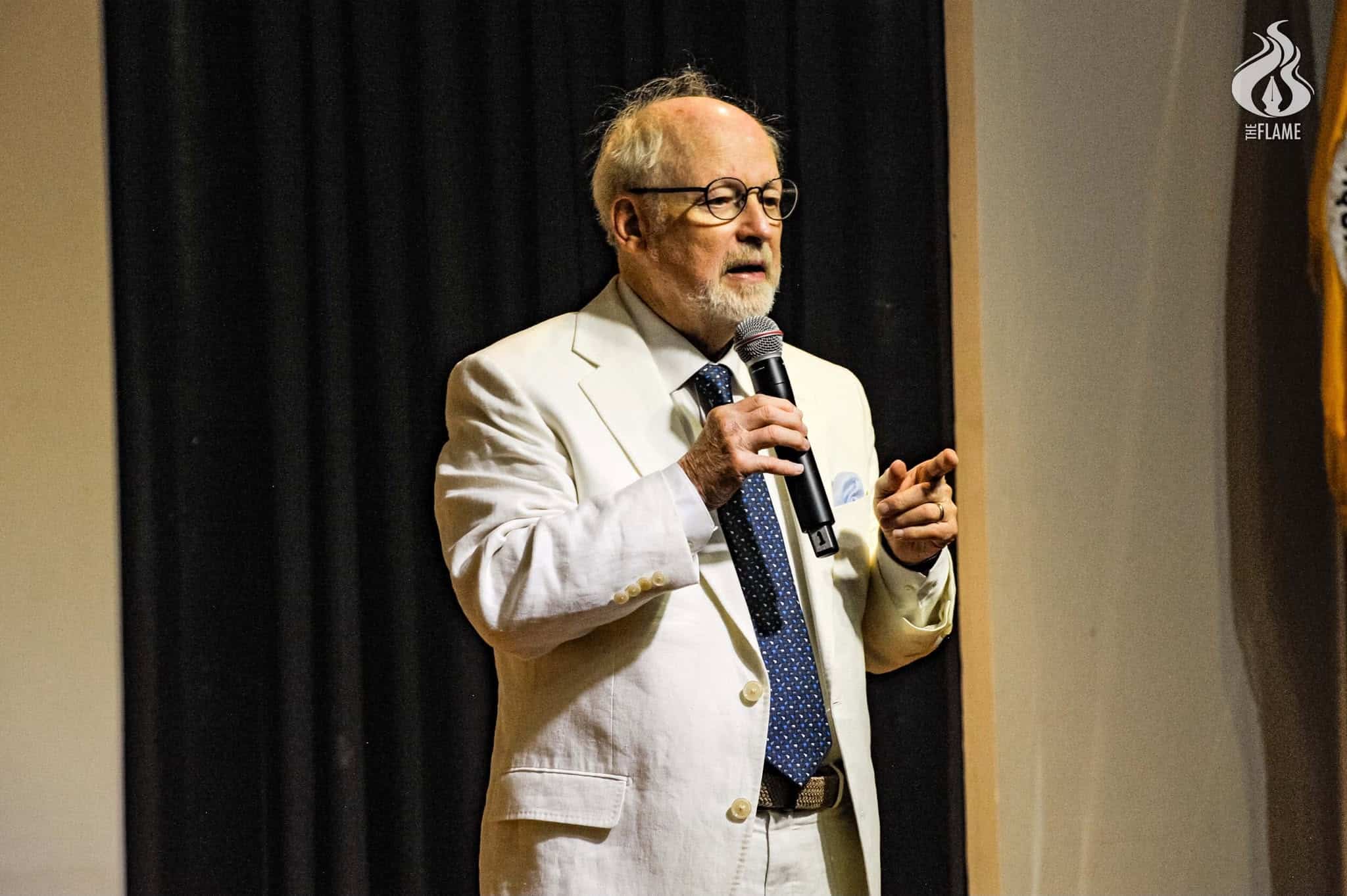
FILIPINO RESEARCHERS must adopt mixed methods more frequently to better understand complex problems, a research scientist said in a recent forum held in UST.
John Creswell, a pioneer in mixed methods research, said the process combines quantitative and qualitative methodologies by integrating numerical data and perspectives to develop a deep understanding of research problems.
“Doing mixed methods, you do have a larger base of data to study your problem, both quantitative and qualitative, both participant perspectives, as well as researchers’ perspectives,” Creswell said during the “Halo-Halo 3: The Filipino Mixed Methods Fair” forum held on Oct. 14.
“One database alone is not enough to understand a complex problem,” he added.
The researcher identified five reasons for using mixed methods, namely stronger evidence, deeper analysis, the ability to tackle complex problems, growing global popularity and the need for up-to-date skills.
Creswell explained that integrating both approaches can generate insights beyond either quantitative or qualitative research. He cited public health, education, climate change, overseas work, mental health and livelihoods as areas where mixed methods research can help researchers examine complex issues.
The research pioneer also acknowledged the challenges of mixed methods, saying it can be time-consuming and requires specific training. He described mixed methods research as a “growing, developing phenomenon around the world.”
The forum highlighted the global expansion of the research method through international research associations, affiliates, and chapters, including the Philippine Association of Mixed Methods Researchers and Emergent Scholars (PAMMRES).
According to Maribel Gaite, executive vice president of PAMMRES, the theme of the research fair drew inspiration from the popular Filipino dessert halo-halo, which combines diverse ingredients into one treat, symbolizing multiple ways of seeing the world toward a shared goal. F