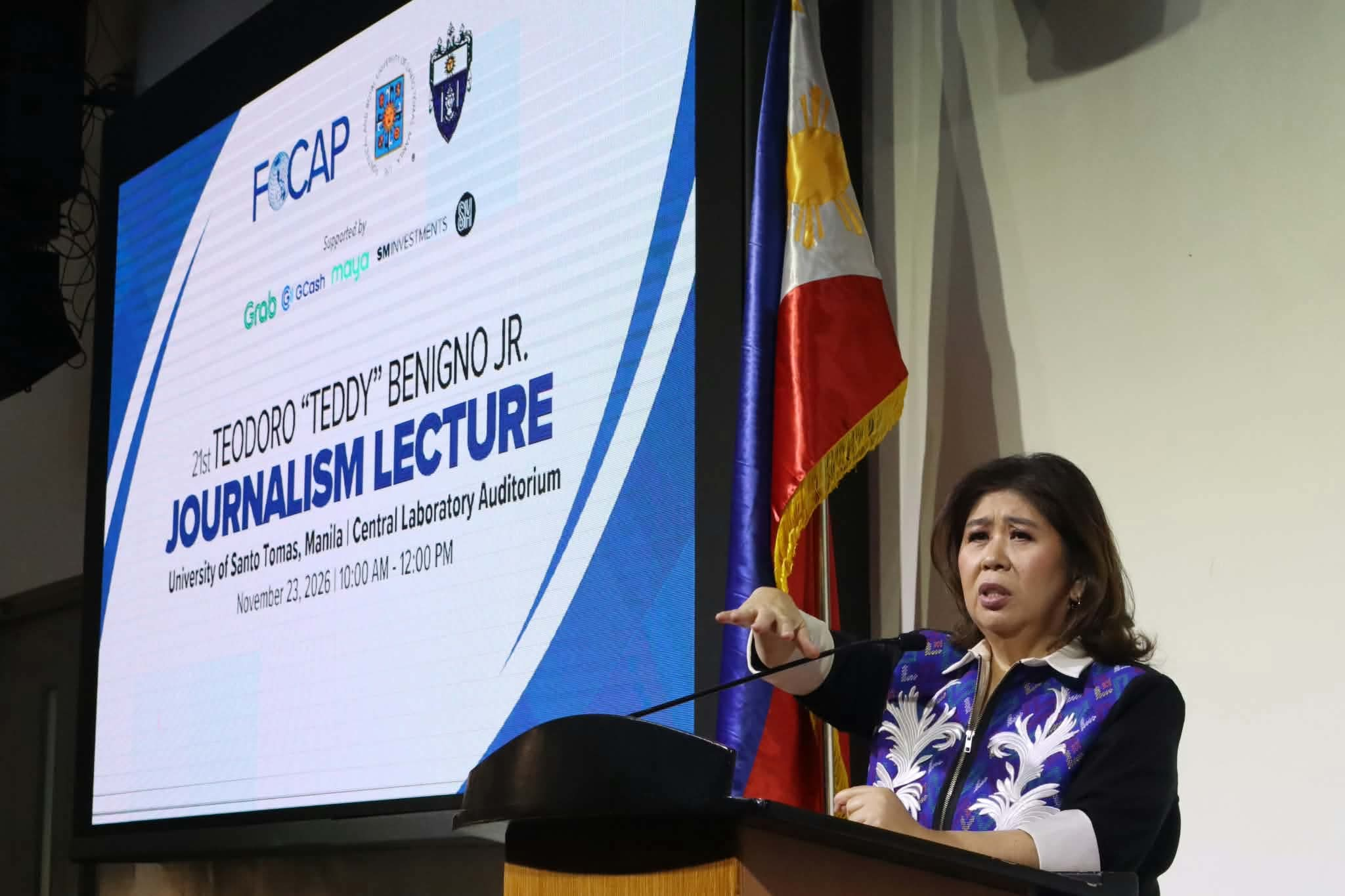
VETERAN BROADCASTER Jessica Soho called on aspiring journalists to report about the plight of the marginalized and to go beyond their echo chambers at a time when algorithms are reinforcing biases and limiting access to contrary views.
During the 21st Teodoro “Teddy” Benigno Jr. Journalism Lecture on Monday, Nov. 23, Soho said journalists can share their humanity and become better human beings through the stories they write.
“Whenever I have existential questions about why we still do this [reporting] because of the fatigue and sickness we always get, that’s the answer: to give voices to the marginalized and the isolated,” she told educators, students and fellow media practitioners at the UST Central Laboratory Auditorium.
“Bigyan ng boses ‘yung mga maliliit at ‘yung mga nasa malalayo o liblib na lugar. Matapos namin na i-feature ang kanilang mga kwento, dumagsa ang tulong at maski papaano gumaan ang kanilang buhay,” she added.
(Give a voice to ordinary people and those in remote or isolated areas. After we featured their stories, help poured in and, in some way, their lives became easier.)
The GMA broadcast journalist also advised budding writers to always connect their stories to the lives of their subjects and go outside their own echo chambers to expand the range of views they encounter.
“Don’t stick to your own exclusive circles or silos… kasi ‘yung algorithm, ibibigay niya lang sa inyo nang ibibigay kung ano ‘yung gusto niyo, ‘di ba? So you have to step out of it. Guluhin niyo rin si Meta,” Soho said.
(Don’t stick to your own exclusive circles or silos… because the algorithm will keep giving you what you like, right? So you have to step out of it. Give Meta a hard time, too.)
Journalism not for ‘divas’
Soho, who hosts the top rater “Kapuso mo, Jessica Soho,” said she could not take sole credit for the work she had done in her over 43-year television career. Alongside reporting and hosting, she helped produce programs such as Saksi and 24 Oras.
Soho revealed that she and her team had to rethink their coverage after critics claimed that they sounded like they were from “people who took taxis instead of jeepneys,”
According to her, divahood has no place in the journalism field.
“Hindi puwedeng maging mayabang o lumaki ang ulo, because there is a whole team working with you and they’re doing most of the heavy lifting and putting in longer hours,” she said.
(You can’t be arrogant or let it go to your head, because there is a whole team working with you and they’re doing most of the heavy lifting and putting in longer hours.)
As head of GMA’s newsroom and as someone who faced the risks of reporting, Soho said she was responsible for getting crews home safely after sending them on dangerous assignments.
In 1990, she and her crew slipped out of a hotel unharmed after it was taken hostage in Cagayan. A military officer was killed in the gunfight that followed, she recalled, emphasizing that no story will ever be worth a journalist’s life.
“No place is really ever safe. So you just have to prepare for worst-case scenarios,” Soho said.
Soho also recounted how she interviewed a father in Tacloban beside a small coffin. The interviewee was asking for help in burying his child after Super Typhoon Yolanda left the city in wreckage.
According to her, disaster reports should always explain what happened and how survivors are going through the situation.
“That’s how you capture the essence of a disaster and hopefully move people and the authorities to send help fast,” Soho said.
Humans first
The broadcast journalist also reminded the students that while reporters strictly should not be involved with their subjects, helping the communities they featured should not be debatable since they are humans first.
“This is our reality–laging may nangangailangan, which is why ang kabilin-bilinan ko naman sa aming reporters and producers who go to calamity sites, bring help… We should not just get the story and leave.”
(This is our reality–there will always be someone in need, which is why I remind our reporters and producers who go to calamity sites to bring help… We should not just get the story and leave.)
Soho emphasized that certain fundamental principles such as trade accuracy, fairness, responsibility and accountability should not be abandoned even if journalism is continuously evolving. Knowing one’s audience also meant striking a balance between what people want to know and what they need to know, she added.
“The platform may have shifted from mainstream to social media, from print, radio or TV to online, analog to digital. But the same values and principles should remain the same. Those are non-negotiables and must never ever change,” Soho said.
Named after journalist and former press secretary Teodoro Benigno, Jr., the journalism lecture was hosted by the Foreign Correspondents Association of the Philippines. F – Charmaine Delos Santos and Enoch Lacanienta with reports from Nitya Aku