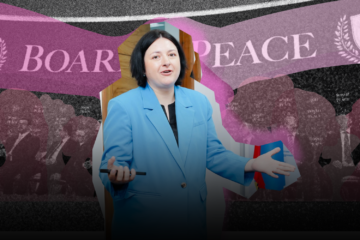

AS THE flood control scandal rages on, a nationwide poll indicated that more than half of Filipinos support the protests condemning government corruption and calling for accountability for those behind the anomalies.
WR Numero’s latest Philippine Public Opinion Monitor found 53% of Filipinos across all demographics expressing solidarity with anti-corruption rallies staged by thousands of Filipinos, including Thomasians.
The survey, conducted from Nov. 21 to 28 this year, polled 1,412 respondents nationwide with a 3% margin of error.
The same poll suggested that 48% of Filipinos distrusted the administration’s ability to investigate and hold accountable those involved in the flood control mess. Only 25% of the respondents expressed an opposite view while 27% said they were undecided on the matter.
President Ferdinand Marcos Jr.’s satisfaction rating also fell to 21% from 35% in August 2025, while his dissatisfaction rating climbed to 47% from 32%.
According to WR advisory group chief analyst Prof. Julio Teehankee, the decline in Marcos’ approval rating may be attributed to the President’s lack of accountability.
“First, the post-SONA (State of the Nation Address) ‘Mahiya naman kayo (Have some some shame).’ Suddenly, you have the President trying to inoculate himself from this scandal, which, incidentally, even if he tries, he has the command responsibility. He is the President,” Teehankee said during a press briefing on Wednesday, Dec. 3.
Dissatisfaction with the Senate, which probes corruption allegations through its Blue Ribbon committee, also rose to 40% from 19%. Only 25% expressed an opposite view.
Meanwhile, satisfaction with the House of Representatives also sank to 27% from 44%, with 35% reporting dissatisfaction with the chamber.
The Independent Commission for Infrastructure, which was formed to probe the flood control issue, was trusted by 37% of the respondents, 32% expressed distrust while 31% were unsure on the matter.
The flood control scandal exploded into public view after Marcos ordered an investigation into substandard and “ghost” or non-existent flood control projects across the country.
A number of lawmakers, public works officials and contractors have since been linked to the issue.
The revelations about the schemes that allowed corrupt officials and contractors to pocket billions in public funds triggered numerous anti-corruption protests, such as the “Trillion Peso March” and “Baha sa Luneta” rallies held on Sept. 21 and Nov. 30.
Thomasians demand accountability
Despite what they claimed to be attempts by the police to “sabotage” their activities during the second Luneta protest, Thomasian activists said they look forward to more mass demonstrations.
“As long as the root causes of poverty and injustice are not resolved, there will always be students who will organize and take action for the democratic rights of the masses, Anakbayan UST chair Dex Frogoso told The Flame.
“The police [were] trying to sabotage the rally when they tried preventing the organizers to set up the stage…Still, we achieved our objective of mobilizing a large group of Thomasians, and it’s noticeable since there are more Thomasians who are well consolidate[d] now politically compared to the last Bonifacio day protest,” he added.
In an interview with GMA News, Manila Police District spokesman Police Maj. Philipp Ines explained that the protesters could not present a permit from the National Parks Development Committee (NPDC) that would allow their rally to be held at the national park.
According to Ines, officers at the scene were only enforcing standard guidelines for public assemblies outside designated freedom parks.
The “no permit, no rally” rule for public places was adopted by the Department of the Interior and Local Government (DILG) in 2015. The policy gave mayors the authority to grant the permit. Rallies in freedom parks and state-owned and operated schools are exempted from the policy.
UST Central Student Council president Annie Agon invited fellow Thomasians to continue participating in calls for reform and accountability.
“Let’s participate to strive for change…The Thomasians want genuine change, so as a student council, one of [our] biggest challenges is how to lead the anger of the Thomasians into collective action,” Agon, also an Artlets student, told The Flame.
UST also showed its support for the protests through its provision of transportation and assistance for Thomasian attendees of the “Trillion Peso March” at the EDSA People Power Monument.
In October, officials and other sectors in the University gathered for a solidarity night to condemn the flood control anomalies.
READ: UST open to joining future anti-corruption protests
However, Teehankee said the protests are being perceived as a means by politicians to pursue their agenda.
“There’s this feeling that the anti-corruption movement is being weaponized. The issue is being weaponized politically and each faction is trying to take advantage of the issue,” he said.
Meanwhile, the surveys presented the majority or half of the population as median voters and “moderate,” meaning the public has reached no clear consensus on political factions, according to Tehankee.
Stalemate
WR Numero also reported that Vice President Sara Duterte, an arch critic of Marcos, posted a much higher satisfaction rating (43%) and a lower dissatisfaction rating (23%).
Previously, the Vice President had a satisfaction rating of 47% and a dissatisfaction rating of 21%.
The survey also suggested that Duterte was the top pick for the 2028 presidential election in all areas in the country.
A third or 33.3% of the respondents preferred the Vice President, followed by Sen. Raffy Tulfo with 13.4% and former vice president Leni Robredo with 13%.
Teehankee said while Marcos and Duterte are facing political setbacks, the Vice President is faring better as she remains “above water.”
“As we end the year, I think all major factions are in a stalemate with the Duterte faction having a slight advantage,” he said.
“Let’s talk about the ICC (International Criminal Court). On the side of the Dutertes, this is the one clink in VP (Vice President) Sara’s political armor. It can work both ways for VP Sara. The high ratings, the continuing high ratings—and if you see the graph, pardon the pun, VP Sara is still above water.”
Duterte’s father, former president Rodrigo Duterte, is facing trial at the ICC in The Hague for alleged crimes against humanity in relation to his bloody war on drugs.
Policy priorities
When it comes to the top five policy priorities of Filipinos, they believe the government should address inflation and low wages, among other economic concerns, crime and corruption.
Increasing the wages of workers (34%) and lowering the prices of food and other basic goods (34%,) emerged as the most urgent concern of Filipinos.
They were followed by combating corruption and other wrongdoing in the government (28%), fighting illegal drugs and crime (22%) and combating poverty and assisting the poor (22%), which tied with the creation of jobs and livelihood (22%).
Sam Ramos-Jones, the WR Advisory Group’s managing director for political intelligence, expressed concerns over the poll results, citing the government’s tendency to adopt “populist economic policies” such as free services. He said such policies are “counterproductive” and neglect long-term effects.
“They (top concerns) speak to a possible support for more populist government interventions in the economy, which, from my point of view, is usually not helpful; it’s usually counterproductive,” he said.
“[Populist economic policies are] short-term gains that are supposed to appease the people, so these are policies that basically create political wins but have long-term financial issues. So whenever there’s talk of the government giving out more services for free or more discounts or more preferential treatment for certain sectors, I have to wonder who’s (going to) pay for it. Of course it’s us who pays taxes.”
The Philippine Public Opinion Monitor is a non-commissioned survey conducted by WR Numero, a pollster based in Pasig City with over 100 field researchers operating in 18 provinces nationwide.
The nationwide survey aimed to provide an understanding of the present political landscape in light of the recent flood control controversy and other key political issues. F – Yimrhaq Mariano, Nitya Aku and Samaya Ty.