THE PROSECUTION of public officials for crimes under the jurisdiction of international tribunals should not absolve the state of its responsibility for such acts or for failing to prevent and punish them, according to an official of a law academy based in Hague, where former president Rodrigo Duterte is detained for alleged crimes against humanity.
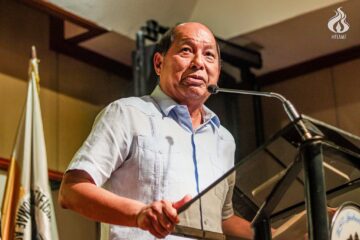
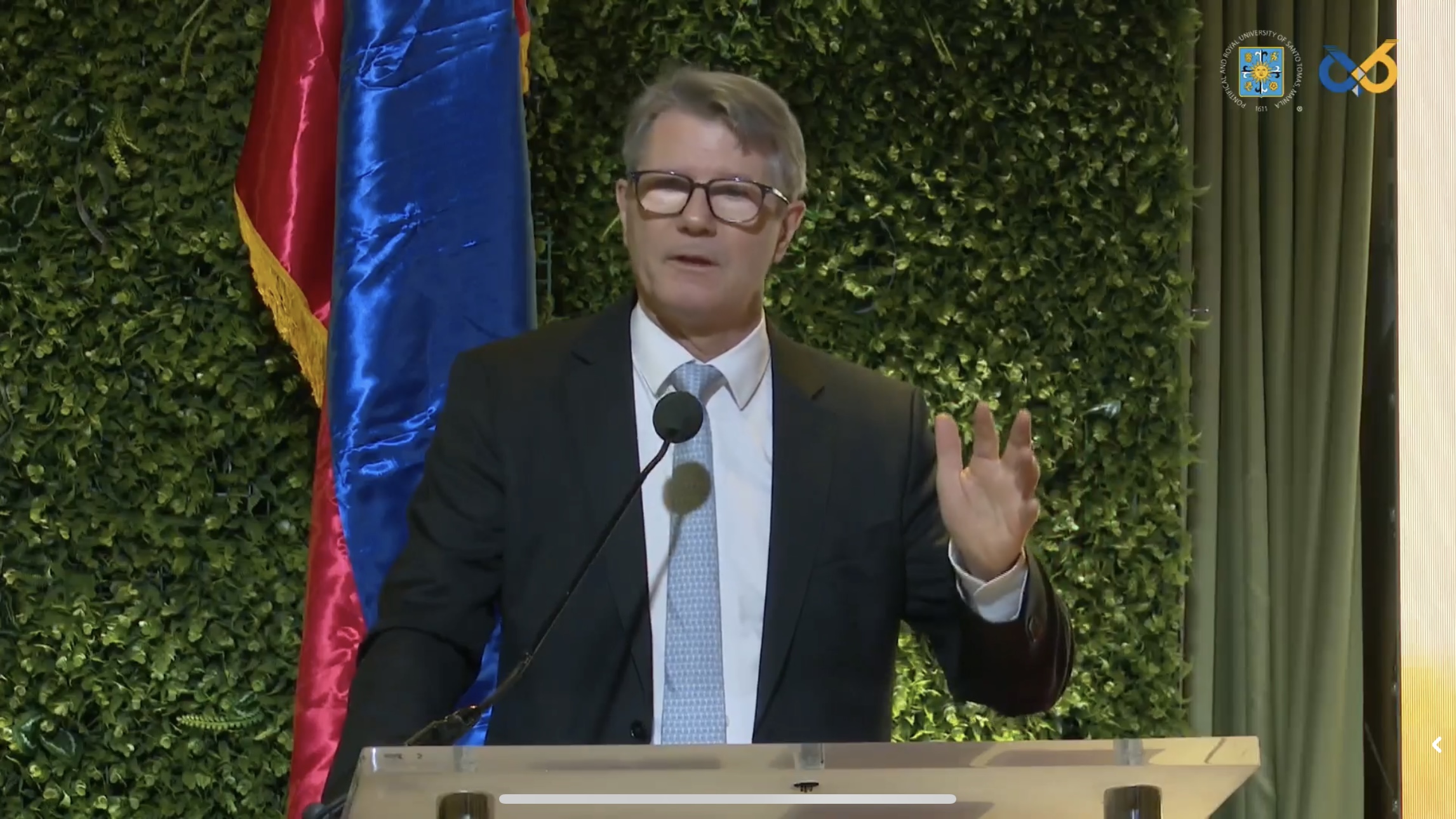
During a forum at UST, Prof. Jean-Marc Thouvenin, secretary-general of the Hague Academy of International Law (THAIL), explained that leading government officials are often held accountable as states cannot be criminally sanctioned and imprisoned for breaches of international law.
However, he pointed out that individual prosecutions do not erase a state’s obligations under international law.
Citing the 2001 International Law Commission articles on responsibility of states, Thouvenin said the “state is not exempted from its own responsibility for international wrongful conduct by the prosecution and punishment of the same officials who carried it out.”
“This is quite a warning for states. It’s not because you allow some kind of individual responsibility in cases, that the state itself can be released of any responsibility. That’s an easy link already,” he said on Wednesday, Feb. 19.
While certain wrongful acts are committed through state machinery or policy, the criminal responsibility of states remains an “illusion” and is not formally recognized in international law, according to the educator.
“It is just obvious that the driving force when it comes to what states do [is] individuals. It is sometimes one man who leads the entire criminal action of a state, and the accomplishment of the crimes is man-made if I may say so,” Thouvenin said.
He also distinguished between international and domestic courts, explaining that the local tribunals still have primary jurisdiction over crimes that threaten transnational peace and security.
The Rome Statute, which created the International Criminal Court (ICC), states that domestic courts serve as the primary judiciary by internalizing international law to prosecute crimes. The ICC functions as a last resort only when national courts are unwilling or unable to carry out these prosecutions.
The THAIL official referred to breaches of international law as the crimes that fall within the ICC’s jurisdiction: genocide, crimes against humanity, war crimes and crimes of aggression.
“Most treaties regarding international crimes only commit states to recognize and implement within their domestic system certain criminal law rules leading them to the definition of the responsibility regimes,” he said
This rule, Thouvenin said, pushed some countries to call for the adoption of a treaty that would obligate states to prosecute crimes against humanity within their domestic systems.
“The underlying idea is, of course, that this convention would have the same effect as the Genocide Convention. It would generate also potentially responsibility of states for doing something through [their] organ with the link to a crime against humanity,” he added.
Unlike the ICC, the Genocide Convention has a “clear” directive for states to include genocide in their systems and sanction it accordingly, he said.
Thouvenin explained that the International Court of Justice interpreted the convention as imposing not only a duty on states to prevent and punish genocide committed by individuals, but also as establishing a direct prohibition on states themselves from committing genocide.
On March 11 last year, Duterte was arrested on an ICC warrant and detained in The Hague for alleged crimes against humanity tied to his anti-drug campaign when he was the president and Davao City mayor.
Even if the Philippines effectively withdrew from the Rome Statute of the ICC as a state party on March 17, 2019, the country was still a member when the alleged crimes occurred, thereby falling under the Court’s residual jurisdiction.
Duterte is scheduled to have a confirmation of charges hearing from Feb. 23 to 27 to determine whether his case will proceed to trial.
Dean Nilo Divina of the Faculty of Civil Law described the Hague Academy as a symbol of the international community’s conscience.
“The Hague has long symbolized the conscience of the international community, the place where principles are tested, accountability is pursued, and disputes are resolved through reason rather than force,” Divina said.
“It is precisely in moments of tension, transition, and transformation, moments such as this, that the discipline we gather to discuss today becomes most relevant and most urgent.”
Thouvenin is a professor of international law at the University Paris Nanterre. He is also a member of the boards of the French Society for International Law, the International Law Association, and the American Society of International Law.
The Forum entitled “Distinguishing between Individual and State Responsibilities under International Law” was hosted by the UST Faculty of Civil Law, the UST Graduate School of Law, and DivinaLaw at the Buenaventura Garcia Paredes, O.P. Building.
Also in attendance was Eduardo Malaya, the Philippines’ ambassador to the Netherlands. F