
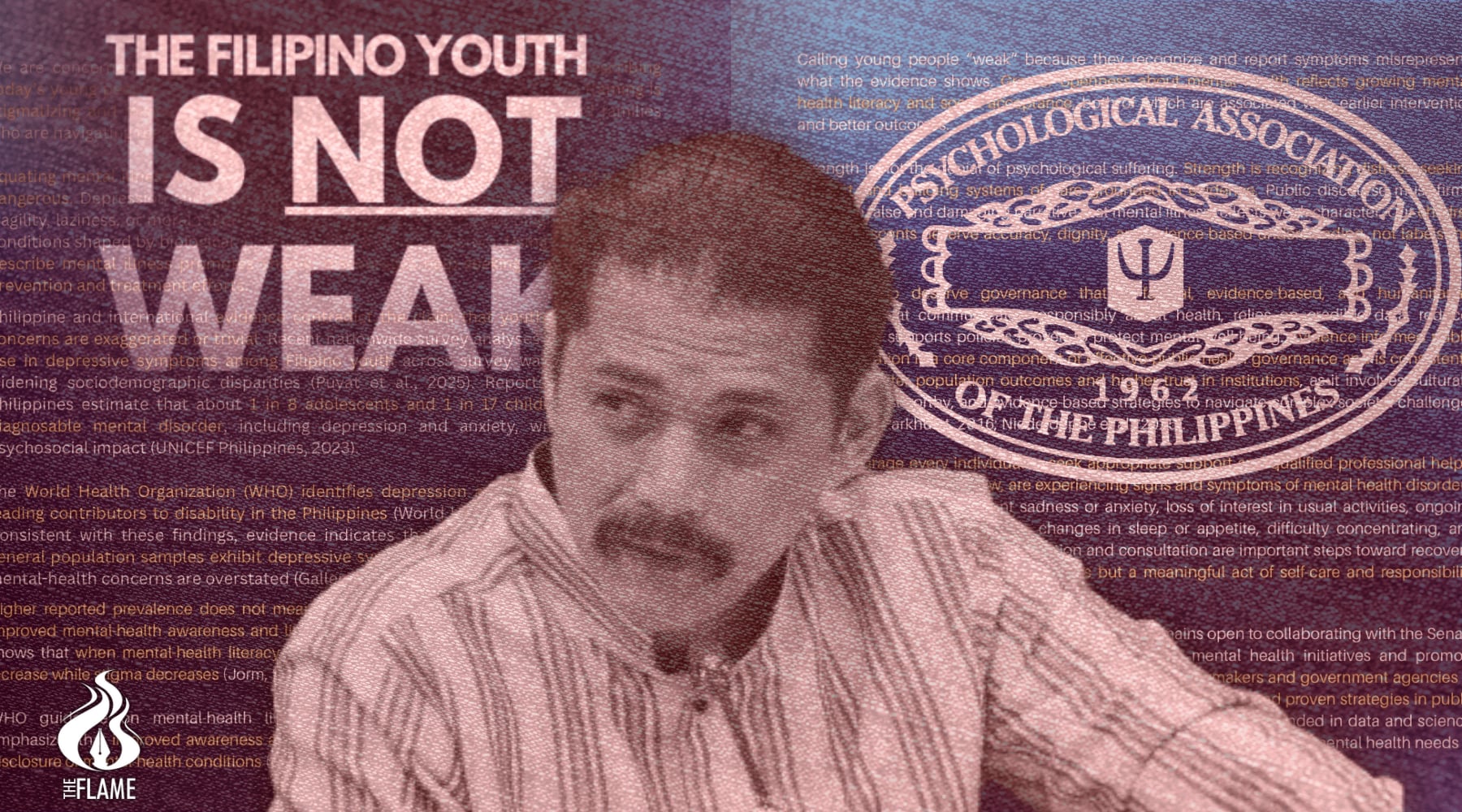
FOLLOWING SEN. Robin Padilla’s controversial remark that today’s youth are “weak,” the president of the Psychological Association of the Philippines (PAP) and Artlets assistant dean said mental health concerns have long existed, but were often unrecognized in the past due to lower levels of literacy on the matter.
During a hearing by the Senate public information and mass media committee on the proposed Children’s Safety in Social Media Act last Feb. 11, Padilla described the youth as “weak” and claimed that depression was not a common term when he was young.
PAP president and Faculty of Arts and Letters Assistant Dean Assoc. Prof. John Manuel Kliatchko said mental health conditions may have been present even in previous generations, but were undetected because people were “less informed” and had limited access to proper diagnosis and education.
“It could have also been there even before, but mental health literacy was lacking compared to today.… So to say that this did not exist before may not be entirely accurate. They were probably just not properly identified then. But now, people are more informed,” Kliatchko told The Flame.
“And not only the young people, even the older people, because when you talk about statistics on depression, anxiety and similar conditions, it’s not just the youth who experience depression and anxiety. It cuts across,” he added.
On its Facebook page, the PAP denounced Padilla’s remarks as “stigmatizing and misleading,” warning that such statements could further harm young people dealing with mental health problems.
“Equating mental illness with weakness of character is scientifically wrong and socially dangerous. Depression and other common mental-health conditions are not signs of fragility, laziness, or moral failure; rather, they are evidence-based, diagnosable health conditions shaped by biological, psychological, and social factors,” the statement read.
While mental health issues have existed for years, Kliatchko said the COVID-19 pandemic likely worsened them, as prolonged isolation had prevented people from performing their daily routines and social interactions.
“Your regular activities can no longer be done… You were restricted, you were limited, even your communication was limited. And then, there was the possibility of feeling alone. This led to many psychological effects to many people,” he said.
Despite strides in awareness, the assistant dean said initiatives should be continuous, emphasizing the importance of consistently reaching out to students through programs such as mental health campaigns and counseling sessions.
“Even as we try our best to provide all chances to get in touch, I believe, it should be an ongoing thing that we should never stop. We should not stop reaching out. So here in the university, for example, there are frequent activities like the Race Against Suicide,” Kliatchko said.
Race Against Suicide is a program facilitated by the UST Counseling and Career Center to train academic staff and administrators in identifying warning signs of mental illness and providing support for students.
“I think, this should always be done. It should not stop. It should not stop because the challenges don’t stop either. They keep coming,” Kliatchko added.
He also mentioned the recently held workshop on cultivating ethical practice through empathy toward students organized by the dean’s office for its faculty members. The event was part of this year’s AB week activities.
“So we’re trying to help the teachers also on how to assist, on how to be of best assistance to our students…Of course, in all of these, we try to find those who can help them,” the assistant dean said.
Kliatchko said legislation could play a key role in ensuring better mental health support. He cited Republic Act 11036 or the Mental Health Act of 2018, which he described as an example of how the government could strengthen policies and improve access to psychological services.
According to Kliatchko, the PAP works to bridge gaps in mental health awareness, enabling people to understand the experiences and challenges of the youth.
“[PAP] is helping out to provide accurate, evidence-based information that can be useful for people of all ages, so that they can also better understand today’s youth,” he said.
Founded in 1962, the PAP is the country’s oldest and largest professional organization of psychologists and psychometricians that advances psychology through teaching, research and practice for human and social development. F ― with reports from Mei Lin Weng