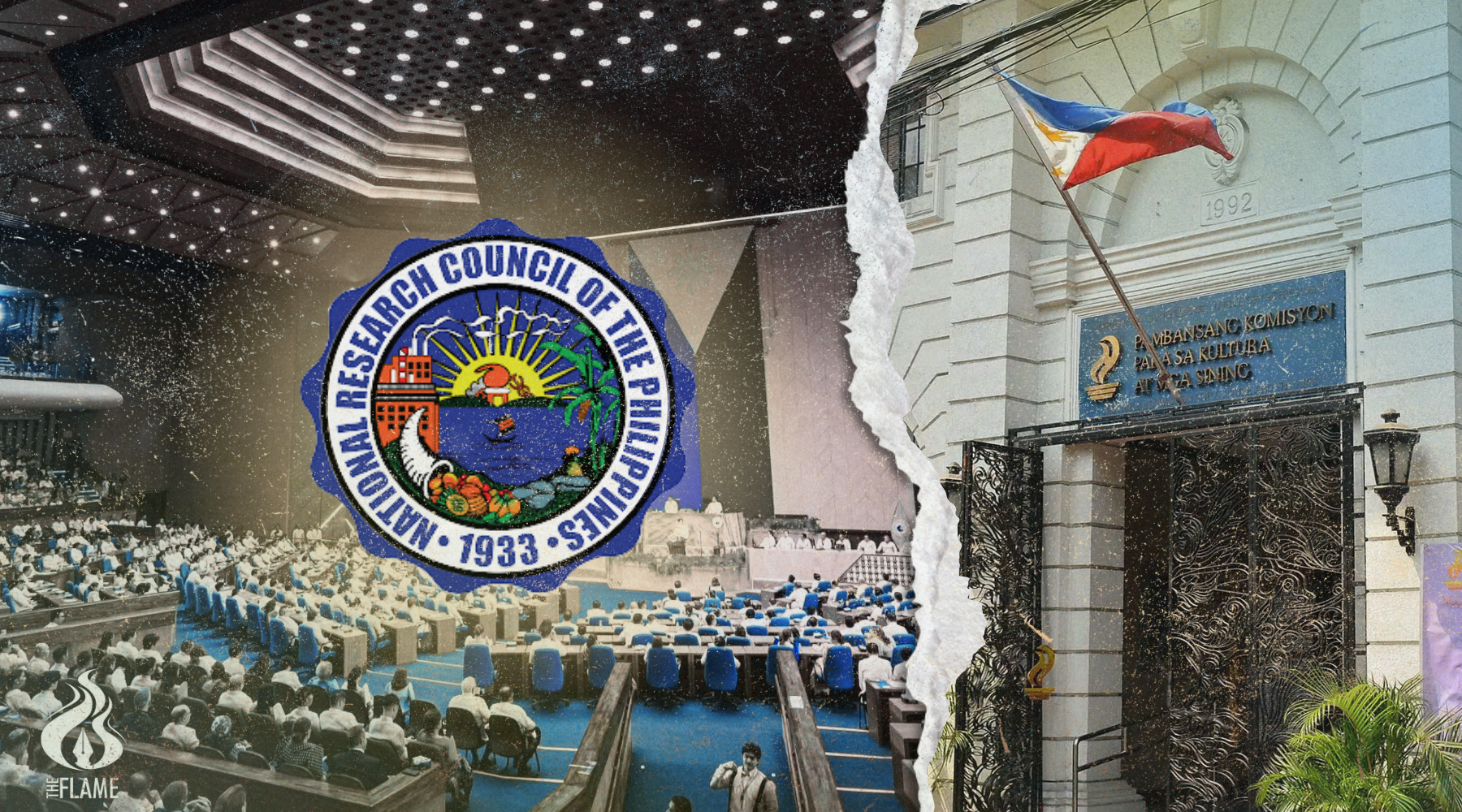
THE HUMANITIES division of the National Research Council of the Philippines (NRCP) has lobbied for more cultural research as senators tackle a bill seeking to establish a Department of Culture.
During the hearing for Senate Bill 817 or the Department of Culture Act on Feb. 4, the NRCP submitted a position paper calling for a greater budget for research and the creation of regional offices, NRCP Humanities Division Chair Prof. Joyce Arriola said.
“It can’t just be dancing, singing, painting. It’s not just artistic production. There should be research also on culture and the arts. That’s the reason why NRCP was invited, to advise on the important role of research in cultural management,” Arriola told The Flame.
“For research, that was part of my observation when I was at the NCCA (National Commission for Culture and the Arts). Then, as for the regional office, that was the clamor of our members from the regions. So, we will be remiss if we don’t get that in,” she added.
The NRCP is an advisory body attached to the Department of Science and Technology (DOST) tasked with promoting research activities and connecting scientists with national and international agencies.
Citing her experience as a former board member and secretary of the NCCA’s National Committee on Literary Arts, the country’s primary cultural agency, Arriola said research has long been underfunded.
“There is a research component. In fact, they (NCCA) support thesis and dissertation, and then research projects. But the budget is small. The biggest budget I saw was P300,000. In NRCP, it’s in the millions that they give,” Arriola said.
“We have to boost the research on our ethnolinguistic groups. The communities of indigenous peoples are dying because they are not given a budget,” she added.
Arriola also serves as the chair of the UST Department of Communication and member of the University’s Research Center for Theology, Religious Studies and Ethics.
The NCCA’s lack of regional offices and funds, Arriola explained, have forced researchers to rely on local government units (LGUs) for their provincial activities.
“For our conference, we have to tap into the LGU…So, we are like beholden to the mayor. Because of the lack of budget, sometimes we ask them to shoulder the daily meals of all the contingents,” Arriola said.
She added that the offices would lessen the “dependence” on Manila that can make other regions feel neglected and help address the concerns of indigenous peoples.
To achieve these goals, the humanities, education and social science divisions of the NRCP requested to be part of the technical working group for the last draft of the bill.
Culture agency
The bill aims to centralize cultural governance and prioritize the sector in national development planning, citing the NCCA’s lack of authority over institutions as it is not a line agency.
If the bill is enacted, the NCCA would be abolished, and various government bodies, such as the Film Development Council of the Philippines and National Parks Development Committee, would consolidate under the Department of Culture.
According to Arriola, the department is envisioned to stand as a “unifying central administration” that can better supervise the country’s culture and arts.
“If you are a department, you have a bigger budget, which will go to the promotion of arts, culture, all over the country, which for several years now, decades, have been neglected because other sectors are considered ‘more important,’” she said.
“Our artists are languishing. Our cultural communities are not being preserved. When it is really that which gives us our identity as a nation. So, if it’s going to be a department, then it will be better preserved, promoted, administered.”
Arriola expressed hope that the bill would come to fruition after it had gone through several drafts since it was first proposed in 2014 by Sen. Loren Legarda.
Legarda, the current chair of the Senate Committee on Culture and the Arts, refiled the bill in August last year.
The department, Arriola said, would likely be comprehensive as governing bodies across different sectors, including those covering the hard sciences, such as DOST and its attached agencies, were invited to the Senate hearing.
Prof. Jose Wendell Capili of the University of the Philippines Diliman, a UST Journalism alumnus, and Prof. Hope Sabanpan-Yu of the University of San Carlos authored the position paper submitted by the NRCP Division of Humanities in the Senate hearing. F – Dave Justine Desilos