REFORMING A corrupt system requires narratives that “refuse to normalize” structures that persist by exhausting people and public outrage, a former budget secretary said.
Former budget secretary Florencio Abad said those in power who have enabled corruption in the budgetary process rely on fatigue by promising arrests and stalling investigations.
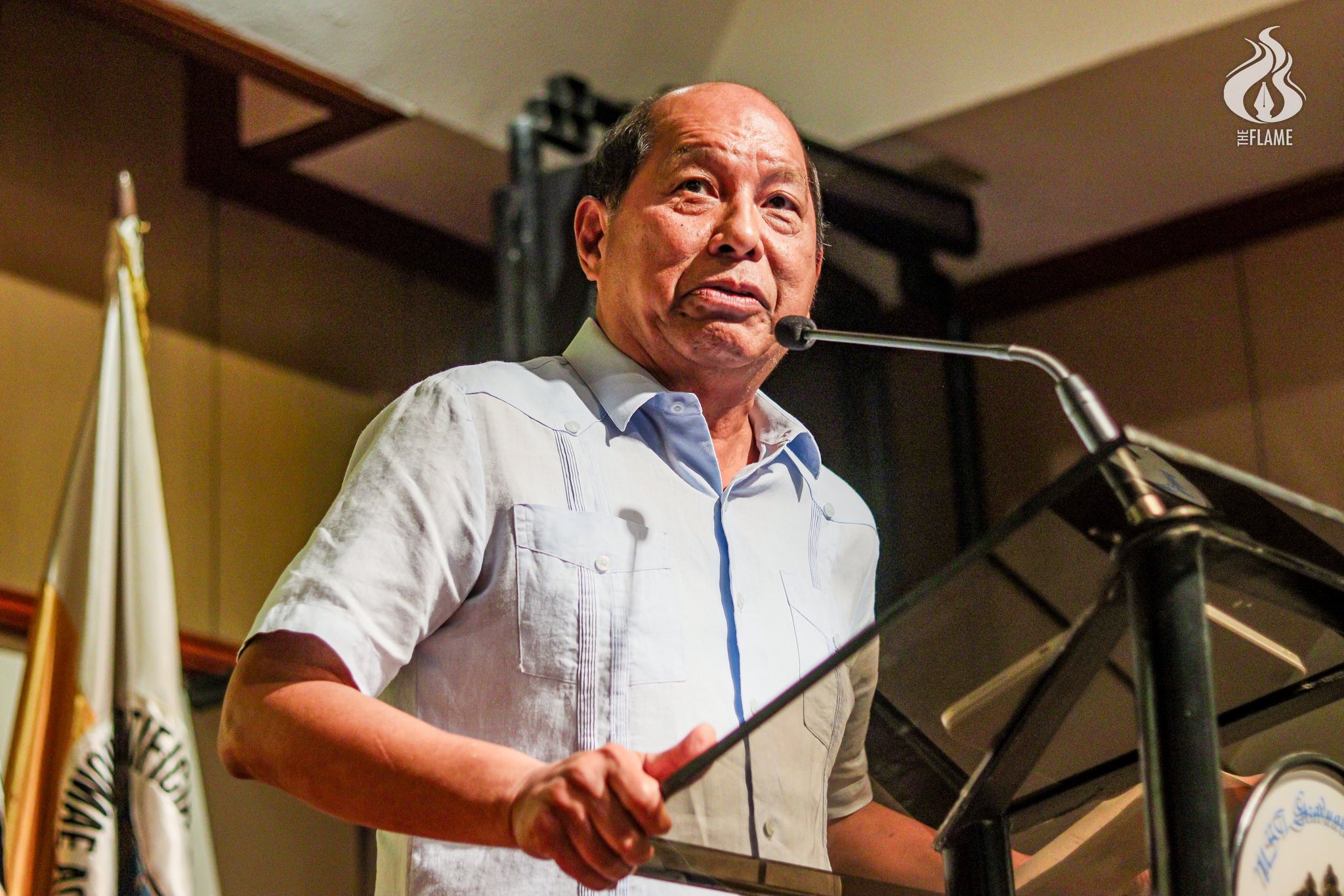
“This brings me to you, writers and journalists. Reforms do not and will not begin in Congress. It begins with a narrative. With what you name. What you repeat. And what you refuse to normalize,” Abad said in a lecture delivered on Friday, Feb. 20.
In a separate interview, Abad said corruption has evolved into a “framework.”
“We have reached a stage where corruption has really gone too far. It is no longer the regular, common corruption that we have in mind. It has become a framework of society…The system itself needs to be changed. We should hold people accountable for corruption,” he told The Flame.
Abad urged journalists to avoid overly technical writing, which he said “dissolves” stories into complexity and abstraction. This, Abad added, “regenerates” impunity by allowing erring officials to return and rebrand.
“Nations do not rise because leaders are flawless. They rise because people refuse the unacceptable. That refusal is where reform begins. That insistence is how systems change,” the former budget secretary said.
According to estimates from the Senate blue ribbon committee, the Philippines has lost P1.14 trillion to anomalous flood control projects in the last 15 years. However, since the corruption fiasco erupted in 2025, no elected official has been jailed.
Corruption now a ‘background music’
Abad said that people often eventually move on after complaining and condemning corruption that it becomes “background music” and no longer news.
“It seems like we’ve accepted that corruption is part of our daily lives instead of feeling outraged,” Abad said.
According to him, the level of corruption in the country had never grown to such a scale before and had now “crossed a threshold.” The national budget was designed and restructured in advance for funds to be redirected quietly and repeatedly, he added.
Various groups, such as the Makabayan bloc, had been opposing the budget passed by Congress for the past three years, citing several issues, including the retention of unprogrammed appropriations.
“This is a political event. One that will define us unless we find the collective resolve to break the cycle once and for all,” Abad said.
Abad graduated from Ateneo de Manila University in 1980 with a degree in Business Management. He later obtained his law degree from the Ateneo College of Law.
Before his political career, Abad taught at the Ateneo de Manila University’s College of Arts and Sciences, School of Government, College of Law and Graduate School of Business.
In 1987, Abad entered politics as a representative of Batanes. He became the secretary of agrarian reform under former president Corazon Aquino’s administration before returning to Congress as Batanes representative in 1995 for three consecutive terms.
From 1999 to 2004, Abad also served as the president of the Liberal Party and eventually became the secretary of education under the Arroyo administration.
Under the second Aquino administration, Abad worked as budget secretary, spearheading various expenditure reforms, including the Performance-Based Budgeting and Grassroots Participatory Budgeting.
Abad’s lecture was the highlight of this year’s iteration of the Adrian E. Cristobal Lecture Series held at the Tanghalang Teresita Quirino in the Benavides Building.
Titled “From Crisis to Courage: Rising Beyond the Plunder,” the event was organized by the UST Center for Creative Writing and Literary Studies, the Unyon ng mga Manunulat sa Pilipinas and the Cristobal family. F