ROOSTERS CROW to herald a new day. Rise and shine, they say. Let the sunlight seep through the morning haze.
A Math teacher wakes up at the break of dawn, sometimes as early as 4 a.m., to brew a good old mug of black coffee. It was his daily fuel to get up, especially on a Saturday in April, a week into summer break at a local public school in Malasiqui, Pangasinan.
For some folks, it was the perfect moment to go to the beach, pack for a camping trip, or travel to the city. But not quite the case for Ronard Ticman.
Vacation only meant that Ticman could finally set aside the lesson plans, reports and other paperwork that kept him preoccupied all school year long. It was time for him to give all the attention to his first love.
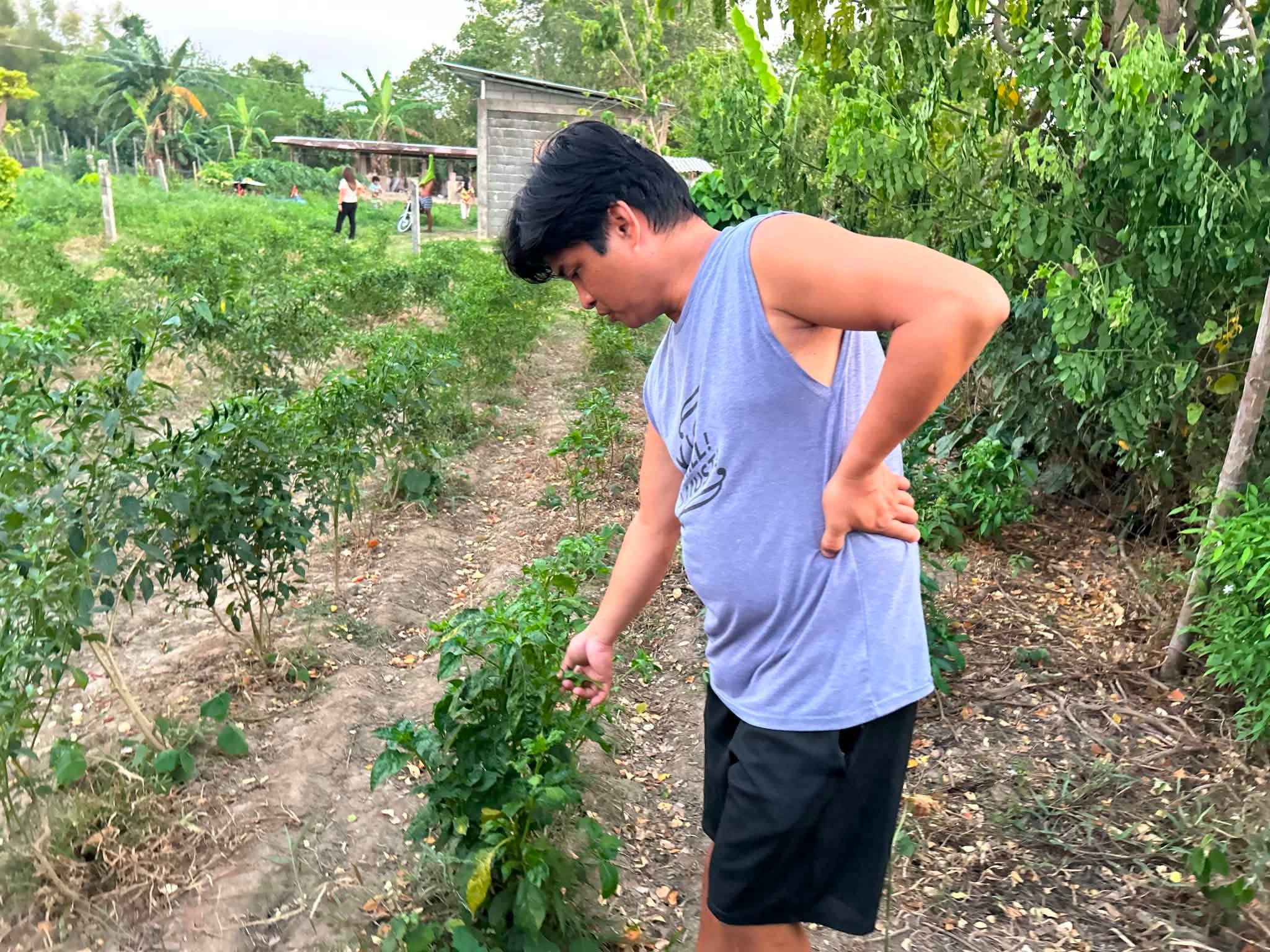
The father of three goes out of his bungalow to walk — just about 150 steps away — to his 2,000-square-meter patola or sponge gourd patch, one of his most beloved high-value crops spread across half of his 4,000 square meters of land he inherited from his parents in Barangay Bobon.
Ticman, 46, has been a farmer his entire life, something he has come to treasure from his elders and guardians.
“I studied, became a teacher, at the same time, farmer. My passion is in my origins. That is important in my life,” the third-generation farmer said in an interview.
“I’d rather lose my job than disregard farming.”
As the sunlight seeps through the open field, it reveals a soil that has already begun to crack here, there and everywhere. Like chapped lips from dehydration, the land was drying up from the peak summer heat that strikes above 40 degrees Celsius by midday.
With the tilled ground once again parched, Ticman fires up his diesel-powered irrigation machine, which has been his ever-dependable workhorse on the farm for more than half a decade.
He attaches a 60-meter hose to the engine that siphons water about eight meters deep below the ground and let it rip. The engine would run for 12 hours and use up six to seven liters of diesel for the second time that week. Prior to harvesting the crop, that is already P5,000 down the drain. And that’s just for patola.
Rising diesel prices have burned through what was once a modest but manageable income. An average sale of P1,000 for sili or chili, another high-value crop of Ticman, is now nearly cut in half by fuel costs alone. The strain also forced changes to the meals served at the dining table.
“The effect is huge. You just lost money for half a kilo of beef…You used to have meat for breakfast. Now you make do with edible leaves,” he said.
While the water pump quenched the cracked soil’s thirst, more fissures began to appear. But this time, it was the pockets of farmers like Ticman getting sucked out dry. Ever since diesel prices exploded almost threefold to P150 per liter because of the conflict in the Middle East, what was once an essential step to keep crops green, glowing, and gushing has suddenly become a tide that drags farmers down, leaving them to drown.
Farmers who put food on our tables are confronting a painful reality: They are stumbling because of a war they never waged. They are hit hard by decisions made mostly by people whose feet never touched the soil they are tilling.
“Irrigation consumes much diesel. It consumes more compared to the tractor… Many have tried solar powered equipment but it is not yet affordable,” Ticman said.
A brighter option?
But what about the blazing golden sun? It glimmers as a beacon of hope, 150 million kilometers away from this blue planet. Touted as a cleaner and more sustainable alternative to diesel, solar energy may be the brightest answer to weather the ballooning costs of fuel. But for many small farmers, it remains painfully out of reach.
For agricultural engineer Adrian Borja, diesel engines are more prone to failure than solar-powered motors because they have more moving parts. But the issue here is neither the lack of machinery, nor the reliance on them. It is the lack of financial capital.
“Farmers complain not about mechanization but about funding,” he said.
Expensive and risky. For many smallholder farmers, that is what the promise of a solar-powered irrigation system boils down to. While it could really free them from paying for costly fuel, the technology can be intimidating. A setup capable of running a five-horsepower water pump can cost around P150,000 — a price requiring a leap of faith for many growers already buried in loans and debt just to sustain production.
While the benefits of solar panels seem promising in the long run, uncertainty still lingers, clouding the eyes of farmers struggling with meager earnings. While the global crisis offers ample reasons to shift, embracing solar energy feels less like a solution and more like a gamble farmers cannot yet afford to take.
“That’s the problem. You can invest by incurring debt,” Ticman said.
“It will take years before you recover your investment.”
Despite the worries, Ticman is “80% close” to investing in a solar-powered system. It has been on his mind even before the Middle East crisis. The only thing holding him back? His concerns about its lifespan and maintenance. So, for now, the teacher-farmer is still in full observing mode.
“I am still thinking about it. If I have money, I could risk it instead of dealing with high diesel prices. But (the equipment) will depreciate. I cannot use it forever,” he said.
“But it would be a big help because it provides free water.”
Priorities
More or less 210 kilometers from Ticman’s humble home, an agricultural non-governmental organization (NGO) is promoting organic farming.
Originally focusing on forestry, Mariwska Integrated Farm in Antipolo, Rizal has broadened its reach, now providing support to about 60 members, 40 of whom are registered as individual farmers, to produce various high-value vegetable crops in 1,000 to 3,000 square meters of plots.
Farmers of the NGO also bear the effects of oil price hikes, especially in the uplands. Their usual fare of P500 going to the town proper doubled. Mariwska, however, kept its prices stable and reduced production scale to stay afloat in the market. Organic as it is, Marwaska can only do so much to aid its members. Not even a free supply of seeds and fertilizers can suffice.
“If they can no longer cope with the costs, they would just plant for their families,” said Michaell Galang, a member of the organization’s board.
It is said that farmers in rural poverty are more than likely forced to prioritize their immediate daily needs for survival over long-term investments. After all, very few are willing to spend on something that could further cut into what little they already have.
“When we look rural poverty, the lower income households of farmers, they really focus on how they get by every month,” Lance Chua, an economist at Ateneo de Manila University, said.
“Their priority would be obtaining food for the day… they do not want to invest, especially in things they are not familiar with.”
Switching to solar energy seems undoable for many smallholder farmers, but the wind takes a gentler course when external players help shoulder the burden by providing the equipment at no cost.
“I don’t think they would (invest) because again, it’s not in their priority… not unless ‘the investment would be carried out for free by NGOs, organizations, universities, etcetera,” Chua added.
Some growers in Antipolo already caught a glimpse of what the future could look like with that kind of help. Through assistance from the National Irrigation Administration (NIA), a handful of Mariwska members were supplied with large solar panels directly attached to their irrigation pumps.
“If it is solar panel, it would allow us to generate huge savings,” Galang said.
“If we can find someone who will donate solar panels, that would mean a lot in terms of reducing expenses.”
But the support is not extended to just about anyone. Farmers lamented that government priorities remain fixed on the country’s top-prized crops: palay and corn. Vegetable growers are left to fend for themselves, waiting for scraps of help that may not come anytime soon.
“The same holds true for subsidies. Rice and corn are commonly prioritized, not the vegetables. Vegetable growers are left out,” Galang said.
When vegetable farmers ask to be provided with solar panels, their pleas fade into the background as more attention is given to staple crops. High-value crop crops, it seems, are often overlooked, unheard, and undermined.
The deepest cracks no longer appear in the parched soil, but are in the system meant to support the farmers. In their eyes, government aid flows through the crevices of the same rice and corn fields, while vegetable growers are left on the dry edges. Only those with connections reap what struggling farmers cannot.
“Some people here no longer have a place for the machineries they got because they are the only ones with access and connection,” Ticman said.
Long road ahead
As farmers wrestle with volatile fuel prices, the government has started betting on the sun. According to the latest 2024 data report from NIA, the agency has ramped up efforts to integrate sustainable technology into the country’s agriculture sector through the Solar-Powered Driven Pump Irrigation Project, which received an allocation of P18.6 billion. The project is expected to be more than 60% complete by the end of the year. Separate solar-powered pump projects worth P30 million have been completed.
As fuel prices continue to fluctuate because of the US-Iran war, government agencies are cautiously testing the waters of renewable energy. At the Philippine Center for Postharvest Development and Mechanization (PHilMech), the transition is gradually taking form, at least for rice.
Under the Rice Competitiveness Enhancement Fund (RCEF), which allocates roughly P9 billion annually for mechanization, the agency has already distributed thousands of machines to an estimated 1.2 million farmers nationwide. Market studies were also conducted as early as last year to explore solar-powered systems for the post-harvest stage, including stationary facilities like rice mills and recirculating dryers.
“After all, we are going there. Why not shift to renewable energy?” PHilMech director Joel Dator said.
However, high-value crop farmers are still heavily dependent on diesel-powered irrigation pumps, tractors, and mobile machinery. These tools, for now, have no practical solar counterparts locally. The shift will likely be slippery and shaky if done swiftly.
“It is not that easy because the investment is costly. You need to check the existing structures,” Dator said.
“If you rush it, other mechanization programs would be affected.”
For many vegetable growers, the hesitation is not just apparent, but also structural. Unlike rice systems that can be centralized and mechanized at scale, high-value crops demand flexibility that solar setups have yet to match. While energy from the sun could ease the burden of volatile fuel prices, affordability remains a major hurdle. The solution? Endure the pain.
“For now, we have no choice. They will really use diesel or gasoline because they are the only ones available and practical,” Dator said.
A matter of dignity
If fuel prices continue to soar, Ticman already knows where the cuts will fall to stay afloat. It’s not on fuel, and it’s definitely not on water. A genuine farmer he is, he could not sacrifice the quality of his vegetables. So where does he stop the bleeding? On the land itself.
The plots will shrink, reducing production supposed to be for the market and limiting it to what can be eaten at home.
“Maybe I will just plant for consumption. If I go beyond that, I would sustain losses,” the farmer said.
Planting stops making sense when every peso is poured into diesel, fertilizer, insecticide and labor, practically leaving no income to enjoy. For Ticman, it’s even better to dump produce than sell them at low prices. It was a way to keep dignity.
“Everything goes to inputs…The prices of chili also decreased so there is more profit…Just throw them away. We may view it as wastage, but for them, they would rather throw it than suffer losses,” he said.
For some, the fields are no longer worth the risk. No matter how much one tries to keep it alive, there is nothing left to do but to accept the loss. But still, they can’t leave just like that. They hold on, even if it means burying themselves in debt. That’s the mindset of the 51-year-old farmer Lorenzo Ferrer, uncle of Ticman.
“Whatever comes our way, we will just go with the flow. We can stop. We will endure it because this is our livelihood,” he said, while irrigating his crops.
“As long as we have ways to borrow money, we will and soldier on.”
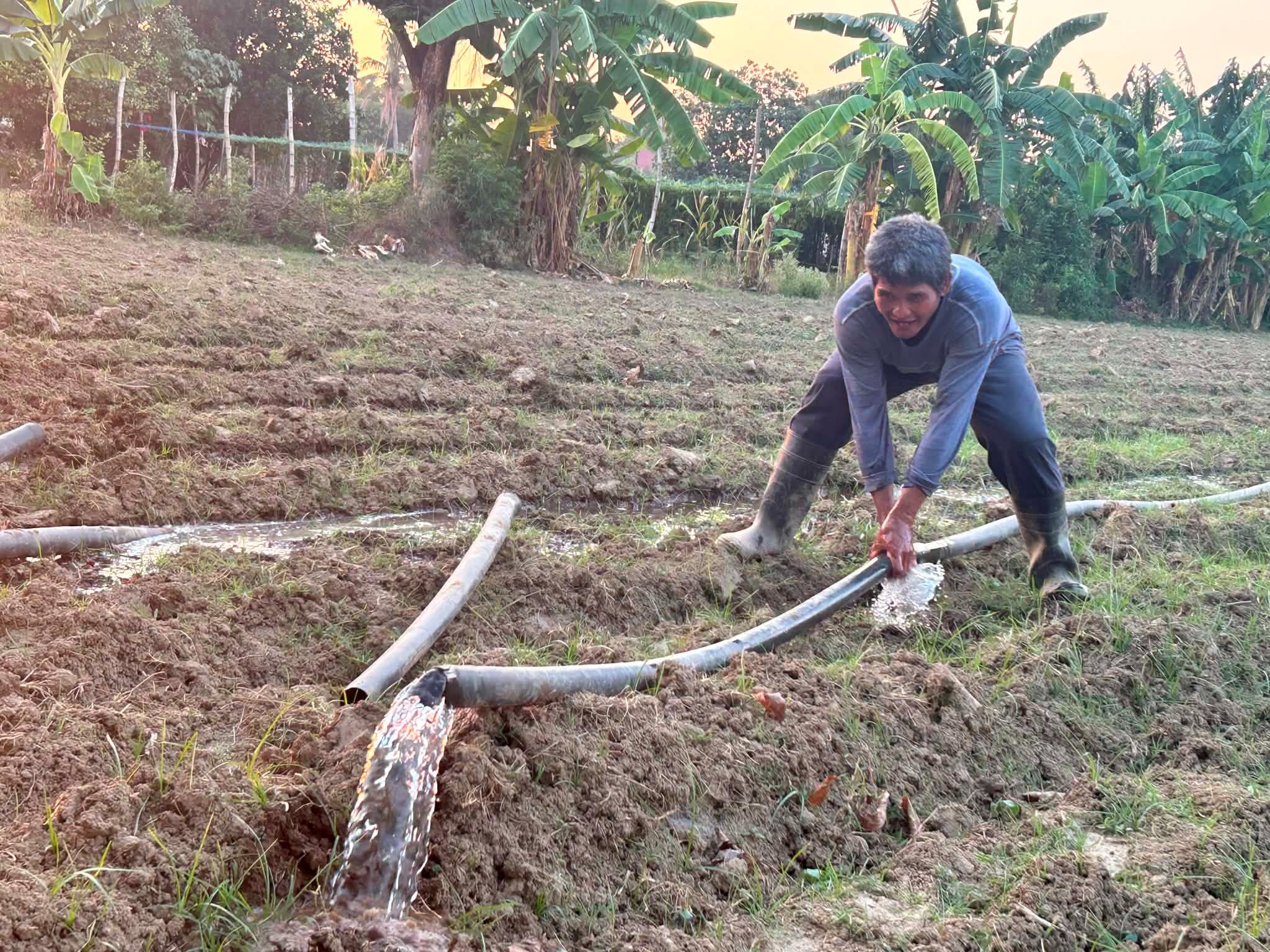
Ferrer does not want to give up that easily, so he looks elsewhere, like doing construction work, to carry on.
But for some farmers, it was already the end of the road. Discarding their once-dearly tended crops was the only way to survive. The very thing that kept them alive had become something they were willing to let go of.
Just a couple of minutes’ walk from Ticman’s patola patch, a neighboring plot of the same exact crop had already been abandoned. The vines were all shriveled, the bamboo all gray, and the soil hardened. It was lifeless, soulless, and dead.
“That’s the most difficult sacrifice you can do. If you are losing money, give it up. Stop irrigating it,” Ticman said.
“Abandon it. It’s gone. Do not act anymore.”
As the sun sets in the west, Ticman shuts down his diesel-powered water pump and begins the familiar walk back to his bungalow, just about 150 steps away from his patola patch, which he promised never to leave.
As solar panels face the sky, farmers are wondering whether the sunlight would ever seep through their parched hopes as they remain trapped in a quandary that can only be resolved by a gamble they cannot afford to take. When will they be freed from having to choose between a scorching present that leaves them hapless and an uncertain future that only a few of them can bet on?
The question will likely linger until roosters crow again some other day. Rise and shine, they will say. F