IF YOUR concept of the Thomasian ideal of compassion includes helping classmates cheat their way to a passing grade, think again.
Enablers like you will end up getting zero in your assessment, according to the revised UST handbook, which also penalizes the improper use of artificial intelligence (AI).
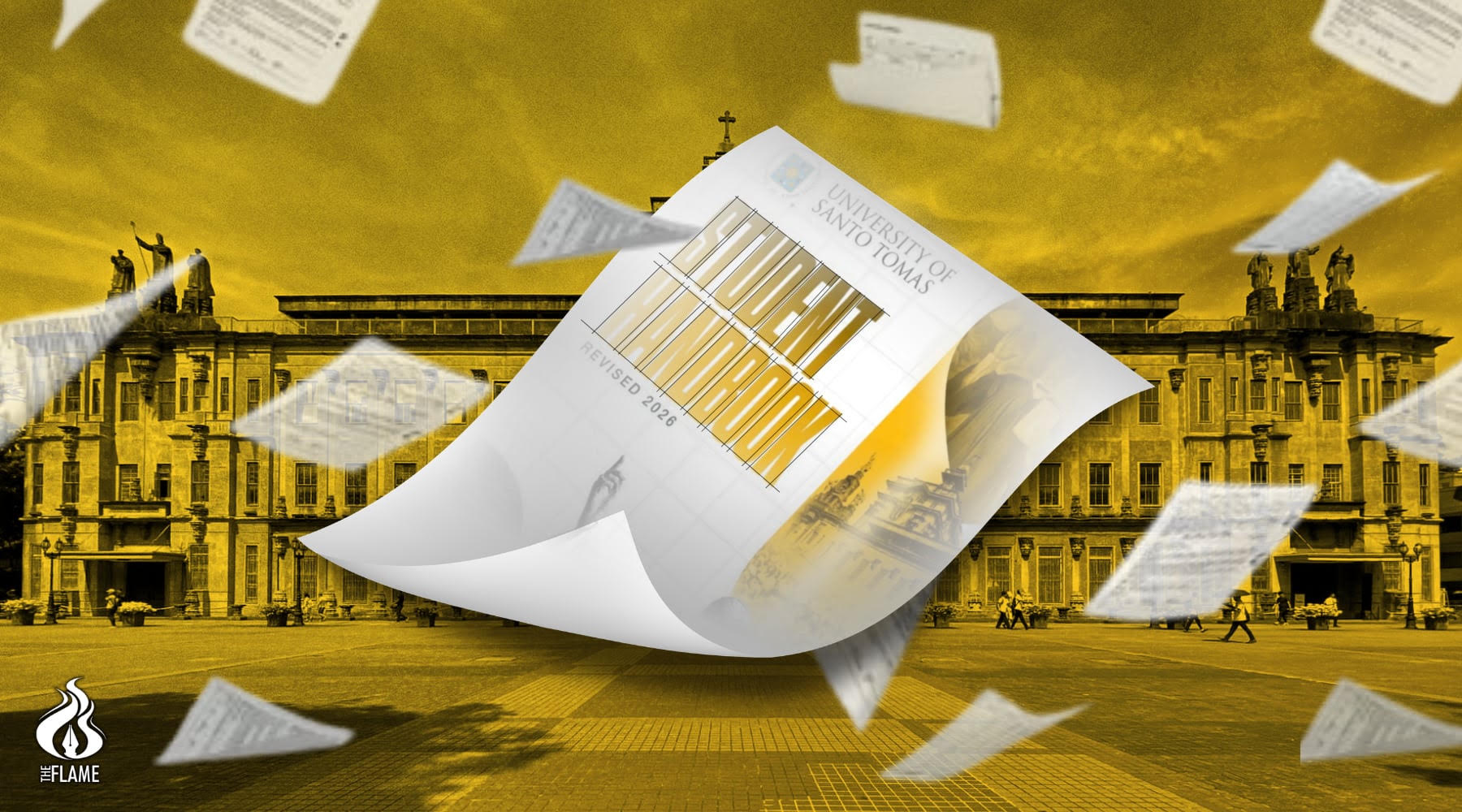
The University recently released the updated version of its student handbook after eight years in response to emerging technological advancements, changes in curriculum standards and administrative functions.
Policies, Procedures and Standards (PPS) No. 1018 has been revised to include rules on student assessments and disciplinary action for violations of academic integrity and honesty. The provision covers the improper use of generative AI and copyrighted materials.
“At all times, students shall uphold honesty and academic integrity and shall use technology responsibly, including generative artificial intelligence, plagiarism and grammar-checking tools, electronic resources, and materials protected by intellectual property rights. Any violation shall subject the student to appropriate disciplinary action,” the provision says.
Under PPS No. 1018, students who are involved in cheating, including those caught assisting or enabling the act, will receive an automatic zero on the assessment. This provision was not mentioned in the 2018 handbook.
Under the updated handbook, academic misconduct, including cheating, submitting falsified results and unauthorized use of another person’s work, is considered an offense punishable by non-readmission, exclusion, or expulsion.
Last year, UST released its guidelines on AI to enumerate clear standards for academic research and publication. The guidelines do not prohibit the use of generative AI but contain rules for its ethical application, including the disclosure of AI use and a prohibition against copying AI-generated output.
READ: UST issues AI policy on research and publication
According to the University’s updated handbook, all major examinations and high-stakes assessments, such as thesis defenses, must be conducted on-site.
Instead of a complete ban on gadgets, which was imposed under the old handbook, the revised rule now allows the use of electronic communication devices and gadgets during assessments and regular class hours when permitted by professors and academic staff. The provision, however, prohibits students from opening other websites or using other devices during online assessments.
PATHFIT now part of GWA
The revised handbook also includes the Physical Activities Toward Health and Fitness (PATHFIT) in the computation of the general weighted average (GWA) of Thomasians, whether taken within or outside the university. Previously, the computation of GWA included only Theology, in addition to the academic courses prescribed in the curriculum.
The National Service Training Program (NSTP) remains excluded from the GWA and is still required of Filipino students. Only international students who have completed a baccalaureate degree, a two-year vocational program, or an associate degree are exempt.
The updated handbook states that the NSTP course shall be taken during the first year. An exemption will be given to those with restrictive medical conditions, but they have to take the course not later than the second year.
The minimum academic units required of candidates to qualify for honors has been reduced from 76% to 75%, as provided in PPS No. 1025 of the new handbook.
Anti-sexual harassment policies
Unlike the old handbook, the latest version includes PPS No. 1034 on gender-based sexual harassment, pursuant to Republic Act No. 11313, or the Safe Spaces Act. The provision seeks to identify forms of harassment and investigate related cases within the university.
“UST further commits to promoting awareness of the value of respecting the dignity and rights of its employees and students through seminars aimed at addressing gender-based sexual harassment within University premises,” the manual reads.
The new handbook also introduces the Committee on Decorum and Investigation (CODI), which will investigate cases involving perpetrators who are employees, academic staff, or UST officials.
The Counseling and Career Center is now divided into two offices to strengthen the University’s mental health services: the Guidance and Counseling Center and the Career Services and Placement Office.
Recognition for athletes
The handbook also creates two new awards that recognize athletes: the Pope St. John Paul II Outstanding Achievement Award in Sports and the Arts and the Pope St. John Paul II Tradition of Excellence in Sports Award.
Pope St. John Paul II Outstanding Achievement Award in Sports and the Arts will be conferred on a student or group of students who achieve distinction in prestigious national or international competition or similar events in sports or the arts.
Meanwhile, a sports team that earns a championship in the same sporting event for at least five consecutive years from a reputable sports organization may be conferred with the Pope St. John Paul II Tradition of Excellence in Sports Award.
Revised enrollment system
The revised handbook also establishes a local enrollment committee to monitor the enrollment process, including registration, advising and course site assignments.
Teachers may now obtain their official class lists through Gurus Personal Access to Information Online, a portal for faculty members to record students’ grades and check employment records.
Cross-enrollment at another higher education institution is also allowed under the revised handbook, subject to academic advising from the program chair.
Fee adjustments
The penalty for students who drop from a program before the official start of classes now costs P10,000 from P5,000 previously.
For special terms, 50% of the payment will be charged for the first week and 100% for the second and subsequent weeks. This applies to both basic and higher education categories.
The provision stating that students whose fees are to be deducted from the salaries of UST officials, faculty members and support staff, and students who have scholarship grants, are not required to pay during enrollment, has been removed.
Other changes
The grading systems for the UST Graduate School and the Graduate School of Law are now also included in the revised handbook.
The handbook also institutionalized changes to the following terminologies:
- Physical Education to PATHFIT
- Psychotrauma Clinic to UST Graduate School Psychotrauma Clinic
- UST SIMBAHAYAN to SIMBAHAYAN Community Development Office
- Legal Aid to Chief Justice Roberto Concepcion Legal Aid Clinic
Changes have also been adopted to the University’s Vision statement, which now describes UST as a “leading Catholic institution of learning in the Asia-Pacific” instead of a “premier Catholic institution of learning in Asia.” F – Dave Justine Desilos, Betchemar Gonzales and Alden Stephen Texon