
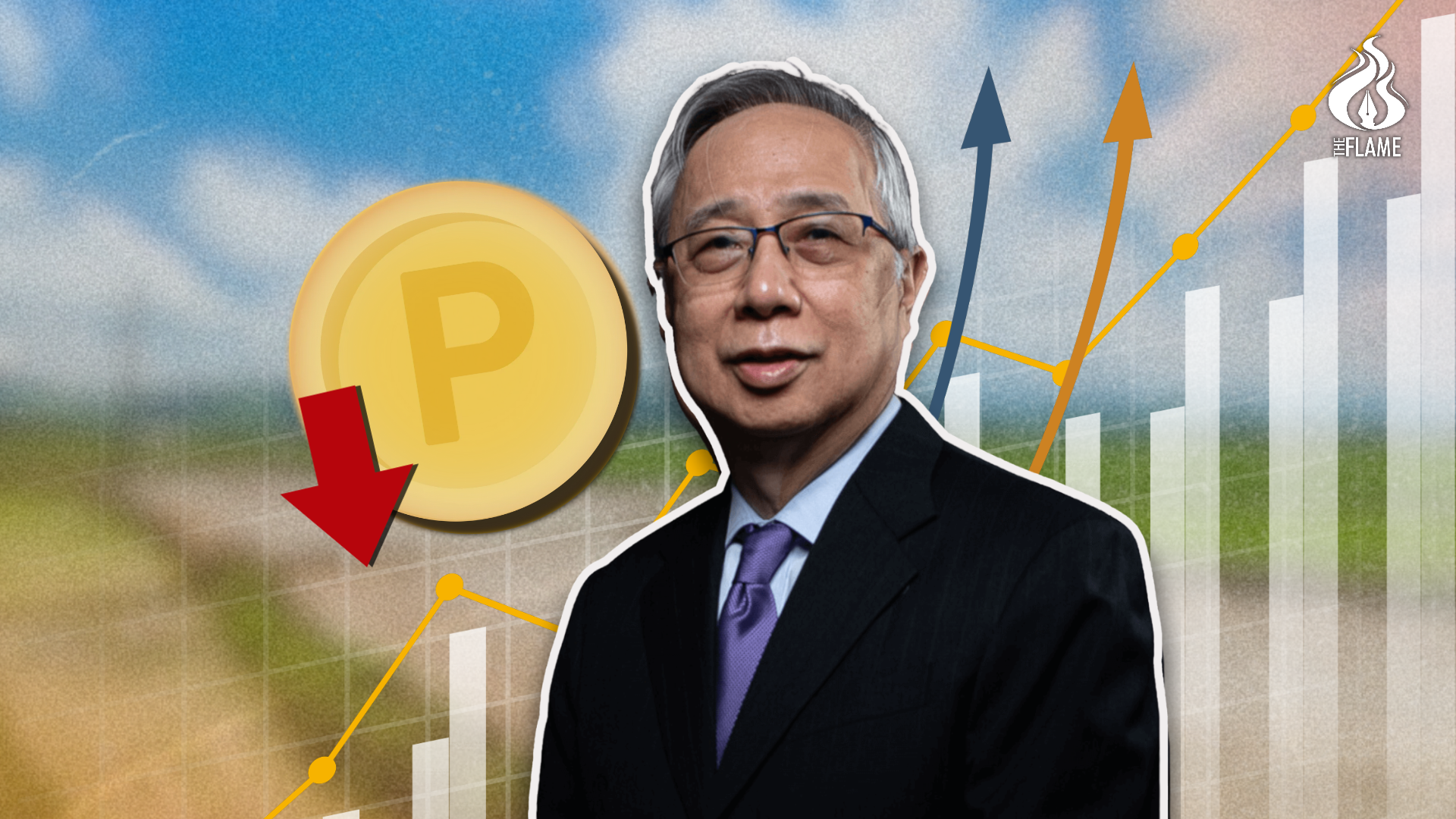
A WEAKER peso may enable the Philippines to make its exports more competitive, but the currency depreciation must be accompanied by efforts to boost farm productivity and lower business costs, an economic reform advocate said during a lecture held at UST on Thursday, Oct. 1.
Calixto Chikiamco, founder and president of the Foundation for Economic Freedom, said a weakened peso would benefit the country by reducing export costs and increasing tourism and the local spending power of overseas Filipino workers whose earnings are in US dollars.
Such benefits would outweigh the costs as long as it became part of a broader development strategy, he added.
“It cannot be by itself used to promote growth. You need to do other reforms together with that. Because if you are able to reduce the cost of doing this then the amount of depreciation need not be so high,” Chikiamco told The Flame after the lecture.
“If you bring down the food prices, then wages don’t have to be so high. So therefore, the amount of depreciation you need would be less.”
While Chikiamco acknowledged that a weaker Philippine peso would result in a “one-time inflation” due to more expensive imports, he said that supporting the country’s exports and welcoming foreign investments would allow competition within its industries, creating an “incentive to innovate.”
“If you’re exporting goods, you don’t have to export people. The export of goods will gradually reduce our trade deficit,” he said during the lecture.
According to the political economist, the government must also stimulate agricultural productivity and lower business costs for it to happen.
Chikiamco proposed agri-industrialization, or the development of industries based on agricultural products, as an area where the Philippines could compete.
He said the country should use its coconut products and marine resources and give more attention to its higher-value added crops, such as ube and mangoes, than its primary staple, rice.
However, Chikiamco said low farm productivity, limited farm-to-market roads, monopolies and high shipping costs and agricultural protectionism constrain agricultural businesses. He proposed removing the five-hectare landholding limit to allow agribusinesses to expand.
Beyond agriculture, he said, government investment in infrastructure could reduce logistics costs and help local firms compete.
He argued that economic changes must be pursued alongside political reforms, as weak institutions could prevent the country from carrying out a sustainable development strategy.
“It’s a matter of our government also making sure that [development] will happen. Now, of course, again, there’s no guarantee,” he said.
The lecture titled “The Philippines and Path Dependence: Understanding the Present Through the Past” was hosted by UST Artlets Economics Society and the Foundation for Economic Freedom at the Thomas Aquinas Research Complex auditorium. F


