
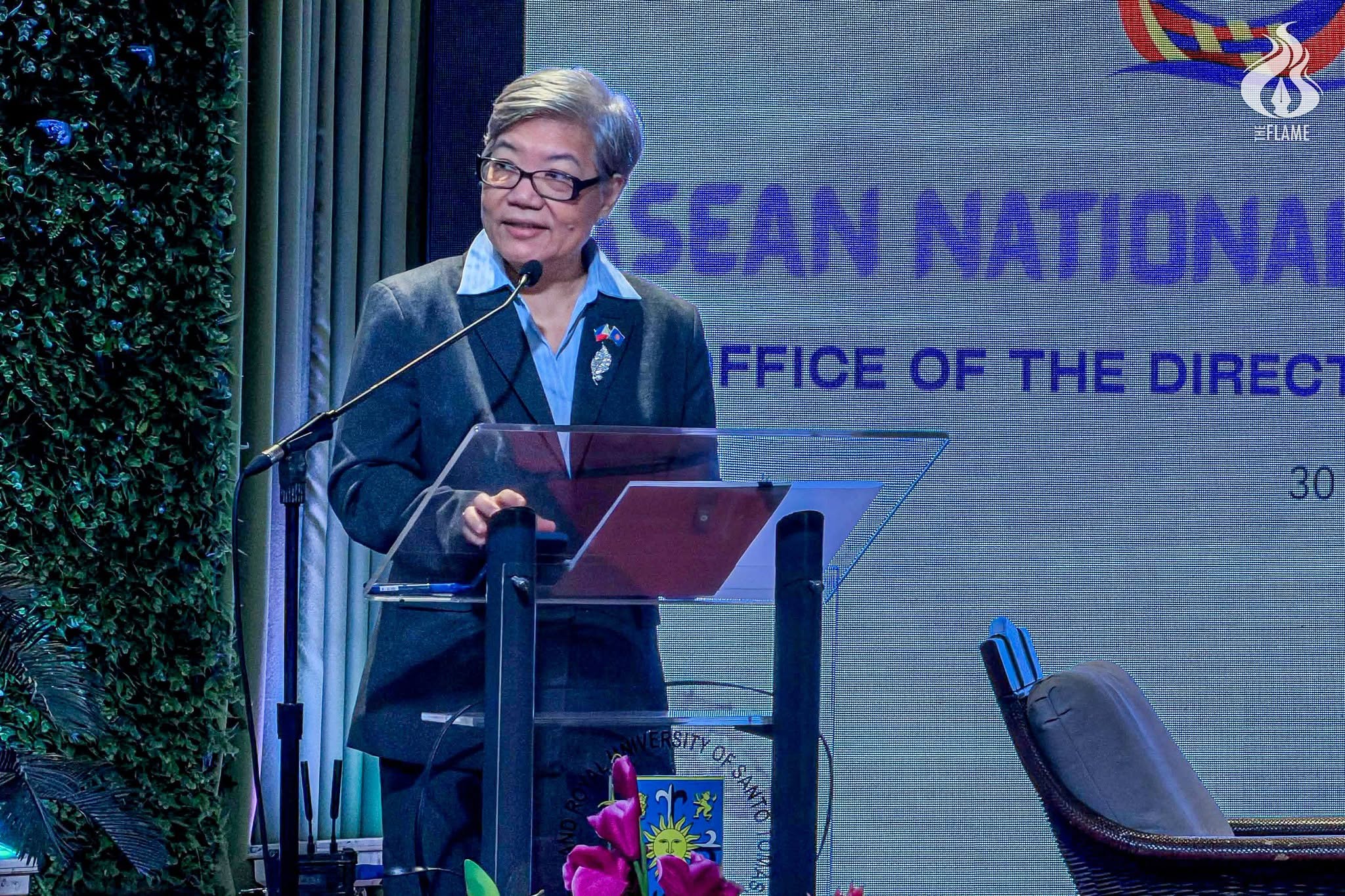
FILIPINOS SHOULD continue to monitor developments surrounding the Pax Silica initiative and remain vigilant while keeping dialogue and diplomacy at the center of discussions, a foreign affairs official said.
Ma. Hellen De La Vega, director-general for operations of the ASEAN 2026 National Organizing Council, said the government is studying the project from an economic perspective while considering concerns about its potential impact on ancestral lands and local communities.
“We’re looking at economic (aspect). Of course, this is not to undermine what you just said of the implications for ancestral lands and things like that. Because these are realities. But for policy, in the realm of public policy, these are actually the things that the governments are studying together,” De La Vega said during the 10th UST Ambassadors Lecture Series on Wednesday, Sept. 30, at the Buenaventura Garcia Paredes, O.P. Building.
“Let’s give it space. Continue to monitor, be vigilant, but there’s no alternative to dialogue and diplomacy. If something can be resolved through discussion, why resort to open hostility or something like that. We are a peace-loving country. This is in our constitution,” she added.
De La Vega said it is still too early to draw conclusions about Pax Silica, as policymakers continue to gather information on how it could affect the country. She described the initiative as “still evolving,” comparing its development to the early stages of globalization and technological change.
“It is very telling that it’s not a political or security agency that started the initiative. It’s the economic side of it. So, I want you to look at Pax Silica like we looked at globalization when it was just starting. It was evolving. It’s the same way with this, it’s also evolving,” De La Vega said.
De La Vega also cited Pax Silica’s regional implications for ASEAN, saying issues such as critical minerals could become relevant as discussions on this initiative develop.
According to her, the government is currently looking at Pax Silica as part of efforts to bolster the technological capabilities of industries in the Philippines and other ASEAN member states.
“We wanted to uplift the Philippines and ASEAN into a different kind of space. A much skilled capacity building of our industries,” De La Vega said.
“But it does not mean that questions will be disregarded. So there has to always be the principle of balance, moderation,” she added.
Pax Silica is a US-led initiative that aims to secure the supply of critical minerals, semiconductors and other materials needed for emerging technologies, including artificial intelligence.
The Philippines joined the initiative in April and is developing a proposed 1,600-hectare high-tech industrial hub in New Clark, Tarlac.
In his fifth State of the Nation Address this year, President Ferdinand Marcos Jr. said that Pax Silica could help boost the country’s economy by creating more jobs and giving the Philippines a stronger role in technology and manufacturing industries.
However, the proposed hub has received flak from environmental groups, farmers and indigenous communities about its risks on land, water resources, livelihood and the environment.
The Department of Environment and Natural Resources said during its 2027 budget briefing that it has not yet received an environmental impact assessment application for the proposed project. F


