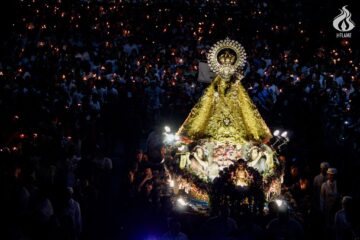
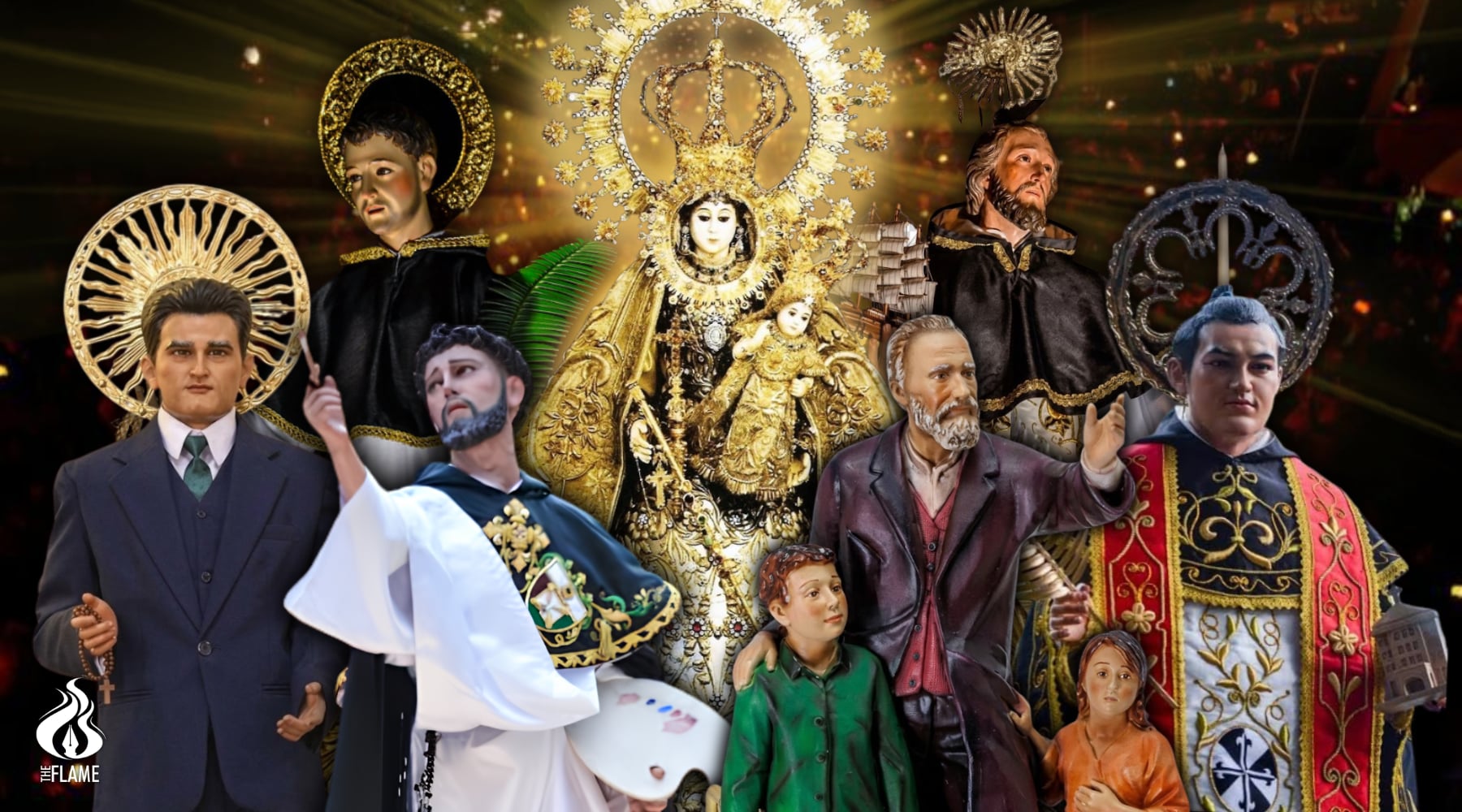
EVERY OCTOBER, the streets of Quezon City come alive with a centuries-old devotion as the image of Our Lady of the Most Holy Rosary of La Naval de Manila walks in a grand procession with an entourage of Dominican saints and blesseds.
The tradition dates back to the 1646 naval battles of Spanish and Filipino forces against the formidable Dutch fleet, whose defeat was attributed to the intercession of Our Lady of the Rosary. Centuries later, the devotion continues at Santo Domingo Church in Quezon City, where the faithful gather every October to honor the Marian image.
Walking alongside the patroness of Quezon City are also the 26 Dominican figures whose lives were shaped by unexpected faithful turns.
However, similar to the current escorts of the Our Lady of La Naval, this sacred procession may be enriched by the inclusion of saints and blesseds whose lives and legacies are also deeply rooted in the Dominican tradition and devotion to Our Lady of La Naval.
One found joy in mountain climbing and serving the poor, another turned away from Satanic practices to promote the Rosary, while others carried their faith across Asia despite the threat of persecution.
These six figures have lived lives that offer a glimpse of the many ways the call to holiness can unfold.
St. Pier Giorgio Frassati
Mountain climbing, friendship and service to the poor were among the defining parts of St. Pier Giorgio Frassati’s life. For the young Italian, faith was not separate from ordinary activities but something to be lived through them.
Born in Turin, Italy, in 1901, Frassati was a university student who regularly attended Mass and received the Eucharist. He also joined Catholic youth organizations and served people in need through the Society of St. Vincent de Paul, an international Catholic voluntary organization.
In 1922, he joined the Third Order of St. Dominic, taking the name Fra Girolamo and deepening his connection to the Dominican tradition.
While it is common to picture saints with solemn faces and halos encircling their heads, Frassati’s life shows that holiness can be practiced through friendships, studies and even through practical jokes despite struggles in life.
Frassati died in 1925 at the age of 24. Pope Leo XIV canonized him on Sept. 7 last year. He is also the patron saint of the UST Senior High School.
St. Bartolo Longo
St. Bartolo Longo’s life took a dramatic turn from his involvement in spiritualism to a renewed commitment to the Catholic faith. He would eventually become one of the most prominent promoters of devotion to the Holy Rosary.
Born in Italy in 1841, Longo studied law in Naples before becoming involved in spiritualism.
There, he was exposed to anti-Catholic teachings and eventually developed an interest in spiritualism. According to accounts, Longo was invited by a friend to a seance, which pushed him into Satanism. After being an active participant in a cult, he climbed its hierarchy and became a priest.
But Longo’s time in this faith was reportedly marred with physical and mental deterioration, including depression and suicidal tendencies. It took intervention from a childhood friend for Longo to be introduced to Fr. Alberto Radente, a Dominican priest, who gradually helped Longo renew his Catholic faith.
With the guidance of people who helped him return to the Church, including Dominican priest Fr. Alberto Radente, he gradually renewed his Catholic faith.
Longo joined the Third Order of St. Dominic in 1871 and dedicated much of his life to promoting the Rosary. He became closely associated with the Shrine of Our Lady of the Rosary of Pompeii and supported charitable initiatives for the poor and children of prisoners.
His work earned him the title “Apostle of the Rosary.” Pope Leo XIV canonized him on Oct. 19, 2025.
Longo’s story highlights the connection between Dominican spirituality and Marian devotion, a tradition reflected in the annual celebration of Our Lady of La Naval.
St. Domingo Ibáñez de Erquicia
Born in Spain in 1589, St. Domingo Ibáñez de Erquicia joined the Dominican Order and arrived in the Philippines in 1611. He taught at the Colegio de Santo Tomás in Manila, the institution that later became UST.
He eventually served as a missionary in Japan, where Christians faced severe persecution. Despite the dangers, he continued ministering to the faithful.
Domingo Ibáñez de Erquicia was martyred in Nagasaki in 1633 with St. Francis Shoyemon, who he received into the Dominican Order as a cooperator brother while they were in prison.
He was canonized in 1987 alongside St. Lorenzo Ruiz and other martyrs of Japan.
His life recalls the Dominican missionaries who helped shape the early Philippine Church and carried their faith beyond the country, even at the cost of their lives.
St. Tomás Hioji de San Jacinto
Born in Japan to Christian parents, St. Tomás Hioji de San Jacinto studied at a Jesuit school in Nagasaki before persecution forced him to leave his homeland. He arrived in Manila in 1614, where he took up philosophy and theology at the Colegio de Santo Tomás.
He eventually joined the Dominican Order and returned to missionary work in Asia. He served in Taiwan, until he returned to his home country, Japan, where persecution against Christians was still ongoing. Despite the danger surrounding Christian missionaries, he proceeded to preach to communities.
He was eventually captured, tortured and executed. In 1987, was among the martyrs of Japan that were canonized by Pope John Paul II.
Blessed Peter González
The maritime history associated with La Naval finds an echo in the life of Blessed Peter González, a Dominican preacher remembered for his association with sailors and seafarers.
Born in Spain around 1190, González entered the Dominican Order after a conversion that redirected his life toward preaching and service. He became known for his preaching and served as chaplain to King Ferdinand III
During his time as the king’s chaplain when Spain defeated the Moors in a battle, González restrained the king’s soldiers from pillaging and persuaded him to treat the defeated Moors with compassion.
After retiring from the court, he devoted himself to ministry in northwestern Spain, where he visited sailors aboard their ships, preached and prayed for them.
Over time, sailors came to invoke his intercession for protection at sea. He became popularly known as St. Elmo, a name also associated with St. Elmo’s fire, the electrical phenomenon sometimes observed as a glowing blue or violet discharge around ship masts during strong storms.
Despite his popular title, González was not formally canonized. In 1741, Pope Benedict XIV officially recognized his veneration in the Catholic Church.
Blessed John of Fiesole
For Blessed John of Fiesole, also known in Italy as Beato Angelico, art became a way to communicate the Christian faith. His religious paintings depicted Christ, Mary and the saints;. His works allowed viewers to contemplate biblical scenes and the mysteries of salvation.
Born Guido di Pietro, the Dominican friar became known as Fra Angelico for the beauty of his work and the holiness associated with his life. His paintings combined religious vocation with artistic talent. He presented sacred subjects, such as the angel Gabriel, the Virgin Mary and Christ, through images that invited prayer and reflection.
Among his best-known works are the frescoes at the Dominican convent of San Marco in Florence. He also worked in Rome, where he died in 1455.
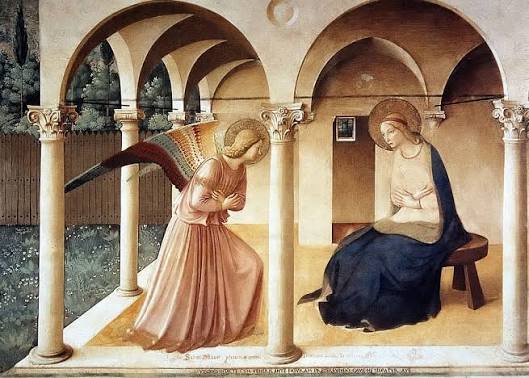
Pope John Paul II approved his liturgical veneration in 1982 and later proclaimed him as the universal patron of artists in 1984. He is the patron saint of the UST College of Fine Arts and Design.
His life remains an example of how artistic gifts can make the mysteries of faith accessible to others as they recount stories of faith throughout the centuries. F