RAYMOND ANDRE Lagmay remembers how the water glistened under the afternoon sun.
His uncle, Tito Inok, would bring him and his cousins to a riverside nestled deep in their barrio, somewhere in San Agustin, Isabela, after lunch. Their laughter echoed across the gushing current that helped cool down the summer day.
Andre looks back fondly at these moments, which came during the brief windows of rest his uncle would get after completing a seafaring contract. The then elementary school student looked up at his uncle’s tall figure swimming beside them.
Years later, he lowered his eyes to a gravestone, tracing the familiar curves of his uncle’s name engraved in delicate cursive upon the cool, polished stone. Sweet kakanin or rice cake laid spread across the cement, their surfaces catching the November sunlight as the midday heat settled over them.
“ ‘Yon ang earliest na talagang naaalala kong na-experience ko personally ‘yung pag-aatang (That is the earliest personal experience I have with atang),” Andre, now a Radio Technology freshman at Saint Louis College in Baguio, said.
While most families honor their departed by adorning their graves with flowers and candles, some in Northern Luzon, particularly in Ilocos and Isabela, express remembrance in ways that are delectable. As part of the atang, an appeasement ritual, families prepare meals and snacks with the intention of offering them to their departed loved ones.
That day was the anniversary of Tito Inok’s funeral. Earlier in the morning, Andre woke up to a bustling kitchen. He saw older relatives filling their family home with chatter and sounds from clanking pots.
“Maaga silang gumising para magluto (They woke up early to cook),” he said.
Andre’s cousins gathered in one part of the house, though their play was cut short by family members calling the young ones over to the kitchen to help. The fleet of little helpers heeded every instruction: bring me this, carry that. Wrinkled hands lovingly molded simple ingredients — glutinous rice, sugar, coconut milk and more — into kakanin, the family’s staple in rituals like this.
The family stayed for an hour or two, gathered around his uncle’s resting place. Nearly everyone would be there, save for the uncles who were studying college elsewhere.
This pag-aatang is an indigenous food-offering ritual for the dead rooted in Ilocano cultural and religious beliefs. Preparing the atang is also not confined to a single date like Undas. It is a constant in every important life event.
The custom reflects the Ilocanos’ view that spirits of those who passed on coexist with the living, wrote Fr. Jeff Clyde Corpuz, a researcher, in a 2020 study titled “Death and Food Offering: The Ilocano “Atang” Ritual from a Contextual Theology.”
“In this sense, death is not the end of life but a continuum in space and time. So death may be the first of last things, but it is not the end — it is a continuation of life in another dimension,” wrote Corpuz, who is also an associate professor at De La Salle University’s Department of Theology and Religious Education.
Family bonding
Not far from the Lagmay family home stands the Pascua residence, where Symon, Andre’s old schoolmate and a UST Literature sophomore, also has memories of performing the atang ritual.
Ever since Symon was a toddler, the custom came with a festive spirit seen during birthdays, graduation parties and holiday dinners for Christmas or New Year’s Eve.
Lively conversations between relatives who have not seen each other for months would fill the room. Bright decorations lined the walls, and young children played games for prizes. Uncles convened to encircle tables with ice-cold beers, while the background music tirelessly repeated familiar tunes.
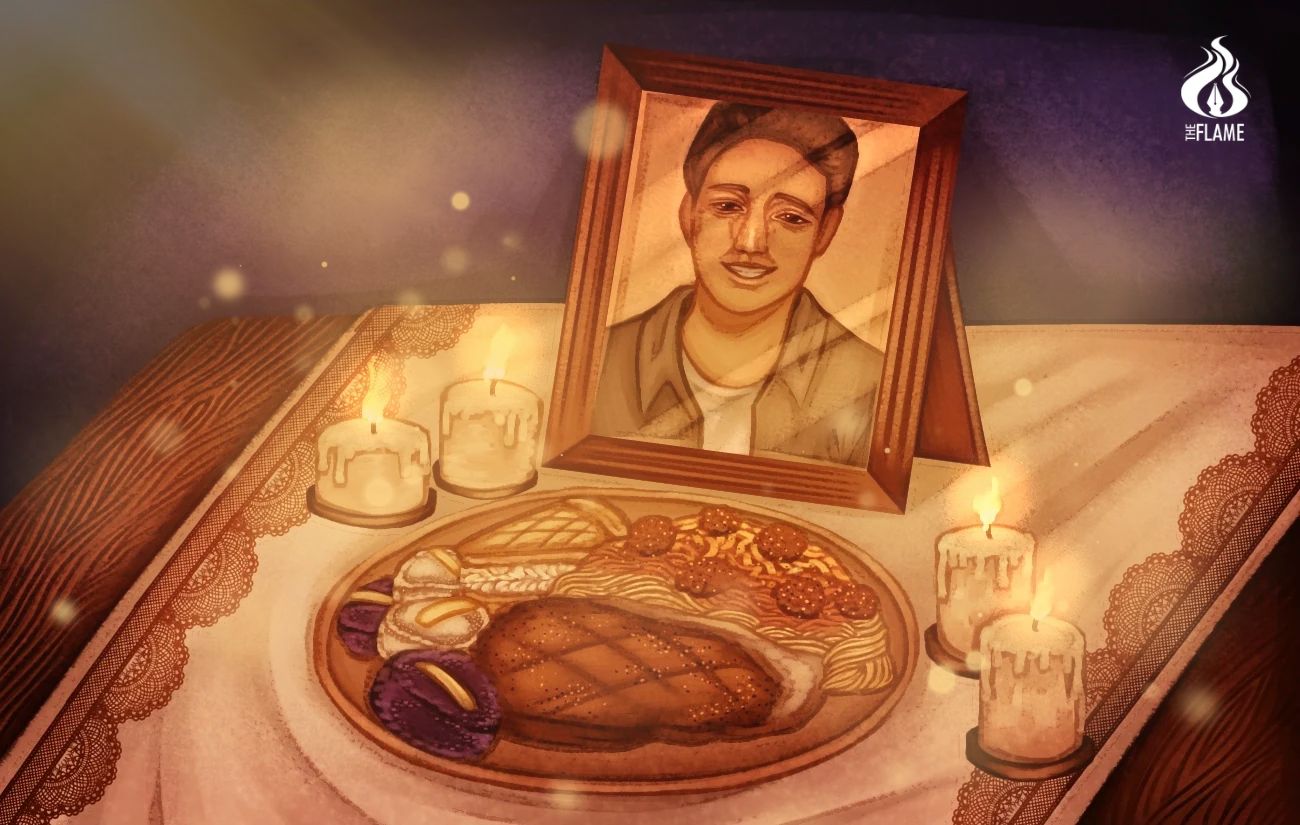
During these moments, the dinner table would host various delicacies and treats: shiny brown lechon and mountains of crispy lumpia, among other viands. Certain plates could not be touched for they are not meant for the living, but for those who are no longer there – souls whose presence are believed to remain at the family table.
“Fondest moments ko na connected sa atang is ‘yung nakukumpleto kami,” Symon said. “Kahit na wala na po ‘yung iba, nasa puso pa rin namin sila.”
(My fondest moment with atang is when we’re complete. Even though the others are no longer with us, they are still in our hearts.)
“Sa amin po sa Isabela, ang ina-atang namin usually is alak, soft drinks at kung ano ‘yung food na na-prepare sa isang occasion. Ilalagay sa platito… Mayroon din mga tobacco at cigarettes,” Symon said. “Kung ano po ‘yung food na kakainin namin, ‘yun din po food sa atang.”
(For my family in Isabela, what we offer for atang is usually alcohol, soft drinks and whatever food we prepared for an occasion. They will be placed on a small plate. There is also tobacco and cigarettes. What we eat is also the food for the atang.)
Other offerings include rice cakes, rice porridge, native wine, betel nut and whatever food the late loved one enjoyed.
Symon remembers leaving out plates for his late grandfather, whom he called “Daddy Florendo,” as well as for his Uncle Anthony. Some relatives they included in their offerings were ancestors he did not meet. Their faces lined the family altar, where the offerings would be made — peaceful expressions frozen in framed snapshots.
Through this, pag-aatang gives “being together” a whole new meaning.
According to Corpuz, some families perform the atang to seek favors, fulfill a sense of responsibility or ask forgiveness from the dead, while others believe the ritual can cure illnesses.
But Symon’s personal reason for having done the atang was not for otherworldly wishes or deals with spirits. Instead, he saw the custom as something that helped bind his family together.
“Part na rin po siya (atang) ng bonding namin,” he said.
(Atang was part of our family bonding.)
A family offering
Preparing a meal for the atang is a special act in itself. Although it is a widely-practiced custom, there are no clear cut rules that every pag-aatang ritual must follow.
Symon’s memories of doing the atang ritual consist of careful hands scooping the dishes from the dinner table onto platitos or mini plates, one for each soul to appease. For those that would want a sip of beer, a cup was poured, he said.
Other families choose to reserve a seat for the departed at the table, while others simply place their dedicated plates somewhere safe. For the Pascua household, they had their altar.
His grandmothers would light three candles and place them beside the offerings. The soft flickers lit the room with the glow of familial devotion. Rosaries hung from the photos. The living family members, standing before the dead, would then pray the five joyful mysteries of the Holy Rosary.
Looking back, Symon felt a mix of emotions whenever his family used to perform the atang.
“[I would feel] sadness kasi nami-miss [ko] ‘yung mga kapamilya na wala na… [Pero] nai-excite [din] ako kasi nakukumpleto kami or nagsasama-sama ang mga buhay pa,” he explained.
(I would feel sadness, because I miss my family members who passed away, but I would be excited that we, the living, are together.)
A dying ritual?
Back then, the tradition was a must-do. Neglecting to do the atang was “not at all allowed,” Symon said. But in both his household and Andre’s, the culture has been slowly fading like embers in the dirty kitchen.
Andre grew up watching and helping older family members prepare the offerings. His younger cousins, however, have grown up in a different world. Gadgets have increasingly occupied their attention, keeping them indoors and away from gatherings that made him and some of his cousins closer to their family and its traditions.
“Hindi kami (older cousins) lumaking may technology dito, technology doon. So we were still able to experience somewhat ‘yung tradition ng families namin,” he said. “Minsan nga po hindi na po sila (younger cousins) nakakasama sa mga ganoong events.”
(We older cousins did not grow up with technology here, technology there. We were still able to somewhat experience our families’ traditions… Sometimes, our younger cousins aren’t able to participate in events like this.)
Andre’s concern is not simply about the younger generation no longer participating in the ritual. It is about the meaning behind the practice that may become harder to pass on. The offerings might remain, but only for compliance, and the understanding of whom they are for could fade.
Preserving the tradition, he believes, means bringing younger children closer to the culture and helping them see beyond the act itself. They need to understand not only what they are doing, but also why and for whom.
“Immerse them in the sense that [they realize] they’re doing this for someone, ‘I’m doing this because this person is important,’ ” Andre said.
Incompatible with Catholicism
In the case of Symon, the last time he participated in the ritual was back in tenth grade before he left to study in Manila. It was during his grandmother’s birthday in April 2023.
His family has decided to let go of the ritual. Among those who decided to discontinue the practice was his mother, Maria, who learned that the piece of local culture could clash with Catholic teachings.
One time, a priest friend of theirs paid a visit to their house. Upon settling in the Pascua family’s living room, he caught sight of the altar with the offerings.
“Uy, may atang kayo? (You do atang?)” the priest pointed out. A discussion then ensued.
“Napag-uusapan [namin] na wala naman daw sa Bible iyon (atang),” Maria recalled. “ ‘Saka ‘yung pag-aatang ay nag-aanyaya pa ng mga negative spirits, kaya recently lang kami nag-stop,” she added.
(We were told that the atang is not in the Bible. Also, the atang ritual invites negative spirits, so we recently stopped it.)
Both mother and son admit that practicing the ritual had been some kind of obligation for them, something born out of inherited custom.
“Personally, nasanay lang po talaga sa tradisyon na ginagawa namin (Personally, we just got used to the tradition that we do.),” Symon said.
“Ang sinasabi lang naman noon [ng mga matatanda] ay ‘yung mga loved ones na pumanaw na, nandiyan lang sila, kaya ‘pag nakakain, kailangan mo rin pagsilbihan kagaya ng pagsilbi natin noong nabubuhay pa sila,” Maria added. “Pero sabi ng mga pari, patay na sila — paano sila makakain?”
(Our elders just told us that our late loved ones are just among us, thus when we eat, we must also serve them like how we would while they were still alive. But just like what the priests said, they are dead now — how can they eat?)
Although Symon admitted that it felt odd at first when his family stopped the tradition, but he eventually came to accept it.
To each his own
The very thesis of Corpuz’s paper focused on addressing the supposed incompatibility between atang and what Catholicism preaches.
According to the paper, atang should be understood as not just an indigenous custom but a “form of religious inculturation.”
In Catholicism, inculturation is where the teachings of the Church are integrated into the culture of a community. The late Pope John Paul II, according to the International Theological Commission, understood that the future of the Church rests on the dialogue between faith and culture.
“Atang… is an inculturated form of liturgy among Ilocano Catholics to remember their dead loved ones in belief that they are in communion with the saints and Jesus Christ as the Savior,” Corpuz wrote.
The paper further argues that the ritual is consistent with Church teachings, as Filipino Catholics believe in the communion of the living, the dead and the saints. The practice of offering food in the atang ritual may be seen as a reflection of the communion of saints.
Instead of being an outright defiance of Catholicism, the atang tradition can become an expression of faith that extends to the locality’s cultural context.
“It is suggested then that other Filipino indigenous practices, norms, beliefs, culture and traditions be explored to strengthen local theology in the country,” Corpuz’s paper read .
Nonetheless, atang still persists as a beloved ritual for many families in the North, such as Andre’s, although this practice is mostly observed only in Undas.
But even Andre is not encouraging families to observe this culture if they no longer wish to.
“It’s their choice,” he said.
For Symon and his mother, refusing to do the atang is a personal and firm choice. As of now, they are convinced that saying shared prayers and keeping memories of the departed in their thoughts serve as remembrance enough. Neither does the Literature student hold any strong desire to preserve the custom when he already has a family of his own.
“Mas gusto rin po nina [Mama at ilan kong tita] na maging mapayapa na ang aming mga kapamilyang sumakabilang-buhay,” he said.
(My mother and some of my aunts prefer our late loved ones to be at peace.)
As dusk settles over the neighborhood and the Undas season steadily wanes, some houses still glow with candlelight and small plates of food can be seen in their dinner tables or in altars. In the middle of this, reconnecting family members indulge in their togetherness while remembering those who have passed on.
Others, like Symon’s family, remember the departed through subtle forms, allowing the scent of atang offerings to fade into the background, and to be confined in the memories of those who still practice it. F