
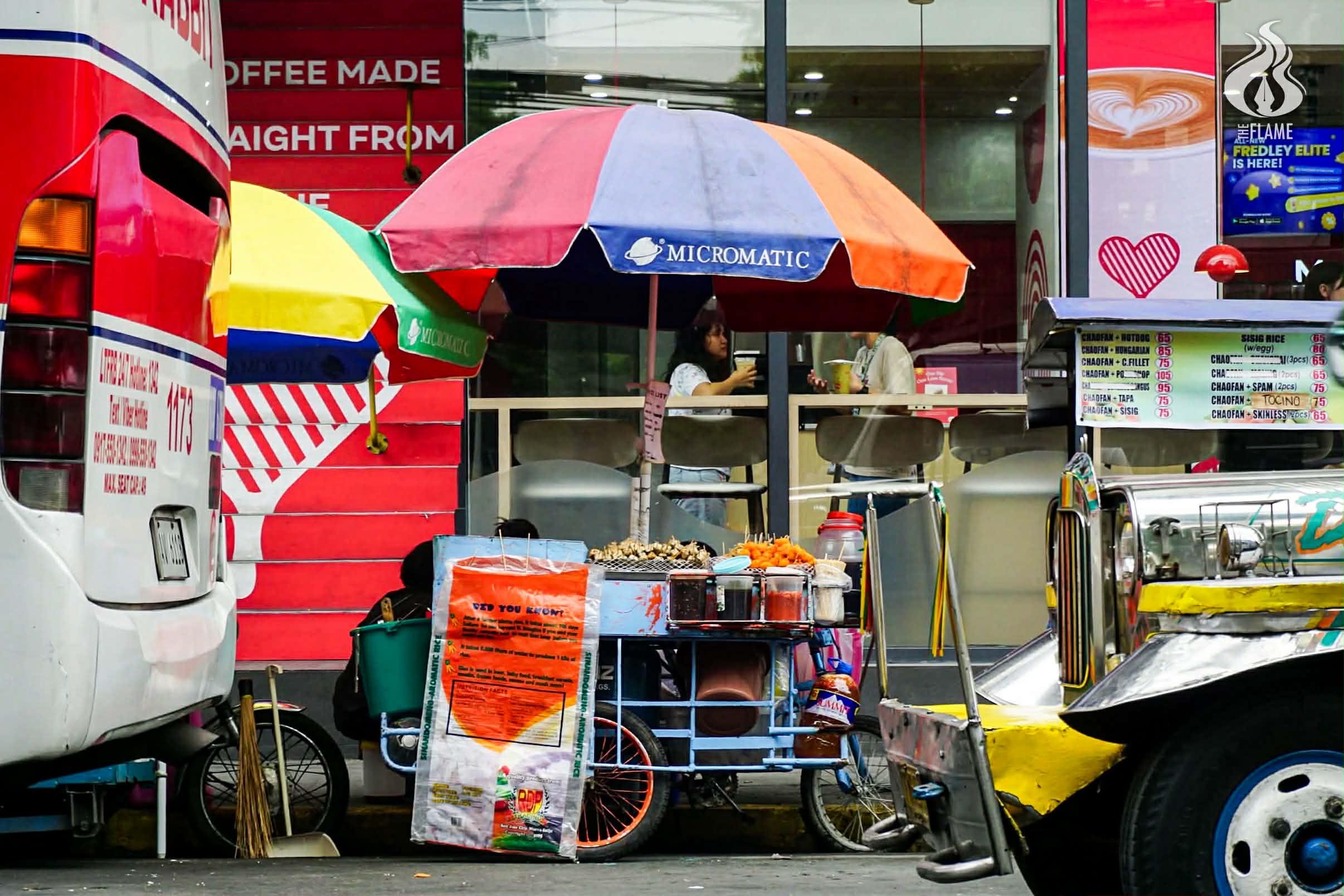
THE SUN burns hotter than the oil they use to cook their saba snacks at Antonio Street.
For more than 25 years, the livelihood of Wilson Ceynas and his wife coming from banana snacks, including turon, maruya and banana cue, have been affected by rising costs, prompting them to continue selling despite the scorching heat of the sun and fewer patrons.
“We really lost a lot. Now we earn so little, only half,” Ceynas told The Flame.
“With how difficult life is right now, if you don’t earn, you can’t cook rice… We endure hardship, heat and cold because we can’t survive without earning from this.”
In a sense, they are in many ways like their sweet offering.
They are tossed, though not with brown sugar, but with the struggle of making both ends meet; skewered not on bamboo sticks, but on a situation where their fates are practically determined by powerful people they vaguely know; submerged not in oil, but in uncertainties brought about by a war they have nothing to do with.
Indeed, the humid temperature is the least of the couple’s concerns for now.
The ceasefire agreement between the US and Iran, whose war has triggered price shocks, offered little comfort to Ceynas as he faces uncertainties with the reduction of onsite classes at UST.
Universities nationwide have been given the leeway to hold all classes online and adopt flexible learning modes until the end of this academic year after President Ferdinand Marcos Jr. declared a state of national energy emergency on March 24.
The emergency is meant to ensure that the Philippines, which is heavily dependent on imported oil, has enough fuel supply while the Middle East situation is volatile. The declaration will remain in effect for one year unless extended or lifted.
To cushion the impact of higher energy costs, UST allowed academic units to hold half of their remaining classes online.
RELATED: UST allows academic units to hold up to half of classes online to conserve energy
The Faculty of Arts and Letters decided to retain its 30% online learning setup, but has adopted an enriched virtual mode for two weeks, a period that coincided with the thesis and thesis proposal defense.
With their little stall now only earning P350 daily from P800, the Ceynas couple continues to cook their P25 banana snacks throughout the day. They start from 9 a.m. and end at 5 p.m or until they ran out of banana leaves for their offerings.
Despite this effort, their stall now only earns P350 a day from P800. But they opted not to increase prices, hoping that the high sales volume will offset the costs.
While on-site modality will remain for summative assessments and skill-based courses, Economics instructor Augusto Laforga explained that more online classes would stifle the earnings of multiple sectors whose main patrons are students
“Many will suffer…Jeepney drivers already earn so little, and they’ll lose passengers. We’re talking about more than 40,000 students, and I haven’t even counted the employees and faculty yet. So many industries will be hit: transport, small vendors and dormitories,” Laforga told The Flame.
Because if the higher costs and fewer campus traffic, street vendors like Ceynas and Janet Dayus are worried that they might not be able to make both ends meet.
“Of course, it’s saddening. We wouldn’t earn, especially when we’re just renting [our residence] and this is our only source of income. This is only where we get our money,” Dayus said.
Double the cost, double the price?
The price of saba bananas had already jumped from P4 to P6 per piece, according to Ceynas. But raising the prices of his snacks is not yet among the options of Ceynas, who is wary about the potential impact of the adjusted price on his sales.
“Everything and everyone has gone up. I’m the only one who hasn’t raised mine,” he said.
“I’m not yet [changing my prices] because it’s going to shock the customers. I’d increase prices if everything goes up, because if I don’t, there would be no profit for me.”
It was not the case for Dayus, who was forced to hike prices after the costs of kerosene and bananas had doubled. Prices for bananas have risen to P70 per kilogram, while a P300 worth of kerosene that usually lasts for more than a day, cannot even hold until the evening, according to Dayus.
Now, a piece of turon and a cup of eight cheese sticks from Dayus’ stall cost P5 higher from P20 and P30, respectively.
“We’re affected badly… what we earn for rice is not enough because we also pay rent,” the 39-year-old vendor told The Flame.
“Those who buy now from us have reduced the items they are consuming… They’re still getting used to it.”
According to Asst. Prof. Teresita Balgos of the UST Department of Economics, vendors around UST often run on limited capital and make small profits, making it difficult for them to adjust prices quickly, as their main customers are students.
“Any increase in production costs further limits their businesses, disincentivizing them to engage in business. Raising prices may not be an immediate option,” the economist told The Flame.
Oil firms implemented massive hikes in April after global supply routes were disrupted by the closure of the Strait of Hormuz, a narrow waterway between Iran and Oman that serves as the passageway of about one-fifth of the world’s oil.
The disruption raised international contract prices and shipping costs, pushing global crude to rise above USD100 per barrel from around USD70.
For the Philippines, the 35th largest importer of crude oil in 2024, this shock translated quickly into higher pump prices and faster inflation. Headline inflation in the Philippines spiked to 4.1% for March from more than 2.4% in the previous month.
Fuel prices climbed by P7 to almost P39 more than a week into the conflict’s escalation, according to the Department of Energy (DOE).
In the second week of May, the DOE reported that prices per liter for diesel and kerosene are rolling back significantly by about P10 and P13, respectively, while gasoline continued to increase by almost a peso.
While prices are simmering down, this year’s accumulated net increase in fuel prices now tallies at an average of around P43, a big jump from the same period last year, which tallied an almost P3 average net increase in fuel prices based on the DOE’s data.
Because LPG is also imported and priced against those same international benchmarks, cooking gas rose alongside other fuels.
DOE monitoring shows that an 11-kg cylinder will now cost an estimate of P1,070 to P1,702 this month from P825 to P1,135 in March, an increase of about P18 to P38 per kilogram.
Laforga explained that changes in fuel supply trickle down even to goods not directly related to oil once delivery costs are factored in. The economist noted that vendors do not realize profit from each sale, adding that they are already in a situation where they are forced to shoulder costs that eat up their profits.
“It’s an unavoidable domino effect that will affect everyone,” Laforga told The Flame.
For Mario (not his real name), a corn and mango seller at Rosarito Street, the latest surge in cooking gas has been devastating.
“I cannot even switch to coal or wood because ashes would fill the street,” Mario said.
“Even though we weren’t hit by a literal missile, it felt like a missile hit us,” the vendor added, likening the price hikes to the air strike carried out by Israel and Iran.
Vulnerability
As the global conflict in Iran drives fuel prices to record highs in the Philippines, Artlets professors are pointing to the country’s lack of focus on domestic energy sources as a key vulnerability.
RELATED: How to reduce impact of global oil supply shocks? Build local economy, Artlets profs say
According to Balgos, the country should revisit trade agreements, protect vulnerable industries and target self-sufficiency in agriculture and food production.
Asian Studies department chair Jonathan Eli Libut said the Philippines should review whether its present arrangements in trade and energy are too rigid, with geopolitical shocks becoming more frequent. The country has to look into diversifying its suppliers and building relations with countries that can serve as its alternative fuel providers, he added.
“The problem exposed by this war in the Middle East is not only dependence, but dependence without enough flexibility… That alone tells us our existing arrangements are not resilient enough,” Libut told The Flame.
Political Science department chair Assoc. Prof. Dennis Coronacion said despite the “stopgap measures” of the government, such as the subsidies given to public transport drivers and the suspension of excise tax on cooking gas, political instability remains possible as economic concerns prolong.
“The economic aspect is the most serious aspect of the conflict in Iran… You would blame the government for being unprepared,” the political scientist told The Flame.
“If the government doesn’t resolve [the economic aspect] in the long run, we might have political instability. There will be popular unrest,” Coronacion added.
To cope with higher fuel prices, the Philippine government has provided public transport drivers with P5,000 subsidies, with some cities like Manila also rolling out additional fuel allowances. The administration also provided a 50% discount on LRT-2 and MRT-3 fares.
The Land Transportation Franchising and Regulatory Board approved minimum fare hikes of P1 to P3 for public utility vehicles, but President Ferdinand Marcos, Jr. ordered its deferment to provide relief to commuters. However, the decision did not sit well with some transport groups who complained that the higher costs are making it difficult for drivers to provide for their families.
The President also signed Republic Act 12316 on March 25, allowing him to suspend the excise tax on petroleum products.
To handle shocks better in the future, Libut cited the need for the Philippines to diversify its suppliers.
“This is about trade, energy, and infrastructure, but it is also about discipline in governance. A resilient socio-economic ecosystem is not just one with resources. It is one with memory. It remembers previous shocks and changes before the next one arrives,“ Libut said.
“The Philippines cannot keep reacting to every energy shock as though it were a surprise. Our country needs to treat energy security as part of national resilience,” he added.
While a ceasefire has kept prices stable since early April, Ceynas is not pinning its hopes on the negotiations among the conflicting parties.
“We don’t know what will happen, maybe we’ll just see.”
As the fresh Middle East conflict disrupts the daily life on campus, cotton candy vendor Roberto Clasara, who has been selling the confection around UST since 2008, said he would just roam around nearby schools if UST crowds dip.
“If more students come back on-site, I can stay here and maybe adjust prices. For now, I just keep selling until I make decent sales,” Clasara said. F