
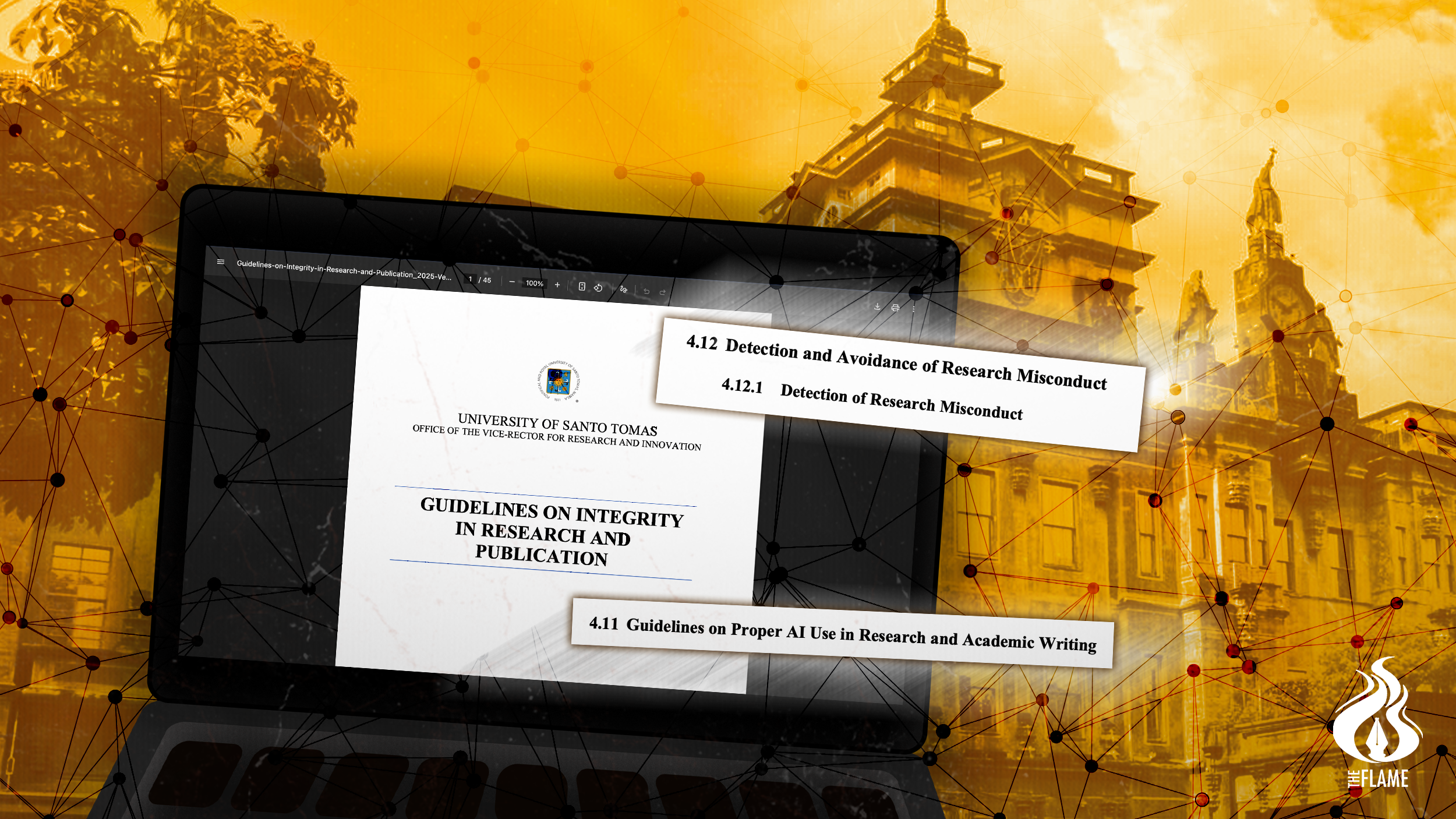
THE UNIVERSITY has released its first formal guidelines and policy on the use of artificial intelligence (AI) in academic research and publication to ensure that all scholarly endeavors are compliant with ethical standards.
The newly crafted AI manual is integrated in the 2025 UST Guidelines on Integrity in Research and Publication, which governs all UST researchers, academic and non-academic staff, students and visiting scholars.
Grounded on four core principles, namely accountability, transparency, ethical responsibility and scientific rigor, the policies and guidelines were adopted as various AI tools are being incorporated across different stages of research work.
It is the first time UST sets research standards on AI, placing the Dominican-run school among the few institutions in the Philippines with guidelines on the technology. Among the institutions that have adopted such a policy are De La Salle University, the University of the Philippines and Far Eastern University.
The manual adopts the 2025 International Committee of Medical Journal Editors Recommendations, which does not prohibit AI, but focuses on its responsible and ethical use, including the mandatory full disclosure of AI assistance and the author’s public responsibility for plagiarism.
“The rapid integration of [AI] into various research lifecycle stages presents unprecedented opportunities and challenges. While AI promises to accelerate discovery, enhance analysis, and automate tasks, it also introduces novel avenues for research misconduct,” the document, a copy of which was obtained by The Flame, read.
Under the new set of guidelines, researchers are required to disclose in their paper the use of all forms of AI technologies, including large language models, chatbots and image generators.
AI used in writing assistance must be mentioned under the acknowledgement section, while AI tools used for data collection, analysis and figure generation should be disclosed in detail under the methods section.
According to the guidelines, chatbots such as ChatGPT, Gemini and Perplexity AI are not permitted to be listed as authors as they hold no accountability for the accuracy, integrity and originality of the paper. Such responsibilities, the document added, fall on the human authors alone.
“Humans are responsible for any material submitted that involves AI-assisted technologies. Authors should carefully review and edit the results, as AI can produce outputs that sound authoritative but may be incorrect, incomplete, or biased,” the document read.
Prohibited acts
Students, faculty or other members of the Thomasian community may face several counts of misconduct if AI is improperly used.
Section 4.11 of the manual states that “copying and pasting large blocks of AI-generated content” may be considered an act of plagiarism without proper acknowledgement and rephrasing. The act may also count as academic misconduct if presented as the human author’s original thought.
The guidelines also warned that using AI-generated text without proper paraphrasing and citation may constitute plagiarism, as such outputs can closely resemble human writing. The manual added that AI can generate synthetic datasets that appear authentic, which some researchers might misuse to support their hypotheses, leading to a case of data fabrication or falsification.
Meanwhile, failure to disclose the extent of AI use in producing text, figures, or analyses may equate to misrepresentation of the researcher’s actual contribution and therefore count as misconduct.
The guidelines also raised the “black box” problem in AI, noting that many advanced algorithms produce outputs that are difficult to interpret or trace. Researchers are expected to understand and explain the AI tools they use, as failing to do so may result in misinterpreted and misrepresented findings.
Other forms of misconduct specified under the manual are misuse of research funds, sabotage, unauthorized use of intellectual property, failing to comply with regulations and inadequate mentorship.
Sanctions
Individuals proven to have engaged in research misconduct may face penalties, which can range from disciplinary measures to even termination.
According to the manual, a finding of misconduct requires proof that the act involved a significant departure from accepted research practices, was committed with intent, knowledge, or reckless disregard, and was established based on sufficient evidence.
Anyone who faces allegations of misconduct will undergo an initial assessment by a committee composed of one to three persons. If a potential misconduct is found following the assessment, the committee would gather more information to identify whether the evidence calls for a full investigation.
During the inquiry process, the committee may interview the complainant, the respondent, and other relevant witnesses, and review research records and materials. The respondent must also be notified in writing of the allegations and given the chance to respond.
After the inquiry, the committee will submit a report of its findings and determine whether a full investigation is needed. If initial findings suggest possible misconduct, the case would be endorsed to the faculty tribunal of the concerned academic unit for further resolution.
The manual was crafted with the contributions of Prof. Florence Navidad of the Institutional Research Ethics Board (REC), along with several UST Research Ethics Committee (REC) units:
- Hospital REC
- Graduate School REC
- College of Rehabilitation Sciences REC
- College of Nursing REC
- Faculty of Pharmacy REC
- Faculty of Arts and Letters REC
- College of Science REC
- Senior High School REC
- College of Education REC
- Faculty of Engineering REC
- College of Commerce and Business Administration REC
- College of Fine Arts and Design REC
The following academic units also contributed to the manual’s content: Faculty of Medicine, College of Information and Computing Sciences, College of Tourism and Hospitality Management and Institute of Physical Education and Athletics.
Executive Assistant for Intellectual Property and Research Assoc. Prof. Michael Jorge Peralta and Executive Assistant for Research Operations and Management Prof. Cecilia Moran served as consultants.
The final manual was endorsed by Vice Rector for Research and Innovation Fr. Jannel Abogado and was approved by UST Rector Fr. Richard G. Ang, O.P. F




[…] READ: UST issues AI policy on research and publication […]
[…] READ: UST issues AI policy on research and publication […]
[…] READ: UST issues AI policy on research and publication […]