
CANDIDATES RUNNING in the UST Faculty Union (USTFU) elections accused the Commission on Elections (Comelec) of potentially disenfranchising teaching staff by maintaining a purely onsite voting system despite increased online work arrangements.
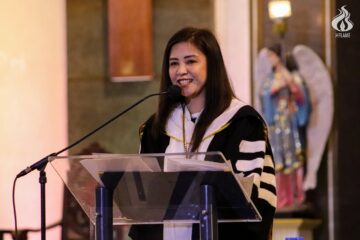
USTFU secretary general candidate Katherine Alonday-Lactaoen slammed the Comelec’s decision to reject pleas for a hybrid election system, saying teachers would struggle to vote due to transportation constraints amid the global oil crisis.
“Ever since the beginning, we have been urging (the Comelec), please be in touch with reality, look at how many of us will be disenfranchised,” Lactaoen said during a press conference of the Sulong party on Saturday, April 25.
“They know there are colleges in EVM (Enriched Virtual Mode) during that time, but look, Comelec denied our appeal and our request because the schedule is tight and whatnot,” the senior teacher from the Senior High School added.
The USTFU elections for faculty members in the UST Graduate School and Faculty of Civil Law were held on April 25, while the general elections are set for April 28 to 29.
The current schedule is a compromise between the poll body and faculty groups, which previously called for a three-day voting period as the original April 28 sole-voting day was deemed “unduly burdensome.”
READ: UST faculty groups seek extension of USTFU one-way election
Lawyer Jennifer Lam-Saludo, who is vying to be USTFU vice president for grievance and complaints, also questioned the Comelec’s decision in light of the University’s announcement of its online setup, pointing out the supposed disparity in the treatment of students and teachers.
“What we are worried about is the disenfranchisement of voters…there are colleges, I just can’t enumerate one-by-one, [but] during the election, they would be in EVM. It feels disrespectful for those who will come here [on campus] just to vote,” Saludo said.
“[If] that is the decision of the management for our students, what more for us USTFU members who are also traveling or commuting to get here to the University?” she added.
In a motion for reconsideration letter dated April 11, Sulong said an onsite voting modality is “foreseeably exclusionary” for voters because of global issues that they claim were “similar if not worse than the COVID-19 pandemic.”
The party emphasized the need for an online setup to ensure the elections remain accessible to all union members.
Meanwhile, USTFU candidate for president Prof. Revenendo Vargas, who is running under the FAIR party, also called for a hybrid election like the union’s online voting conducted in 2021 during the pandemic.
Vargas, a faculty member from the Institute of Religion, criticized the USTFU incumbent leadership for supposedly failing to anticipate and adapt a permanent resolution to the union’s current voting concern.
“Rather than being a standard, institutionalized procedure, the shift to a hybrid mode is being treated as an emergency intervention. We must hold our leaders accountable for this lack of foresight; the stability of our democratic processes should not depend on last-minute remedies, but on proactive governance,” he said in a statement posted on Facebook on April 14.
In response to the proposals submitted by Sulong and FAIR, Comelec said that decisions over the election policies and the determination of the voting modality are under the authority of the USTFU Board of Directors.
“The Comelec, in its mandate, implements policies and resolutions as approved by the Board and does not have the authority to initiate or decide on such matters independently,” the letter, dated April 15, read.
The Comelec directed both parties to relay their concerns to the USTFU officers and Board for proper consideration, adding that the two groups must convene for the appropriate resolution to determine the most suitable election modality.
However, Saludo explained that a quorum was not met as only eight out of 22 Board members attended.
In its motion for reconsideration, the Sulong party refuted Comelec’s response, saying the poll body is also mandated to adopt and promulgate rules and regulations to secure secret balloting and enable broad participation under the USTFU Constitution and Bylaws.
Rule on uncontested bets
Sulong vice president for legal affairs aspirant Asst. Prof. Danielito Jimenez also disapproved of the USTFU Comelec’s new 50% plus one provision for uncontested candidates, saying the change is unconstitutional because it was not in place in the last elections.
Under the new election guidelines released by USTFU Comelec, the winner of unopposed positions will be determined by counting at least half plus one of the total votes cast.
“Sulong is appealing to the Comelec… because it is surprising that there is a new guideline requiring a “50% plus one” to those who are running unopposed… This is a revision of the USTFU Constitution and Bylaws because it is not the provision written in the previous elections,” Jimenez said.
The Sulong party has four candidates running uncontested in this year’s elections. They are seeking the posts of internal vice president, external vice president, treasurer and sergeant at arms. Meanwhile, the FAIR party’s auditor aspirant is the lone candidate for the post.
Following disputes with Comelec, Sulong presidential candidate Asst. Prof. Emerito Gonzales called on fellow faculty members to exercise their right to vote despite the commission’s decision.
“We exerted exhaustive effort presenting rigorous legal arguments to the UST Comelec to advocate a hybrid voting system. We believe that in this digital age, your convenience should be a priority,” Gonzales said.
“Our responsibility to cast our ballots is the only way to secure the future of this union… Without that collective voice, we cannot effectively protect the gains of our CBA (collective bargaining agreement) or continue the fight for a just share for all,” he added. F