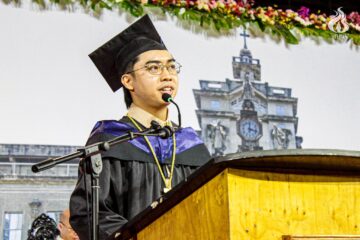
(Editor’s note: The full text of the address of thanks of Asst. Prof. Joselito Zulueta, summa cum laude of UST Graduate School Class of 2026)
The Very Reverend Father Richard G. Ang of the Order of Preachers, Rector Magnificus, our Graduate School Dean, Dr. Mike Vasco, Father Regent, Rodel Aligan, O.P., my fellow graduates, distinguished faculty, administrators, families, friends, ladies and gentlemen:
Good afternoon.
If you look at today’s program, you will see that something is very curious. This ceremony is not officially called graduation. It is called a Commencement Exercise.
At first glance, that seems backward. After years of coursework, comprehensive examinations, research, thesis writing, revisions, consultations, deadlines, and more deadlines, we naturally think of today as an ending. We have crossed the finish line. We have completed a long and demanding journey.
And yet the University insists on calling this occasion a commencement—a beginning.
The word itself comes from an ancient academic tradition. In the earliest universities of Europe, a commencement was not a farewell ceremony. It was the moment when an apprentice scholar became a master or a doctor and formally entered the community of learned people, and it marked the beginning of a new responsibility: to teach, to lead, to create knowledge, and to place one’s learning at the service of society.
The “exercise” in commencement exercises would refer to the public acts by which students demonstrated that they were worthy of admission into that scholarly guild or association—through disputations, lectures, debates, and dissertation defenses.
In other words, commencement was never about leaving the university behind. It was about carrying the university’s mission into the world.
Today, we stand within that centuries-old tradition.
As graduates of the University of Santo Tomas, we belong to an academic lineage stretching back more than four centuries. Founded in 1611 by the Dominican Order, UST is generally recognized as the oldest existing university in Asia. Yet even UST was heir to older traditions, particularly of those great Spanish universities, Salamanca and Alcalá de Henares, whose intellectual culture helped shape the educational ideals the Dominicans had brought to the Philippines.
The commencement ceremonies of those ancient universities were not the quiet, orderly affairs that we know today.
They were dramatic, colorful, and occasionally terrifying.
The most notorious of these traditions was known as the noche triste—the “sad night” or, more accurately, the night of ordeal.
On the eve of their doctoral examinations, candidates at Salamanca were secluded in the Chapel of Santa Barbara inside the old cathedral. There, they spent the night preparing for a public defense before some of the most formidable scholars of their time. Imagine the anxiety. Imagine the sleeplessness. Imagine knowing that the next day your learning, your preparation, and perhaps your future would be tested before an audience.
Compared with that ordeal, our thesis or dissertation defense may not seem quite so intimidating.
Or perhaps they still do.
Indeed, every graduate student has experienced some version of the noche triste.
For some, it was the night before a comprehensive examination.
For others, it was the final weeks before a thesis deadline.
For many of us, it was not just one night, but several months of uncertainty, frustration and self-doubt.
It was the moment when the literature review seemed endless, the data refused to cooperate, the argument would not come together, the chapter returned covered in corrections, the proposal rejected, the revision seemed impossible.
Every scholar eventually discovers that knowledge is not acquired without struggle.
Every scholar learns humility.
And every scholar learns perseverance.
The students at Salamanca who survived their noche triste celebrated in ways that would astonish modern universities. Upon earning their doctorate, they would paint a large crimson ‘Victor’ on walls and buildings throughout the city. The pigment was famously made from bull’s blood, charcoal and oil. It was their public declaration of victory after years of labor.
Fortunately, the University of Santo Tomas does not require us to paint España Boulevard in bull’s blood.
Our administrators would surely object, and also Yorme.
Yet the spirit behind that ancient tradition remains alive.
The hood that we wear today is our Victor.
The diploma that we receive is our Victor.
The smiles of our parents, spouses, children, mentors, and friends are our Victor.
The celebration that awaits us after this ceremony is our Victor.
The medieval scholars of Salamanca painted their victories on stone walls. We will write ours in classrooms, laboratories, boardrooms, hospitals, courtrooms, churches, communities, publications and institutions.
Their victory was announced in red letters.
Ours will be written in the quality of our work and the integrity of our lives.
That is why commencement is such a fitting name.
Today is not the end of our education.
It is the beginning of our stewardship of what we have learned.
An undergraduate degree teaches us the contours of a field. Graduate studies challenge us to contribute something new to it. We return to school not merely to accumulate credentials, but because we believe that there are questions worth answering, problems worth solving, and truths worth pursuing.
The world today faces no shortage of challenges, as Dr. Paul Castillo told you in the request for petition for investiture. We live amid rapid technological change, social divisions, environmental crises, and profound uncertainties. The temptation in such times is to retreat into cynicism or indifference.
But universities exist precisely to resist those temptations.
At this moment of celebration, it may also be worth reflecting on a question that reaches beyond us, beyond this hall.
Recent proposals to reduce the General Education curriculum in our colleges remind us that the purpose of a university education is never merely economic. Universities do not exist to produce workers in the marketplace. They exist to form free human beings.
The great humanist Edith Hamilton warned against an education centered only on utility. A democracy, she argued, depends upon citizens capable of critical thought, moral judgment, and intellectual independence.
Likewise, Sister Miriam Joseph, the Shakespeare scholar, reminded us that the liberal arts are not luxuries but the very disciplines that teach us how to reason, communicate and to discern truth.
Science may tell us what can be done, but philosophy, literature, history, and the arts help us ask what ought to be done.
The nation certainly needs engineers, scientists, accountants, technologists, but it also needs citizens who can distinguish truth from falsehood, wisdom from information, and conscience from convenience. The liberal arts cultivate precisely those capacities.
To reduce education to job training is to misunderstand both education and the human person.
A university worthy of its name forms not merely labor-ready graduates but thoughtful, ethical and free men and women capable not only of making a living, but also making a life.
Universities exist because human beings continue to believe that truth matters.
They exist because reason matters.
They exist because wisdom matters.
And they exist because knowledge, when guided by commitment, conscience and compassion, can improve the human condition.
That conviction lies at the heart of the Dominican intellectual tradition.
For more than four centuries, UST has sought not only to form competent professionals but also men and women capable of serving the common good. Our degrees therefore carry both privilege and responsibility.
They remind us that learning is not a possession to be hoarded but a gift to be shared.
Before I conclude, allow me to express our collective gratitude.
First, to our families, loved ones and friends.
While our names appear on these diplomas, none of us arrived here alone.
Many of you endured our absences, our deadlines, our stress, our preoccupation with research, our moods. You listened patiently as we discussed topics that perhaps only a few, a handful of specialists, could fully appreciate. You celebrated our small victories and encouraged us through all our setbacks.
Some of you made sacrifices we may never fully understand.
Some worked harder so that we could study.
Some postponed dreams so that we could pursue ours.
Today belongs to you as much as it belongs to us.
So thank you very much.
To our professors, advisors, panelists, administrators and staff of the Graduate School and of UST at large, thank you for accompanying us on this journey.
You challenged us when we became complacent.
You corrected us when we were mistaken.
You encouraged us when we doubted ourselves.
Most importantly, you showed us that scholarship is not merely the accumulation of information but a disciplined search for truth. We are indebted to you.
But before all else, we give thanks to God, the source of all truth and wisdom.
As Thomasians, we are reminded of the final prayer of our patron, St. Thomas Aquinas. After a lifetime of study, writing, and teaching, he desired only one reward: Non nisi te, Domine—”Nothing but You, O Lord.”
Those words remind us that every honor, achievement, and degree finds its meaning only in the One who is the highest good.
Above us on the Main Building stand the allegorical figures of Faith, Hope and Charity—the Tria Haec. May these virtues guide us beyond knowledge toward wisdom, beyond success toward service, beyond ourselves toward God, to whom belongs all glory and all thanksgiving.
And finally, to my fellow graduates:
Look around this hall.
Each person seated here carries a story.
A story of sacrifice.
A story of persistence.
A story of faith.
A story of resilience.
We came from different professions, disciplines, generations and circumstances. Yet we share one achievement: we refused to give up.
Today, we celebrate not only what we have accomplished, but also what we have become in the process.
So let us leave this hall mindful of the heritage we have inherited—from Salamanca and Alcalá, from the Dominican founders of UST, from the generations of Thomasians who had come before us.
Let us honor that heritage not simply by remembering it, but by extending it.
May we continue to seek the truth.
May we continue to serve others.
May we continue to use our knowledge with wisdom, humility and courage.
For today, we do not merely graduate, today we commence.
Congratulations, Class of 2026.
Thank you, and good afternoon.