
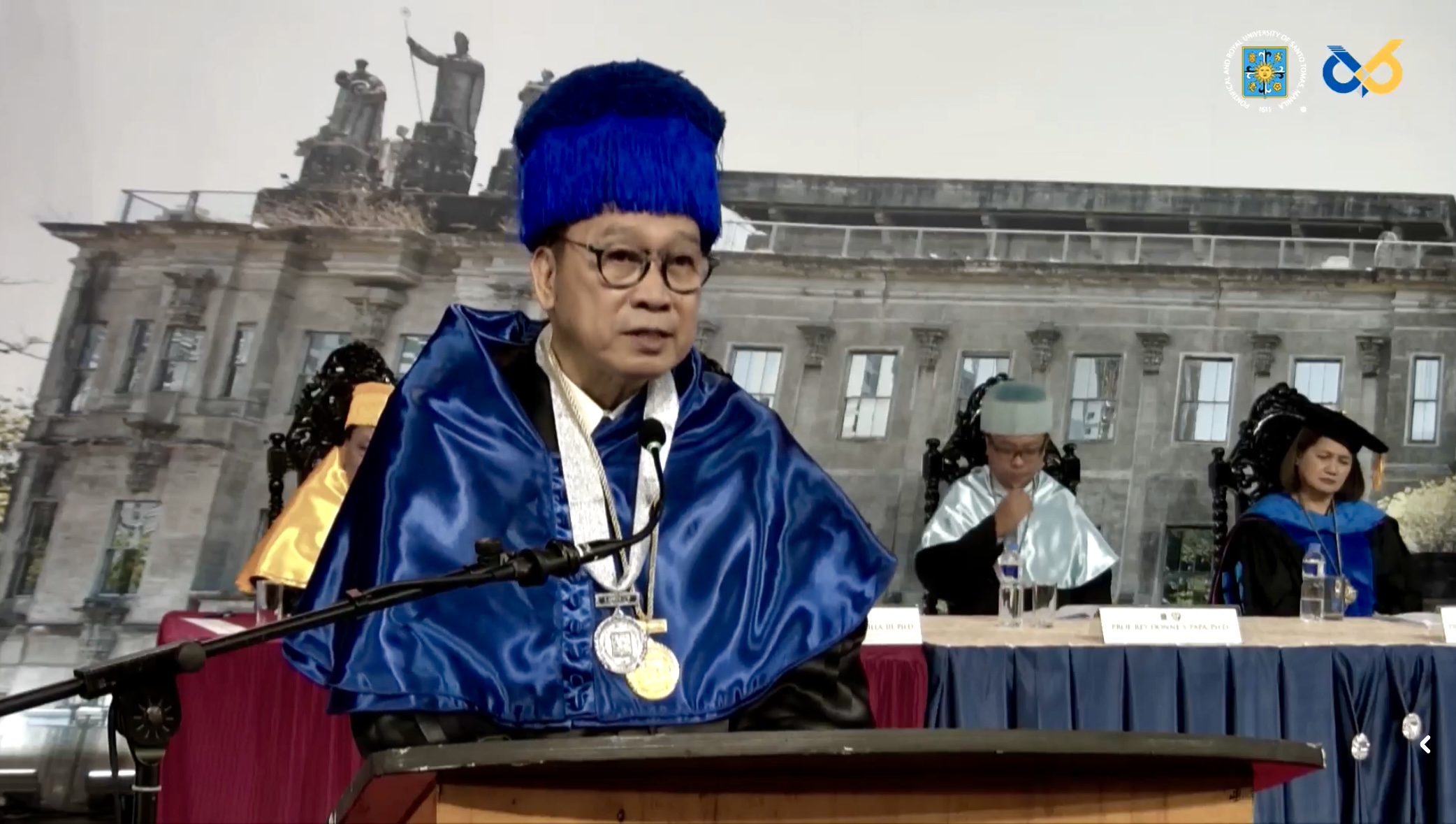
ESTEEMED JOURNALIST and Artlets faculty member Asst. Prof. Joselito Zulueta emerged as the batch valedictorian of the UST Graduate School class of 2026, completing his Doctor of Philosophy in Literature degree summa cum laude.
Zulueta was one of the more than 200 graduates who attended the Graduate School’s solemn investiture rites on June 16.
He earned his bachelor’s degree in Journalism from UST in 1991 and obtained his Master of Arts in Literature from the Graduate School in 2017.
A respected figure in Philippine journalism, Zulueta spent decades covering labor, education, foreign affairs, Malacañang and Church affairs. He served as features editor and opinion-editorial page editor of the defunct Manila Chronicle before joining the Philippine Daily Inquirer, where he became senior editor, editorial writer and arts and culture editor.
Zulueta had been practicing journalism even before he graduated, having served as features staffer and editorial board member of The Flame, the official student publication of the Faculty of Arts and Letters. He was also part of the features and circle sections of The Varsitarian, the official student publication of UST, of which he now serves as adviser.
Beyond the newsroom, Zulueta established himself as a literary and cultural critic through his work in cinema studies, literature and cultural history. He previously chaired the National Literary Arts Committee of the National Commission for Culture and the Arts and the Manunuri ng Pelikulang Pilipino, the organization behind the annual Gawad Urian Awards.
His published works tackled Philippine cinema, literature, journalism and history, including an anthology on Vilma Santos he co-edited with Literature Prof. Augusto Aguila and contributions to books on filmmaker Brillante Mendoza, Cinemalaya and national hero José Rizal. He also served as editor and contributor to several publications on Dominican and Thomasian heritage.
Among his recognitions are the Carlos Palanca Memorial Award for Literature in 1996, the National Book Award in History in 2007, the Catholic Mass Media Award for Best News Coverage in 2015, the Outstanding Alumnus in Media Award from the UST Graduate School in 2018, the TOTAL (The Outstanding Thomasian Alumni) Award for Media in 2024 and the The National Commission for Culture and the Arts Research Award in 2025.
Zulueta is currently an assistant professor at the Faculty of Arts and Letters, where he teaches courses on literary criticism, film theory, arts and culture writing, opinion writing and religion reporting.
In his address of thanks, Zulueta reflected on the meaning of commencement exercises, saying they mark the beginning of a scholar’s responsibility to place learning at the service of society.
“Today is not the end of our education. It is the beginning of our stewardship of what we have learned. An undergraduate degree teaches us the contours of a field. Graduate studies challenge us to contribute something new to it. We return to school not merely to accumulate credentials but because we believe there are questions worth answering, problems worth solving, and truths worth pursuing,” Zulueta said.
“The world today faces no shortage of challenges. We live amid rapid technological change, social divisions, environmental crises, and profound uncertainties. The temptation in such times is to retreat into cynicism or indifference. But universities exist precisely to resist those temptations.”
Zulueta said recent proposals to reduce the General Education curriculum in colleges serve as a reminder that the purpose of a university education is never merely economic.
“Universities do not exist simply to produce workers for the marketplace. They exist to form free human beings,” the journalism educator said.
“Science may tell us what can be done; philosophy, literature, history, and the arts help us ask what ought to be done.
A nation certainly needs engineers, scientists, accountants, and technologists. But it also needs citizens who can distinguish truth from falsehood, wisdom from information, and conscience from convenience. The liberal arts cultivate precisely those capacities.” he added.
The Commission on Higher Education has deferred the implementation of a much-criticized proposal to reduce general education units in the college curricula from 36 to 18, citing the need to conduct more consultations with stakeholders.
Zulueta argued that reducing education to job training is “to misunderstand both education and the human person.”
“A university worthy of its name forms not merely labor-ready graduates but thoughtful, ethical, and free men and women, capable not only of making a living but also of making a life,” Zulueta said.
“Universities exist because human beings continue to believe that truth matters. They exist because reason matters. They exist because wisdom matters. And they exist because knowledge, when guided by commitment, conscience and compassion, can improve the human condition.” F


