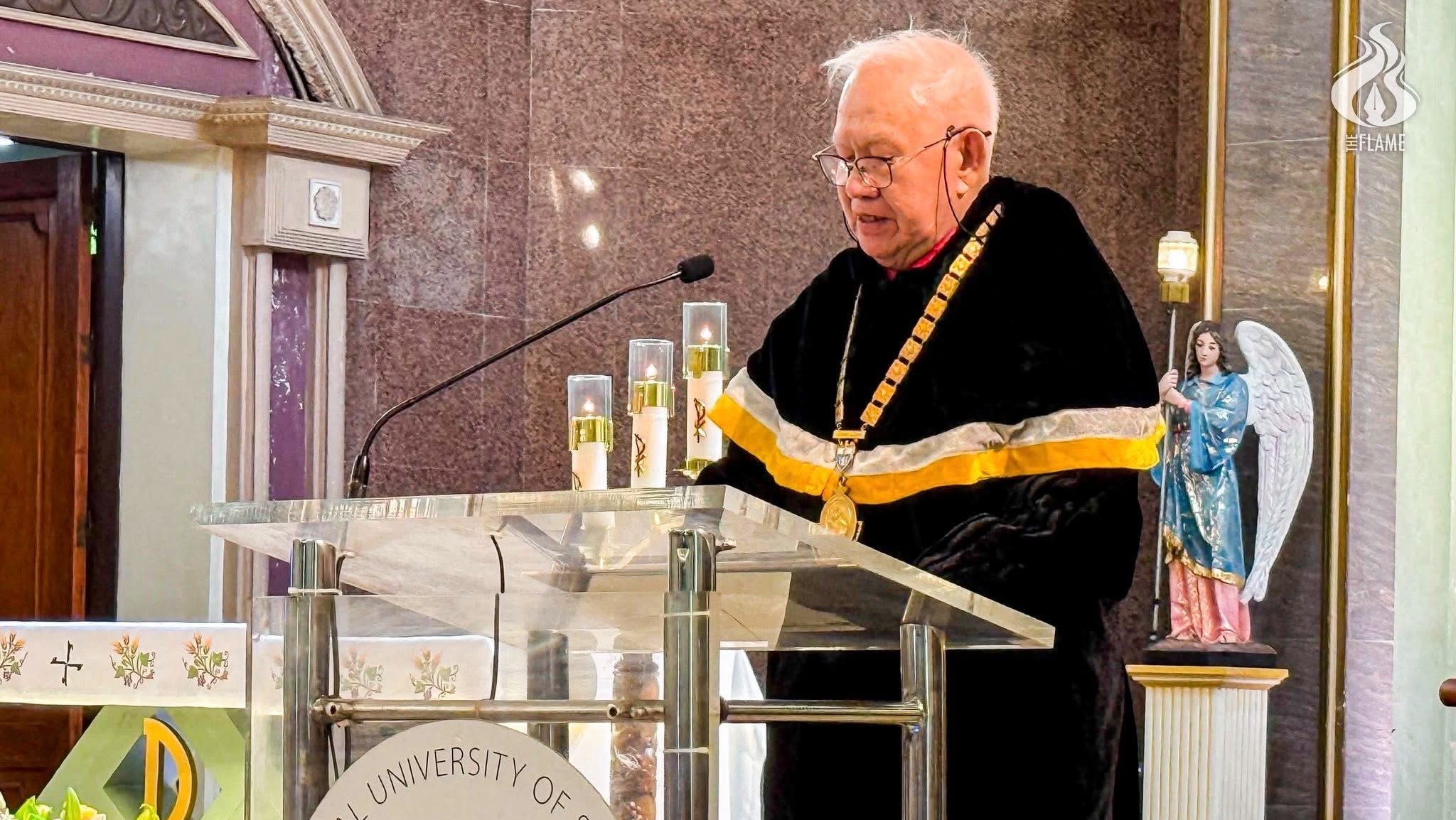
FILIPINOS SHOULD cultivate a philosophy rooted in their own historical and cultural experience instead of merely imitating foreign ideas in the local language, the founding chair of the UST Department of Philosophy said during this year’s Discurso de Apertura.
Professor Emeritus Alfredo Co said political sovereignty alone does not guarantee intellectual independence, especially when Filipino philosophy merely translates foreign concepts instead of producing original thought.
“To merely re-skin foreign orthography is to erect a hollow architecture, a spectral ghost of structural thought that ultimately betrays the very soul it seeks to house,” Co said at the Santisimo Rosario Parish on Wednesday, Aug. 5.
“We are not here to merely speak in Pilipino. We are summoned here to think in Filipino at the absolute height of rational, rigorous reasoning,” he added.
Co said the country’s decades-long pursuit of Filipino philosophy has often mistaken linguistic translation and Filipinization for genuine philosophical creation, leaving the discipline without a systematic intellectual tradition.
He cited similar intellectual movements in Africa, Latin America and Asia, saying their philosophical traditions emerged from sustained reflections on their own historical and cultural experiences rather than from borrowed systems of thought.
Co said the Philippines should likewise move beyond relying on Western or colonial traditions for intellectual direction. He argued that pursuing a philosophical renaissance would turn indigenous ideas and the country’s layered history into a rigorous and forward-looking system of thought.
“We do not need to excavate a lost golden age to discover our footing. Instead, our renaissance must be born from an historical givenness of our own complex, layered existence,” Co said.
He described the envisioned Philippine renaissance as an “archi-synthesis” that would combine the structural rigor of Western philosophical traditions with the country’s indigenous and holistic cultural character.
“We do not merely search for indigenous philosophy. We consecrate one,” he said.
Four stages of academic development
Co said the development of a national philosophy would depend on the intellectual maturation of individual scholars, who must undergo four stages of academic development.
The first stage is receptio, during which scholars absorb foundational texts and acquire technical competence in their chosen fields. This is followed by repetitio, when they demonstrate mastery of their sources and establish themselves as authoritative commentators.
In the third stage, disputatio, scholars begin to question inherited ideas, identify gaps in established thought and develop an independent intellectual voice.
The final stage is auctoritas, in which scholars move beyond merely repeating others’ ideas and become sources of original knowledge within their respective traditions.
“Yet, unlike the European Renaissance, which looked backward to a pure, classical source, the Philippine renaissance must not be an act of structural recovery of a buried golden age, but an awakening toward a distinct trajectory, one of archipelagic integration,” Co said.
He urged Filipinos to take part in the long-term intellectual undertaking, which he said would require patient scholarship, sustained reflection and the courage to move beyond inherited systems.
“The task of architecting this legacy is now entrusted to your able hands, where the world will closely witness your capable presencing,” he said.
Titled “Indigenous Filipino Philosophy: From Excavation to Void to Presencing,” Co tackled Philippine independence from foreign influences that hinder Filipinos from discovering their own identity and systematic school of thought.
First held in 1866, the Discurso de Apertura is the University’s annual inaugural lecture conducted alongside the Misa de Apertura to formally mark the opening of the academic year. F – Bai Jehann Maharaynie Paz and Alden Stephen Texon