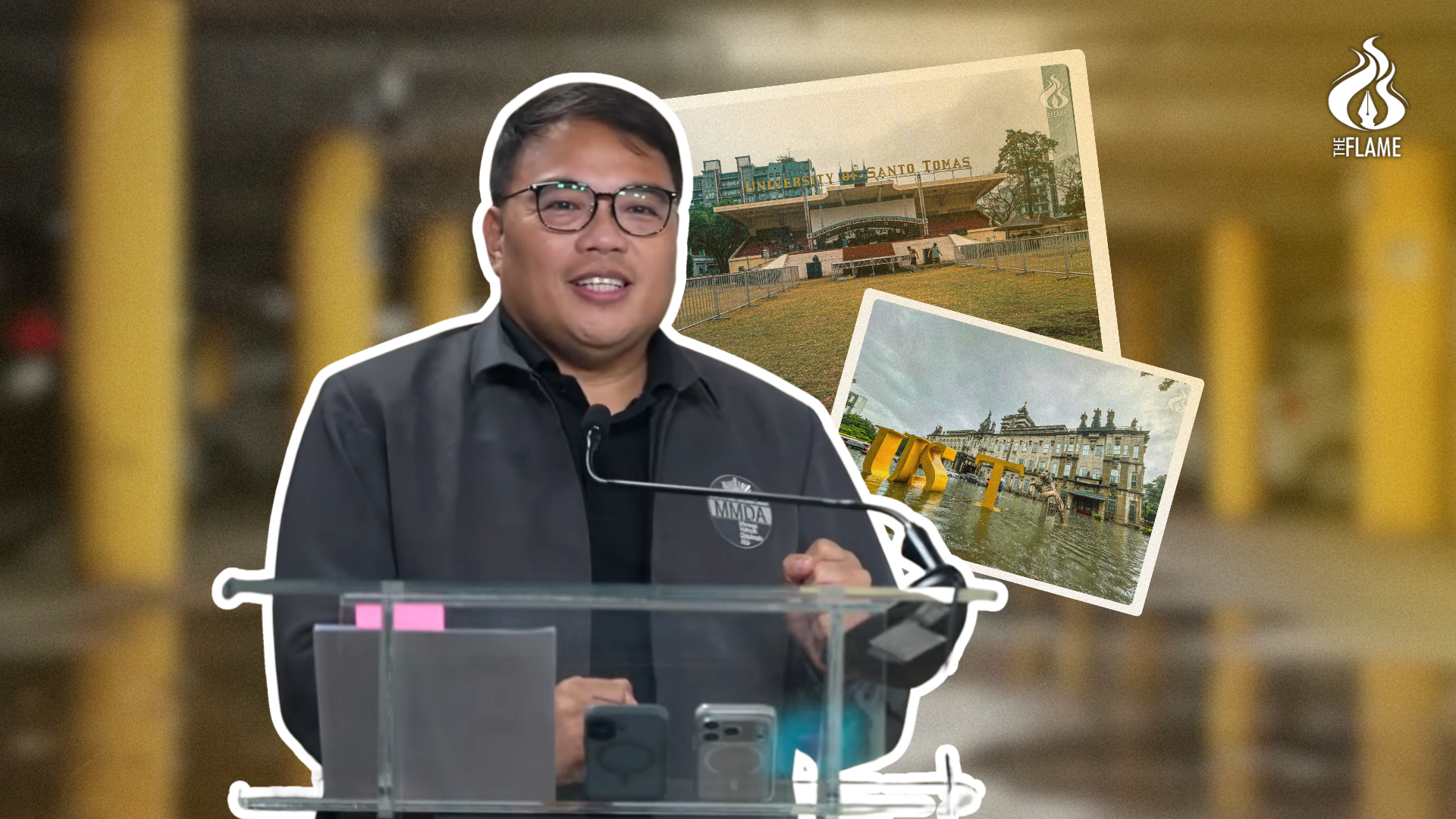
THE METROPOLITAN Manila Development Authority (MMDA) will propose an underground parking facility as a compensation for the catchment basin it intends to construct in UST to persuade the school administration to approve the project.
In a chance interview, MMDA chairman Romando Artes said the proposed underground facility could address UST’s limited parking capacity by accommodating more vehicles, while the catchment basin would help mitigate flooding on campus.
“Our plan, just to compensate [for the proposed catchment basin in UST], is to build an underground parking facility at the catchment area, one that can accommodate 400 cars,” Artes told The Flame.
“We know that parking is scarce at UST; students and people coming for medical check-ups often resort to street-side parking. So, we will provide that as an additional incentive to encourage them to agree,” he added.
The Marcos administration initially named UST as among the sites for its flood control projects. However, the University was excluded from the 39 priority sites because of the school administration’s concerns about preserving historical sites.
The proposed basin can hold up to 72,000 cubic meters of rainwater along España Boulevard.
READ: UST not among 39 possible sites for rainwater catchment structures
Artes cited Miriam College in Quezon City as one of the priority sites for the flood mitigation efforts, saying it would serve as proof to UST that the project is feasible. He added that the government has undertaken similar projects in Intramuros without affecting historic sites.
“So, if we manage to execute that properly, we could go back to UST; We would have a showcase to demonstrate that the execution at Miriam [College] went well, suggesting it might be something we could replicate,” the MMDA chairman said.
The rainwater catchment basin has been under discussion for nearly 15 years, dating back to the term of the late president Benigno Aquino III. The project was canceled by the Aquino administration after the University expressed concerns about its possible impact on sites that have become part of the country’s cultural heritage. F