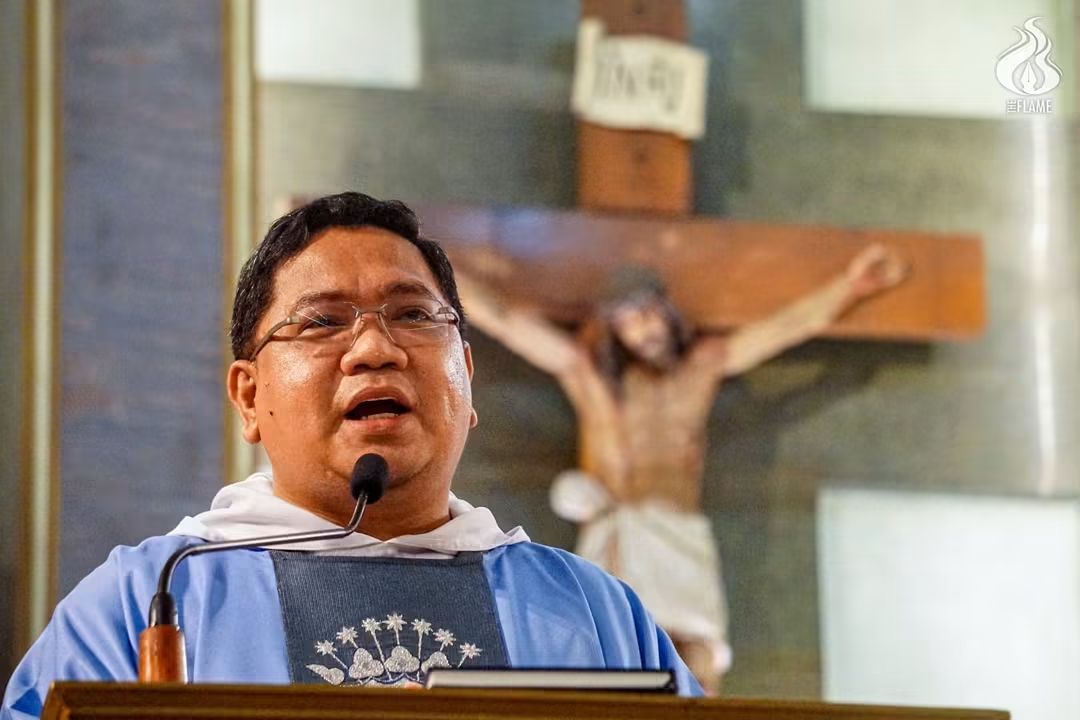
CATHOLICS MUST challenge the notion that human existence is “accidental” and see their lives as something intentionally given by God with a purpose, a Dominican priest said.
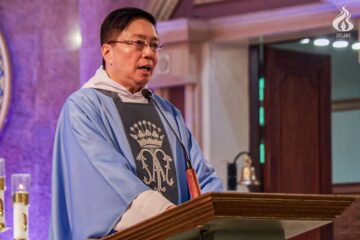
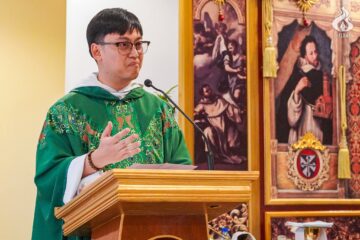
Fr. Jannel Abogado, O.P., dean of the UST Faculty of Sacred Theology, urged the faithful to emulate the Blessed Virgin Mary’s understanding of existence. According to him, the mother of Jesus believes that each person has a predetermined purpose according to God’s wisdom.
“If existentialism provides that our birth is accidental, the birth of the Virgin Mother speaks that our birth is intentional,” Abogado said during the celebration of the Feast of the Nativity of the Blessed Virgin Mary on Tuesday, Sept. 8, at the Santisimo Rosario Parish church.
Abogado explained that the idea of regarding birth as accidental came from the rise of existentialist philosophy in the 20th century, saying that people were being “thrown” into the world without choosing the circumstances of their birth. This view can lead people to believe that life has no predetermined purpose and that individuals must instead create their own purpose, according to Abogado.
“We did not even choose where we are to, where we are born, who our parents are, what nationality we’re to be born into, and yet we are simply thrown into this world. That’s why they say that our birth is accidental,” he said.
However, Abogado introduced a different understanding of human existence according to the birth of Mary, in which God gives each person life with a purpose conceived according to His wisdom.
Abogado said Mary’s parents Joachim and Anne prayed for a child despite the fact that her mother was unable to bear a child. Their prayer was soon answered because Mary was set to fulfill a particular role in salvation history as the mother of Jesus Christ.
“God gave us to our parents because we have a purpose. What is our purpose? It is for us to discover,” he added.
The priest also recounted St. Joseph’s experience when he found out that Mary was pregnant, adding that it illustrates how God’s purpose may not always correspond with one’s original plan.
“St. Joseph had a plan for his life. But that plan was disrupted because the Virgin Mother or Virgin Mary, whom St. Joseph was to marry, had already or was already with a child,” he said.
While Mary and Joseph received an angelic message to convince them of their roles, Abogado also reminded the faithful to discern God’s purpose on their own without getting a direct sign.
“It’s not the case with us,” he said. “[W]e have to work doubly hard to discern what is the role given to me by God, what is the purpose in life that God wants me to do or wants me to perform,” he said.
Abogado said that fulfilling God’s purpose is not an exercise in pursuing oneself. A person’s role, whatever it may be, must remain attentive to those who need his or her service.
“But one thing is sure, the role that God wants us to do, whatever it is, it is a role that does not forget the needs of those who are in need of our service,” the priest said.
Abogado called on Catholics to emulate the life and faithfulness of Mary and Joseph, as they understood the calling for their respective roles and remained open to the persuasion of God.
“Once they knew their purpose, their role, then they were obedient. They became faithful. And so that is also the invitation to us,” he added.
The mass commemorated the physical birth of the Virgin Mary, a period regarded as the “dawn of salvation” that preceded the arrival of Christ. It is one of the most ancient Marian feasts of the Catholic Church. F