

RAINFALL ECHOES across the auditorium as residents of the fictional Barangay Hanggan wade through floodwater while hanging Christmas decorations overhead.
Beneath glowing parols and playful banter, the locals’ feet drag against submerged streets — a familiar image for many Filipinos who have learned to celebrate milestones alongside disaster.
The flood in Artistang Artlets’ latest major production is not merely a backdrop. It is a consequence left for the audience to ponder on.
Staged from May 14 to 16 at the Girl Scouts of the Philippines Auditorium, “Hanggang Humupa” dismantles the culture of glorified resilience in communities repeatedly abandoned by the very systems meant to protect them. Directed by Chloei Angeleine Fornea, written by Kyte Villanueva, and managed by Erah Laurice Alcaraz, the sociopolitical play is the first major production under the guild’s 45th season theme, “Uusbong, Uusad.”
While previous productions explored relational and personal growth through Binibining Maria Clara and Okatokat, “Hanggang Humupa” broadens the conversation toward societal growth; it examines how neglect from institutions spills over into Filipino homes and communities.
Fornea, a Behavioral Science senior, shared that the play was inspired by the playwright’s lived experiences in Barangay Landayan, San Pedro, Laguna, alongside the recurring controversies surrounding unfinished flood-control projects in recent years.
“This issue in itself repeatedly takes place and it has not been resolved ever since,” Fornea told The Flame.
Survival sold as strength
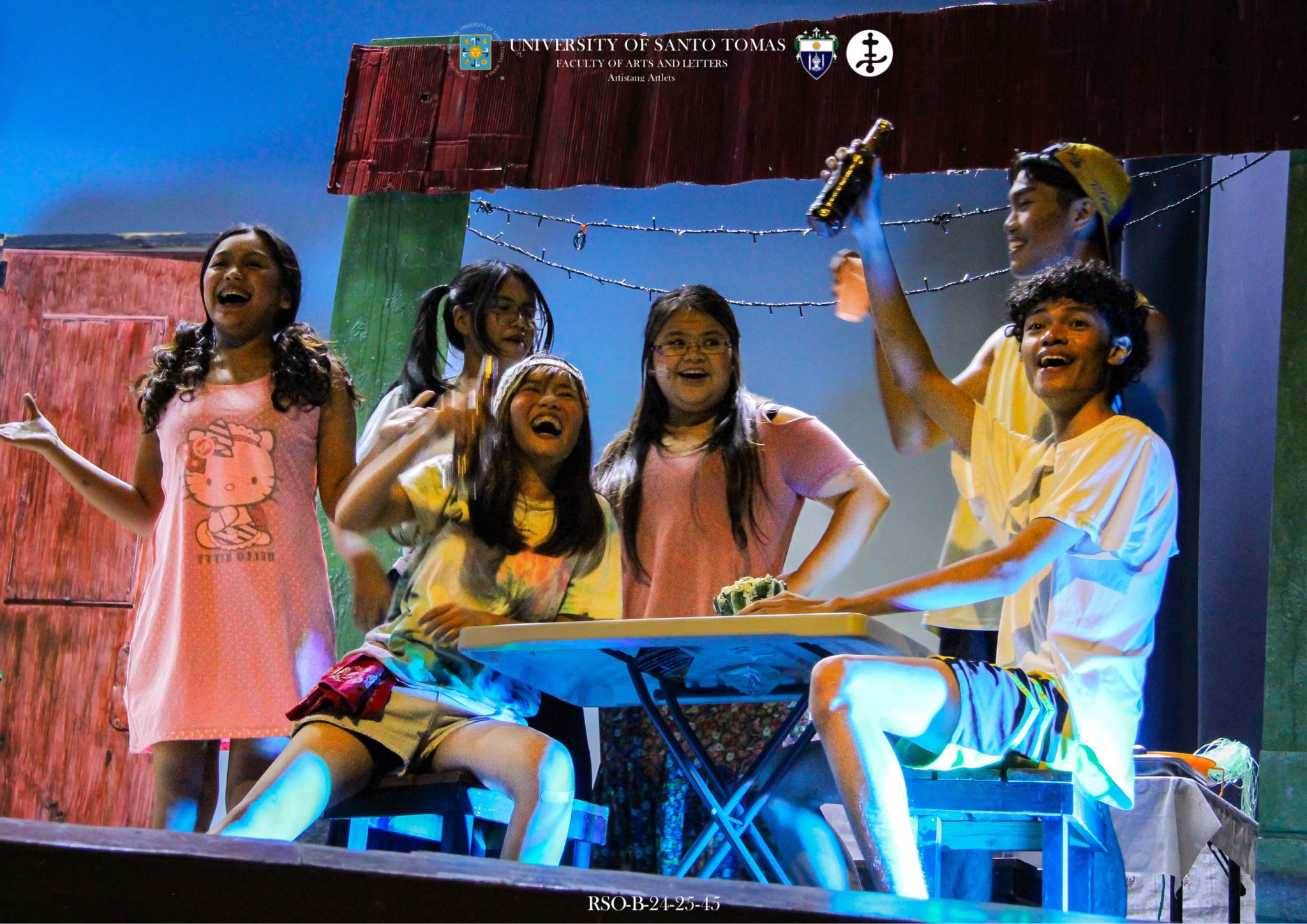
Throughout the production, rain becomes relentless.
The sound of water sloshing beneath each scene reminds the audience that the residents of Barangay Hanggan can never truly escape the flood around them. Yet despite the worsening conditions, life continues as usual.
Children joke around. Families prepare for Christmas. Neighbors gather in sari-sari stores and salons. Characters laugh off typhoon warnings as if disaster were simply another inconvenience to endure. This normalization reflects a distinctly Filipino reality: calamities arrive so frequently that survival itself becomes a routine.
But “Hanggang Humupa” questions the cost of constantly enduring such calamities.
The production’s interconnected storylines expose how resilience, though often celebrated as a Filipino trait, can also become a convenient excuse for systemic neglect.
Mylene (Samantha Agbayani and Alyssa Esmeria), the eldest daughter of an overseas worker, sacrifices her youth to fulfill the role of her absentee mother, Nora (Selah “Ike” Francisco and Villanueva), who spent ten years working in Dubai. Her younger sister, Myra (Julia Cruz and Fatima Rivera), dreams of escaping the submerged barangay entirely.
When Nora unexpectedly returns home, buried tensions surface: Mylene had dropped out of college, had secretly given birth and had used her tuition to support her pregnancy.
The conflict reflects a painful reality among many Filipino families separated by labor migration — where sacrifice sustains survival, but emotional distance quietly fractures relationships.
Elsewhere, Joan (Alcaraz and Juliana Domingo) refuses to rely on anyone after growing up in a broken household. When Luis (Harrison Tambasacan), the son of barangay chairman Kapitan Lito (Cholo Astete), offers to financially support her to stop her from migrating abroad, their relationship begins to unravel.
Even love becomes entangled with survival.
Systems built to fail
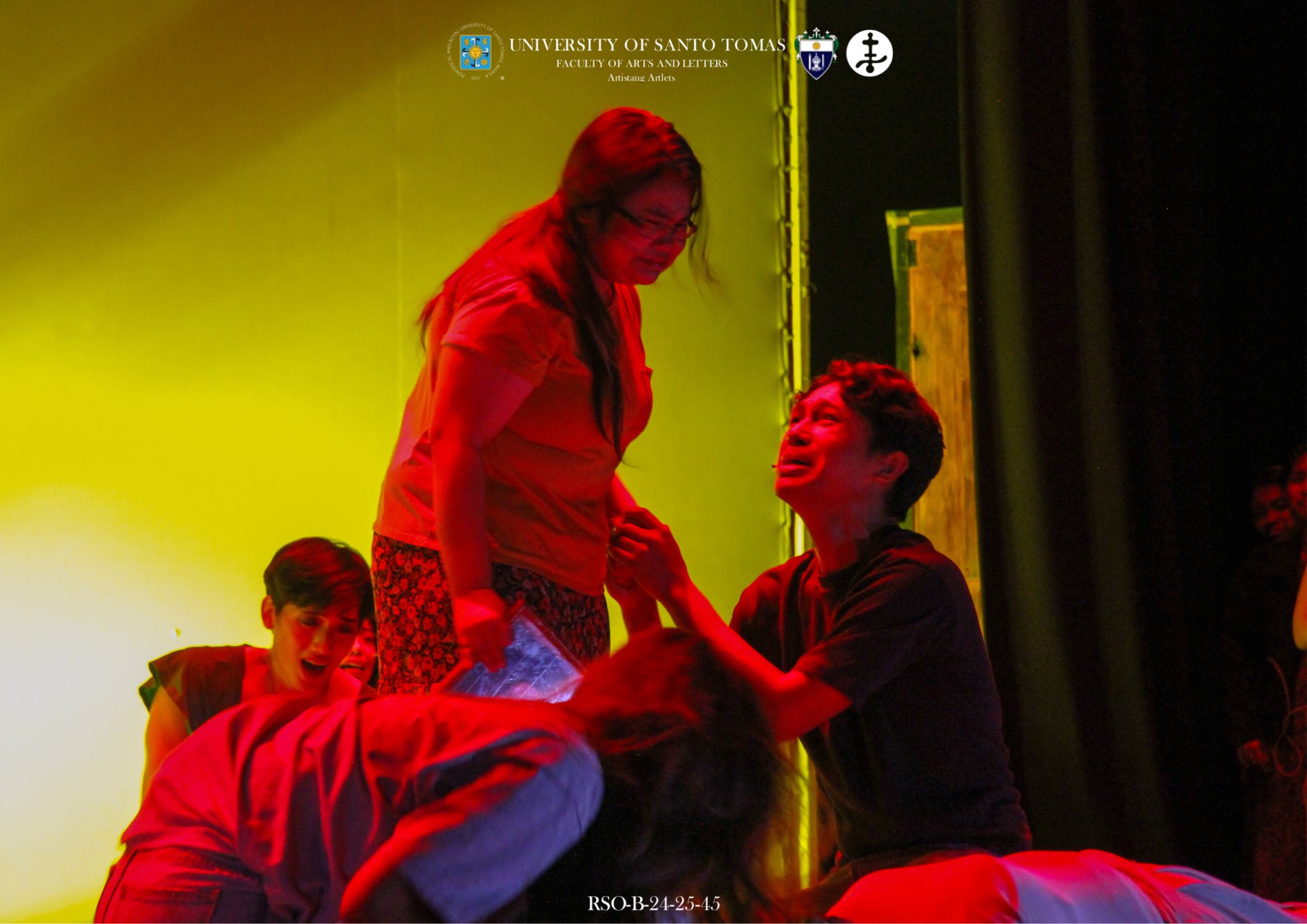
As the production progresses, the flood ceases to feel natural.
Residents eventually reveal that the barangay’s decade-long flooding problem stems from unfinished infrastructure and defective government projects near the lake. Older residents Nita (Rio Arguelles) and Arturo (Bryan Arcangel) admit they once tried demanding accountability from local officials, only to be ignored.
“Wala na nga tayong laban, wala pa tayong pera kaya siyempre mas mahirap bumoses. Kaya mo ba’ng lumaban sa kanila?” Arturo tells the students.
(We are no match for them, and we also don’t have the money. That makes speaking up harder than it already is. Can you take them on?)
Their resignation becomes one of the play’s sharpest commentaries. Rather than empowering citizens, the constant demand for resilience conditions communities to adapt endlessly to suffering they did not create.
As the typhoon intensifies, Kapitan Lito orders residents to gather at the barangay plaza. When Myra questions whether the evacuation center can withstand rising floodwaters, he dismisses her concerns, insisting that residents have survived disasters before anyway.
Later, he privately admits to his son that the nearby sports complex — a safer evacuation site — had been reserved for the birthday celebration of the mayor’s child. The revelation feels disturbingly familiar in a political climate where public officials continue to evade accountability for unresolved infrastructure controversies and recurring disasters.
Negligence is not portrayed as dramatic villainy. Instead, it appears through indifference, delay and normalization.
‘Hindi huhupa ang galit’
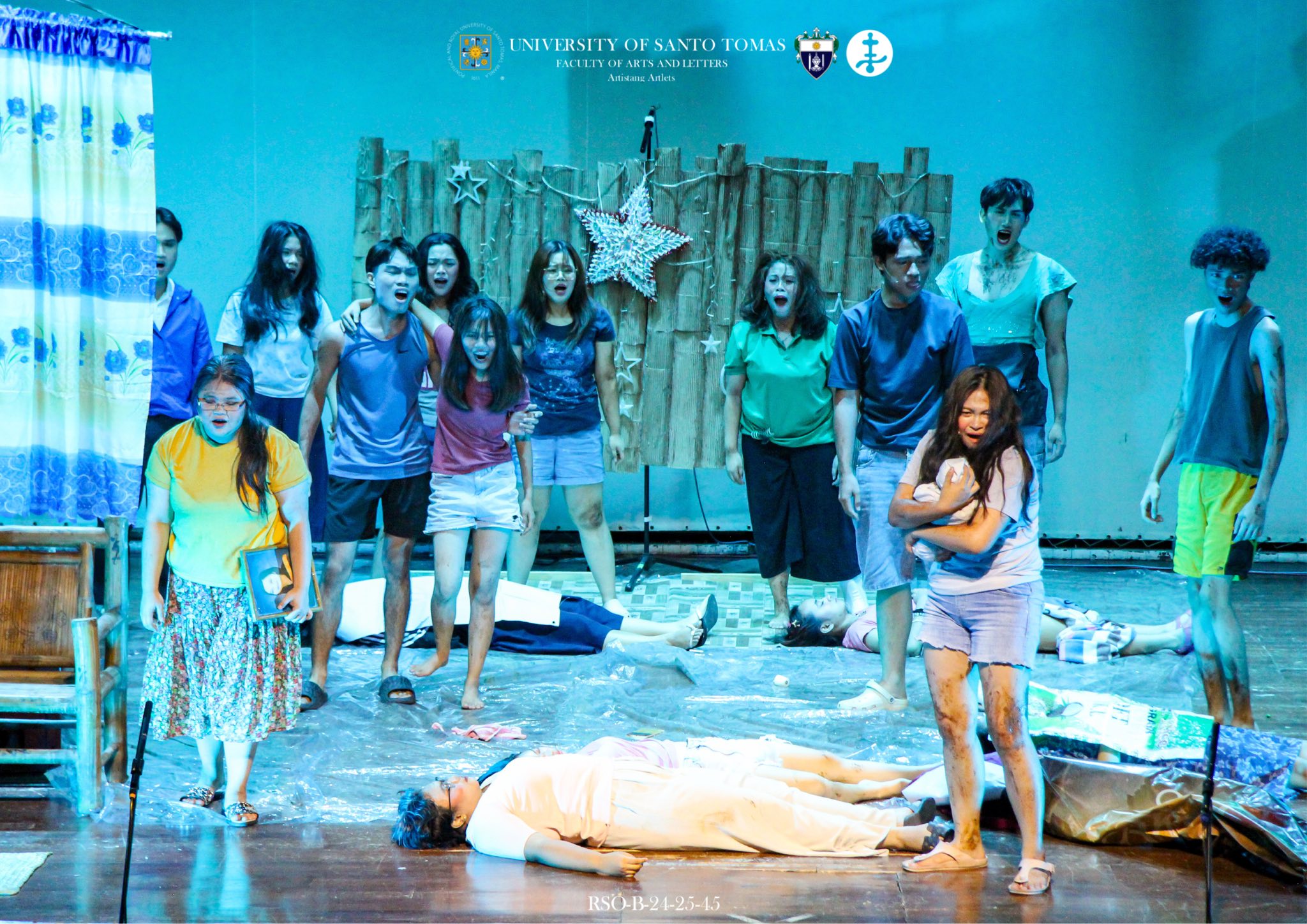
Inside the overcrowded evacuation plaza, Mylene, Lena, Myra, Nora and other residents endure poor ventilation, food shortages and inadequate accommodations as they wait for the storm to pass.
Then the floodwaters enter.
Bagyong Undin leaves six fatalities behind, including Nora and her granddaughter Lena. In one of the production’s most devastating moments, Luis re-enters carrying Myra’s lifeless body while grieving families identify their loved ones one by one.
The screams of anguish give way to the play’s final musical number as Mylene cradles Lena and leads the ensemble through their grief.
Then comes the final line: “Hindi huhupa ang galit.”
The production closes not with hope, but with remembrance.
More than a play about flooding, “Hanggang Humupa” confronts the dangerous expectation that Filipinos must continuously endure hardship while those responsible quietly move on from accountability.
Fornea emphasized that the production ultimately seeks to challenge collective forgetfulness — especially in a society constantly overwhelmed by one crisis after another.
“Kung walang mangangalampag, may makakalimot. Kung may makakalimot, walang mananagot,” she said.
(If no one speaks up, people will forget. If they forget, no one will atone.)
“It encapsulates our whole play and also encapsulates why we are doing this and why we do this as artists.” F