IF A journalist distorts the truth for a story that will change society, is the act justified?
Written by The Philippine Star business reporter Elijah Felice Rosales, Human Rights Story of the Year explores the ethics of journalism and asks whether the media wholeheartedly serves the interests of the marginalized.
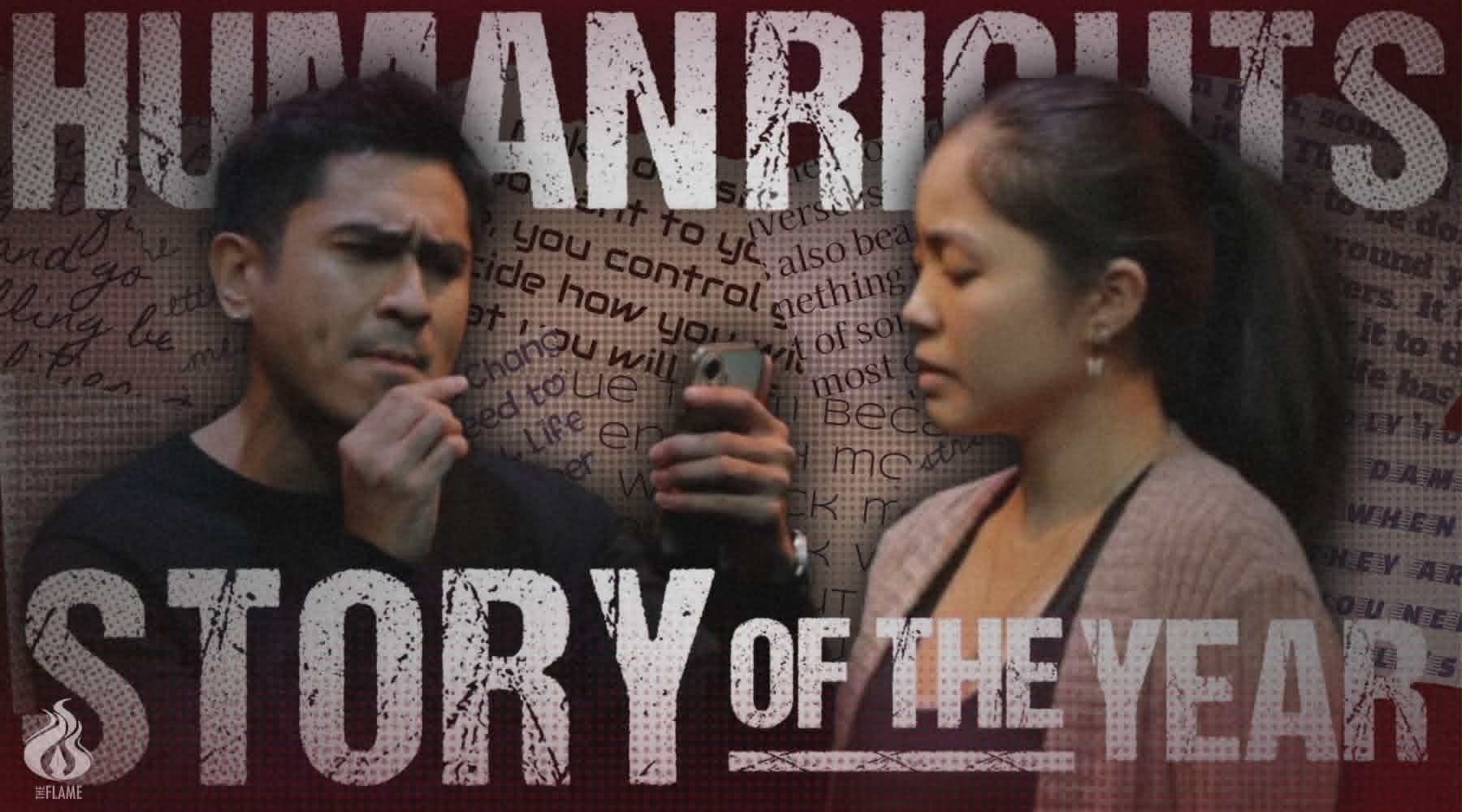
Set to receive a journalism award in New York, Ish (Justine Peña) is confronted by her former colleague-turned-government spokesman, Doy (CJ Navato), who accuses her of withholding credit for him in their award-winning article on the human rights abuses under the Duterte administration’s Oplan Tokhang.
They disparage each other in an argument centered on the subject of their piece: an unseen character named Dolor, whose husband was a victim of Tokhang, the controversial drug war that left thousands of people dead.
Through this exchange, the play questions the gray areas of journalism and the dangers of viewing subjects and their stories from a single angle.
The play’s main strength is the way it sets up its moral dilemma. Rosales struck a balance in crafting characters that are equally understandable but difficult to side with. Instead of being characters with “black and white” values, Ish and Doy were depicted as flawed people. Their varying principles reflected how right and wrong boil down to one’s interpretation and situation.
On one hand, Ish omitted important information in her report because she thought that its inclusion could affect the overall message of their piece and the public’s perception of Tokhang victims.
On the other hand, Doy—who insisted on including the information Ish wanted to omit because it was “right”—was previously caught taking bribes. Despite his good intentions to tell the truth behind his and Ish’s piece, he was not exactly a person who stood on high moral ground.
Unlike Ish and Doy, who were physically seen throughout the play to demonstrate and defend their conflicting morals, Dolor’s dilemma falls into the hands of the audience.
Ish described Dolor as a widow who was still recovering from her husband’s death, highlighting her intention to frame Dolor’s story in a one-dimensional tragic angle, which Doy heavily criticized.
The play is bookended by an audio recording of Dolor detailing the crucial information that could have changed the perception of Ish’s award-winning article. Through this recording, the audience could hear the raw, unfiltered voices of victims such as Dolor. This allowed them to gain a deeper understanding of Ish and Doy’s main conflict and the message that the play wishes to impart.
Through these characters, the play’s moral dilemma appeared. Audiences were left without a character to truly get behind, as the characters constantly go back and forth, defending their actions and beliefs.
Peña portrayed Ish with strong conviction. Her performance was balanced by subtle uncertainty about her character’s guilt, as seen in her visible doubt and an affective, defensive tone. This guilt was best seen in the long strings of silence the two characters share after their audible finger-pointing heats to a boil, giving the audience a tenser feeling than any loud rebuttal.
Navato’s performance as Doy was powerful, effectively conveying a frustration born of remorse. This was seen in scenes where his character responded to the disparagement of his past mistakes and revealed a person who knows he was not infallible despite wanting to do good.
Director Nelsito Gomez’s minimalist approach helped spotlight the powerful writing even further. The minimal use of technical effects gave better focus to the important moral debate at hand.
The set design’s sparse layout appropriately reflected the barrier between the media and the marginalized. Against the background of the set is a gated fence that visualized journalists as spectators from the inside: looking out, unable to truly live in their subjects’ shoes despite being able to interact with them.
While the blocking and character action may seem too ordinary at times, the casual approach to the characters’ movements highlighted the actors’ performances and gave an authentic feeling to an argument between former peers.
Human Rights Story of the Year asks the audience a question that is impossible to answer. Its intention was never to encourage the audience to reach a conclusion about which side is right and which is wrong, but rather to make them acknowledge the shortcomings of the industry from which they receive their truths.
The play urges it’s viewers to step back from the argument and focus on what truly needs to be done in today’s news and media landscape: listening to the voices that need to be heard.
Human Rights Story of the Year was one of the new plays featured in Virgin Labfest XXI, alongside 11 other new plays and three returning acts.
With the theme ‘Hubo’t Hubad,’ the show ran from June 3 to 28 at the Cultural Center of the Philippines’ Tanghalang Ignacio Gimenez, also known as the CCP Black Box Theater. F